Cyberabad Municipal Corporation Processes 783 kg Of Religious Waste
WATER & WASTE

Cyberabad Municipal Corporation Processes 783 kg Of Religious Waste

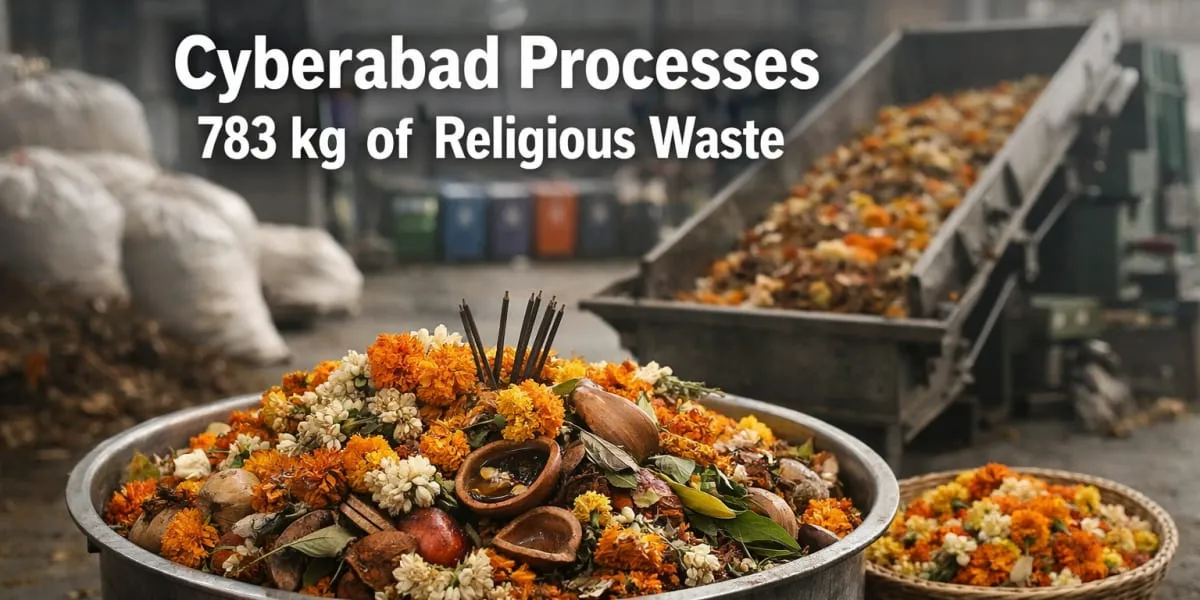
The Cyberabad Municipal Corporation (CMC) carried out a Divine Waste Drive to promote eco-friendly management of religious waste across the city. Officials said the civic body processed 783 kg of devotional waste collected from Medchal, Kompally, Madhapur, Allwyn Colony and Nizampet as part of collection, segregation and recycling measures. The operation aimed to reduce landfill load and mitigate environmental impact from ritual materials. The drive took place on 26 July 2026 and formed part of ongoing sanitation efforts.

In a concurrent bulk household collection initiative, CMC removed 191 bulky items from public spaces to improve sanitation and clear encroachments. The inventory included 52 sofas, 82 mattresses and 57 other furniture pieces, which were transported for appropriate disposal and processing. Officials indicated these efforts form part of routine drives to maintain public health standards and urban cleanliness. Recyclable materials were directed to authorised processing facilities for recovery.

Teams were reported to have employed segregation at source and route-level sorting to channel recyclable components for processing while ensuring non-recyclable matter followed authorised disposal paths. The drives were staged across specified localities with logistical support from municipal sanitation units and partners tasked with safe handling of waste. The civic authority emphasised the importance of such campaigns in lowering municipal solid waste volumes and extending the life of landfill facilities. Sanitation teams received training on safe handling and segregation protocols.

The civic body said residents were being encouraged to use designated collection schedules for bulky items. Observers noted that systematic collection and recycling of religious and bulky household waste can contribute to broader environmental sustainability goals and cleaner neighbourhoods. The initiative complements existing sanitation strategies within Cyberabad and is expected to be repeated seasonally.

The Cyberabad Municipal Corporation (CMC) carried out a Divine Waste Drive to promote eco-friendly management of religious waste across the city. Officials said the civic body processed 783 kg of devotional waste collected from Medchal, Kompally, Madhapur, Allwyn Colony and Nizampet as part of collection, segregation and recycling measures. The operation aimed to reduce landfill load and mitigate environmental impact from ritual materials. The drive took place on 26 July 2026 and formed part of ongoing sanitation efforts. In a concurrent bulk household collection initiative, CMC removed 191 bulky items from public spaces to improve sanitation and clear encroachments. The inventory included 52 sofas, 82 mattresses and 57 other furniture pieces, which were transported for appropriate disposal and processing. Officials indicated these efforts form part of routine drives to maintain public health standards and urban cleanliness. Recyclable materials were directed to authorised processing facilities for recovery. Teams were reported to have employed segregation at source and route-level sorting to channel recyclable components for processing while ensuring non-recyclable matter followed authorised disposal paths. The drives were staged across specified localities with logistical support from municipal sanitation units and partners tasked with safe handling of waste. The civic authority emphasised the importance of such campaigns in lowering municipal solid waste volumes and extending the life of landfill facilities. Sanitation teams received training on safe handling and segregation protocols. The civic body said residents were being encouraged to use designated collection schedules for bulky items. Observers noted that systematic collection and recycling of religious and bulky household waste can contribute to broader environmental sustainability goals and cleaner neighbourhoods. The initiative complements existing sanitation strategies within Cyberabad and is expected to be repeated seasonally.

Next Story
Infrastructure Urban

Centre Clears Power Distribution Upgrade for Uttar Pradesh

The Central Government has approved power distribution projects worth Rs 407.39 billion for Uttar Pradesh under the Revamped Distribution Sector Scheme (RDSS). The investment will be used to modernise the state's electricity distribution infrastructure and strengthen network capacity across urban and rural areas. The package targets one of the country's largest distribution networks as the state experiences rapid urbanisation and rising electricity consumption. Planned interventions include the strengthening of distribution lines, modernisation of substations, replacement of ageing electrical ..

Next Story
Infrastructure Energy

India Data Centres To Consume 191 TWh By 2040 Driving Renewables

A Wood Mackenzie report says India's operational data centre capacity is projected to increase more than fivefold to 12 gigawatt (GW) by 2030 from 2.2 GW in 2025 as artificial intelligence (AI) and cloud computing drive demand. It projects electricity consumption to rise from 10 terawatt-hour (TWh) in 2025 to 191 TWh by 2040. The study forecasts a compound annual growth rate of around 40 per cent and notes AI-dedicated capacity will surge nearly 24-fold from 275 megawatt (MW) in 2025 to 6,546 MW by 2030. The report places India's digital economy at Rs 32 trillion (tn) in 2025 and says it contr..

Next Story
Infrastructure Transport

Hydrogen Train Completes 1,200 Kilometres Of Trials

India's first hydrogen train was flagged off between Jind and Sonipat on July 17 and has travelled over 1,200 kilometres in trials, saving diesel consumption of more than 3,200 litres, a Railway Ministry press release said. The deployment marks the introduction of a zero-emission fuel cell train into route testing and represents a milestone in domestic rail innovation. The train generates electricity onboard through a chemical reaction between hydrogen and oxygen, producing electricity to propel the vehicle while emitting only water vapour as a by-product. There is no smoke and no tailpipe car..

Advertisement

Subscribe to Our Newsletter

Get daily newsletters around different themes from Construction world.

STAY CONNECTED

Advertisement

Advertisement

Advertisement