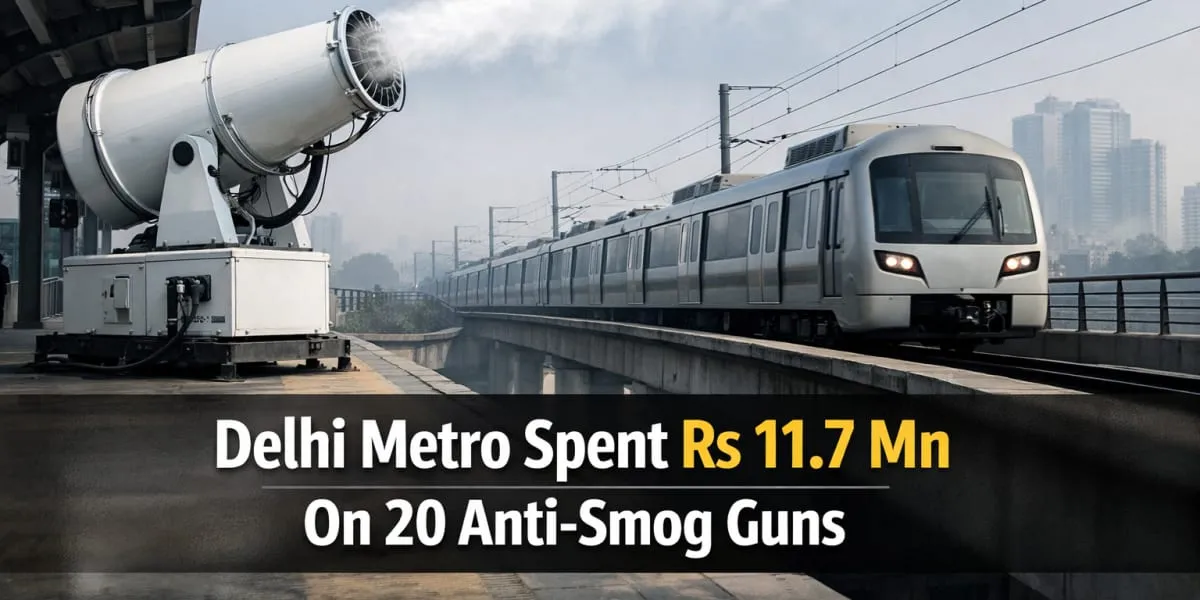
Delhi Metro Spent Rs 11.7 Mn On 20 Anti-Smog Guns
RAILWAYS & METRO RAIL

Delhi Metro Spent Rs 11.7 Mn On 20 Anti-Smog Guns

An RTI filing has revealed that the Delhi Metro Rail Corporation spent Rs 11.7 million (mn) on 20 anti-smog guns deployed in the national capital. The Delhi Metro Rail Corporation is the state-owned urban transport operator and the expenditure covered procurement and installation of the devices. The disclosure names the number of units and the total outlay without giving operational performance data. The disclosure was provided after a request under the Right to Information Act and includes documentation of the transaction.

The records show that 20 units were acquired for use at metro stations and adjacent premises as part of measures to address seasonal air pollution. The documents list the procurement cost and the locations of deployment but do not attach evaluation reports on air quality impact. The cost figure has been converted from the original reporting to reflect the amount in million for clarity. Anti-smog guns are one of several interventions used to address episodic pollution across the city.

The purchase represents a unit cost of about Rs 585,000 per anti-smog gun, calculated from the total reported expenditure. The per unit figure may assist analysts and urban planners in comparing alternatives and assessing value for money without implying an endorsement of the technology. The RTI response therefore supplies a quantitative basis for scrutiny of environmental spending. The total figure does not reflect additional costs such as maintenance, power consumption or staff time required to operate the devices.

The disclosure has added to public information on municipal responses to pollution and can inform further examination by civic groups and policy makers. The figures will be relevant to debates about the best deployment of limited public funds to improve air quality across the city. Officials have the data needed to evaluate results and to decide on any adjustments to strategy. Stakeholders can use the disclosed numbers to model costs and to recommend oversight measures where appropriate.

"Join industry leaders at RAHSTA Expo, India's premier platform for roads, highways and traffic infrastructure. Register now to explore innovations, network with experts and shape the future of mobility."

An RTI filing has revealed that the Delhi Metro Rail Corporation spent Rs 11.7 million (mn) on 20 anti-smog guns deployed in the national capital. The Delhi Metro Rail Corporation is the state-owned urban transport operator and the expenditure covered procurement and installation of the devices. The disclosure names the number of units and the total outlay without giving operational performance data. The disclosure was provided after a request under the Right to Information Act and includes documentation of the transaction. The records show that 20 units were acquired for use at metro stations and adjacent premises as part of measures to address seasonal air pollution. The documents list the procurement cost and the locations of deployment but do not attach evaluation reports on air quality impact. The cost figure has been converted from the original reporting to reflect the amount in million for clarity. Anti-smog guns are one of several interventions used to address episodic pollution across the city. The purchase represents a unit cost of about Rs 585,000 per anti-smog gun, calculated from the total reported expenditure. The per unit figure may assist analysts and urban planners in comparing alternatives and assessing value for money without implying an endorsement of the technology. The RTI response therefore supplies a quantitative basis for scrutiny of environmental spending. The total figure does not reflect additional costs such as maintenance, power consumption or staff time required to operate the devices. The disclosure has added to public information on municipal responses to pollution and can inform further examination by civic groups and policy makers. The figures will be relevant to debates about the best deployment of limited public funds to improve air quality across the city. Officials have the data needed to evaluate results and to decide on any adjustments to strategy. Stakeholders can use the disclosed numbers to model costs and to recommend oversight measures where appropriate.

Next Story
Infrastructure Transport

Third Railway Line Between Tatanagar And Adityapur Likely By September

The third railway line between Tatanagar and Adityapur is expected to be commissioned by September as work on the corridor advances, according to railway sources. The project to add a fourth line on the busy route is progressing and has been allocated Rs 50.89 billion (bn) in funding. The allocation underscores the focus on increasing capacity and easing congestion on the corridor. Relevant timetables are being adjusted to integrate the new capacity into regular operations. Construction activity has involved track laying, formation work and signalling upgrades along strategic stretches, with m..

Next Story
Infrastructure Transport

Indian Railways Approves Rs 2.7 bn Kavach Rollout in Odisha

Indian Railways has approved a Rs 2.7 billion (Rs 2.7 bn) plan to install the Kavach train collision avoidance system on 631 route kilometres in the East Coast Railway zone. The Ministry of Railways said the work will form part of a wider Kavach deployment programme that relies on an LTE based communication backbone rather than a standalone installation. The approval marks the latest stage in the steady expansion of the indigenous safety technology across the national network. The decision aims to enhance safety and reliability on corridors serving Odisha and adjoining areas. The project will ..

Next Story
Infrastructure Transport

Indian Railways Accelerates Modernisation Drive

Indian Railways utilised nearly 30 per cent of its capital expenditure budget for FY2026-27 within the first two months of the financial year, spending more than Rs 840 billion (bn) in April and May against a planned outlay of Rs 2.93 trillion (tn) for the year. The Union Budget allocated Rs 2.93 tn in total capex, comprising Rs 2.81 tn through gross budgetary support and Rs 120 bn from extra-budgetary resources. The early absorption indicates robust project execution and an aggressive infrastructure push. A significant share of the spending is being channelled towards track infrastructure, in..

Advertisement

Subscribe to Our Newsletter

Get daily newsletters around different themes from Construction world.

STAY CONNECTED

Advertisement

Advertisement

Advertisement