+
Indian Railways Uses Over 80 per cent of FY26 GBS by December
RAILWAYS & METRO RAIL

Indian Railways Uses Over 80 per cent of FY26 GBS by December

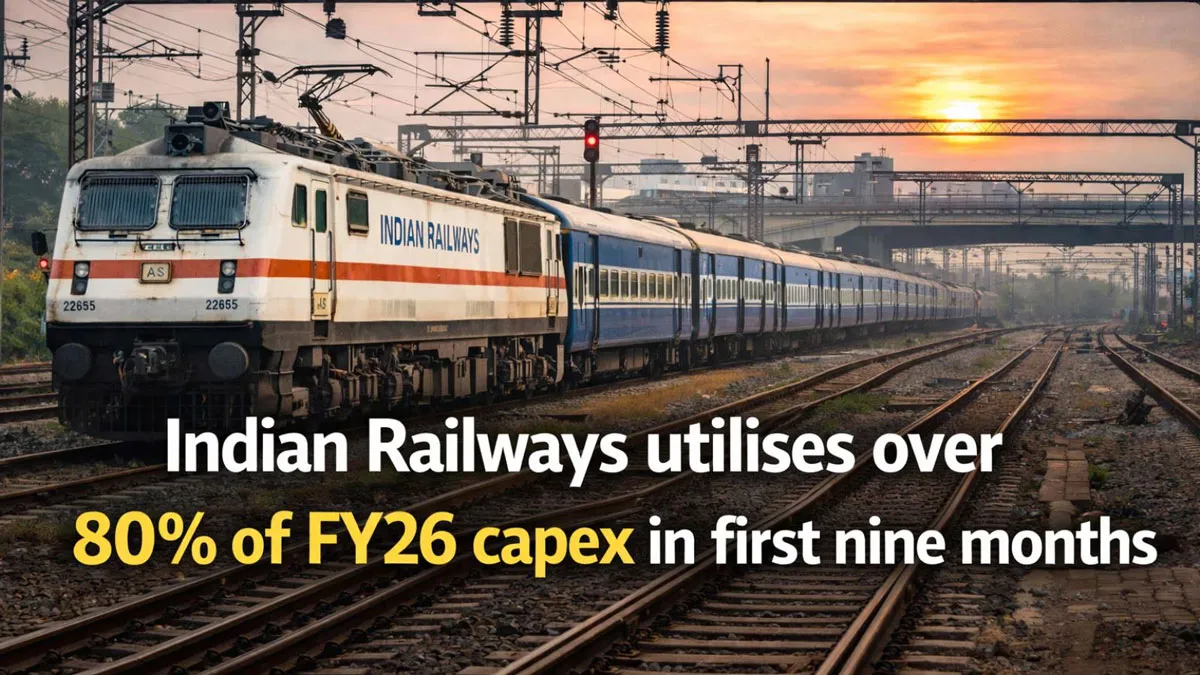
Indian Railways has utilised more than 80 per cent of its capital expenditure allocation under the Gross Budgetary Support (GBS) outlay for FY 2025–26 within the first nine months of the financial year, with spending focused on safety, capacity expansion, infrastructure modernisation and passenger amenities.

In a statement, the national transporter said it had spent 80.54 per cent, or Rs 2,031.38 billion, of the total GBS outlay of Rs 2,522 billion as of the end of December 2025. This represents a 6.54 per cent increase in GBS utilisation compared with the same period a year earlier.

Indian Railways said 84 per cent of the allocated funds under the safety-related works category have already been utilised. Spending on capacity augmentation stood at Rs 760.48 billion, or 69 per cent of the Rs 1,092.38 billion allocated for the segment. Passenger amenities recorded utilisation of 80 per cent, with expenditure reaching Rs 95.75 billion by December 2025.

The railways said the impact of sustained capital expenditure over the past decade is evident in the rollout of 164 Vande Bharat train services and 30 Amrit Bharat services, the implementation of the indigenously developed Kavach automatic train protection system, and electrification of more than 99 per cent of the broad-gauge network. It also highlighted extensive investments in new lines, gauge conversion, track doubling, traffic facilities, public sector undertakings and metropolitan transport systems.

“These initiatives have significantly improved speed, safety and passenger comfort, while keeping rail travel affordable,” the statement said, adding that the Ministry of Railways’ GBS expenditure plan remains on track, with infrastructure works being executed at a rapid pace.

Indian Railways has utilised more than 80 per cent of its capital expenditure allocation under the Gross Budgetary Support (GBS) outlay for FY 2025–26 within the first nine months of the financial year, with spending focused on safety, capacity expansion, infrastructure modernisation and passenger amenities. In a statement, the national transporter said it had spent 80.54 per cent, or Rs 2,031.38 billion, of the total GBS outlay of Rs 2,522 billion as of the end of December 2025. This represents a 6.54 per cent increase in GBS utilisation compared with the same period a year earlier. Indian Railways said 84 per cent of the allocated funds under the safety-related works category have already been utilised. Spending on capacity augmentation stood at Rs 760.48 billion, or 69 per cent of the Rs 1,092.38 billion allocated for the segment. Passenger amenities recorded utilisation of 80 per cent, with expenditure reaching Rs 95.75 billion by December 2025. The railways said the impact of sustained capital expenditure over the past decade is evident in the rollout of 164 Vande Bharat train services and 30 Amrit Bharat services, the implementation of the indigenously developed Kavach automatic train protection system, and electrification of more than 99 per cent of the broad-gauge network. It also highlighted extensive investments in new lines, gauge conversion, track doubling, traffic facilities, public sector undertakings and metropolitan transport systems. “These initiatives have significantly improved speed, safety and passenger comfort, while keeping rail travel affordable,” the statement said, adding that the Ministry of Railways’ GBS expenditure plan remains on track, with infrastructure works being executed at a rapid pace.

Next Story
Infrastructure Transport

Second Mountain Tunnel Breakthrough in Palghar Advances High Speed Rail

The Mumbai-Ahmedabad high speed rail (MAHSR) project reached a milestone with the breakthrough of a mountain tunnel in Palghar, Maharashtra. Mountain tunnel MT-six measures 454 metres long and 14.4 metres wide and will accommodate up and down tracks. The breakthrough follows MT-five near Saphale on second January 2026 and the MT-six excavation was completed from both ends using the New Austrian Tunnelling Method. The ministry reported that the tunnelling was completed within 12 months. The New Austrian Tunnelling Method is favoured for its flexibility in complex geology and irregular tunnel s..

Next Story
Infrastructure Transport

Modi Government Pushes Atmanirbhar Container Drive With BCSL MoU

The Union Government advanced a plan to create an integrated, domestically anchored container ecosystem with the signing of a Memorandum of Understanding to establish the Bharat Container Shipping Line (BCSL). The MoU was signed by key agencies including the Shipping Corporation of India and Container Corporation of India alongside major port authorities and Sagarmala Finance Corporation Limited under the Ministry of Ports, Shipping and Waterways, in the presence of senior ministers. The initiative aligns with the Container Manufacturing Assistance Scheme announced in the Union Budget 2026–2..

Next Story
Infrastructure Urban

Ministry Reports Gains In Mobility For Marginalised Communities

The Ministry of Social Justice and Empowerment is implementing skill development, education and rehabilitation schemes to promote socio-economic mobility and sustainable livelihoods for marginalised and disadvantaged communities across the country. Programmes target Scheduled Castes, Other Backward Classes, Economically Weaker Sections, De-notified Tribes and Safai Karamcharis through specialised implementing corporations and empanelled training institutes. Pradhan Mantri Dakshata Aur Kushalta Sampann Hitgrahi Yojana, or PM-DAKSH, provided skill training and placement support through the Nati..

Advertisement

Subscribe to Our Newsletter

Get daily newsletters around different themes from Construction world.

STAY CONNECTED

Advertisement

Advertisement

Advertisement

Open In App