NFR Launches Key Railway Projects to Boost BTAD Connectivity
RAILWAYS & METRO RAIL

NFR Launches Key Railway Projects to Boost BTAD Connectivity

Northeast Frontier Railway (NFR) has unveiled major railway projects to enhance connectivity and economic growth in Assam’s Bodoland Territorial Area Districts (BTAD). These initiatives align with the national Viksit Bharat vision, focusing on regional development and job creation.

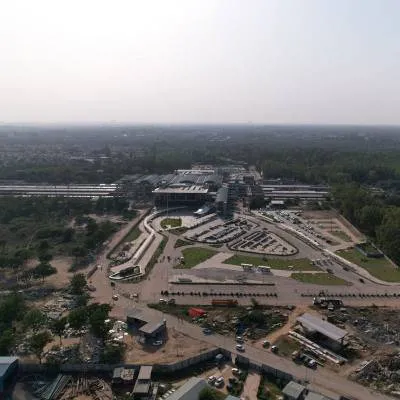
A key project is the Wagon Periodic Overhauling (POH) Workshop in Basbari, Kokrajhar. The workshop, costing Rs 2.56 billion in phase one, will initially overhaul 75 wagons per month, scaling up to 250 in future phases. Its location near Basbari station and Rupsi Airport will boost logistics and local employment.

NFR is also leading the Rs 40.33 billion Kokrajhar–Gelephu Railway Project, a cross-border link between India and Bhutan. This project will enhance trade, tourism, and regional cooperation under India’s Act East policy.

Additionally, NFR is modernising BTAD stations, including Kokrajhar and Gossaigaon Hat, under the Amrit Bharat Station Scheme (ABSS). New train stoppages at key stations improve commuter convenience.

With ongoing electrification and infrastructure upgrades, NFR is committed to driving sustainable socio-economic transformation in BTAD.

Northeast Frontier Railway (NFR) has unveiled major railway projects to enhance connectivity and economic growth in Assam’s Bodoland Territorial Area Districts (BTAD). These initiatives align with the national Viksit Bharat vision, focusing on regional development and job creation. A key project is the Wagon Periodic Overhauling (POH) Workshop in Basbari, Kokrajhar. The workshop, costing Rs 2.56 billion in phase one, will initially overhaul 75 wagons per month, scaling up to 250 in future phases. Its location near Basbari station and Rupsi Airport will boost logistics and local employment. NFR is also leading the Rs 40.33 billion Kokrajhar–Gelephu Railway Project, a cross-border link between India and Bhutan. This project will enhance trade, tourism, and regional cooperation under India’s Act East policy. Additionally, NFR is modernising BTAD stations, including Kokrajhar and Gossaigaon Hat, under the Amrit Bharat Station Scheme (ABSS). New train stoppages at key stations improve commuter convenience. With ongoing electrification and infrastructure upgrades, NFR is committed to driving sustainable socio-economic transformation in BTAD.

Related Stories

Gold Stories

Next Story
Infrastructure Urban

KONE Opens India's First Digital Experience Centre in Pune

KONE, a global elevator and escalator manufacturer, has inaugurated its first Digital Experience Centre (DEC) in India, located in Pune. The facility aims to showcase how artificial intelligence (AI), connectivity and data-driven technologies can enhance customer experiences and improve building operations.The centre was inaugurated by Jussi Herlin, Executive Vice Chair, KONE Corporation; Philippe Delorme, President and CEO, KONE; and Nandan Nilekani, Co-founder and Chairman of the Board, Infosys.Designed as an interactive customer environment, the facility demonstrates digital solutions cover..

Next Story
Infrastructure Urban

CII GreenCo Launches Circularity Guidelines for Indian Industry

The Confederation of Indian Industry (CII) GreenCo Council has launched the CII GreenCo Circularity Guidelines – Pilot Version at the 17th CII GreenCo Waste & Resource Management Summit 2026 in Chennai. The initiative aims to strengthen resource efficiency, waste reduction and circular economy practices across Indian manufacturing and process industries.The guidelines introduce a structured framework with circularity indices covering raw materials, consumables, packaging and other resource inputs. These indicators will help industries assess existing practices, identify opportunities to ..

Next Story
Infrastructure Energy

Global Electronics Association Launches IPC-1783-CO2E Standard

The Global Electronics Association has introduced IPC-1783-CO2E, a new international standard aimed at improving consistency, transparency and comparability in product carbon footprint reporting across the electronics manufacturing industry.The standard, titled International Standard for Data Collection and Reporting of CO2 Equivalent (CO2e) Emissions for the Electronics Manufacturing Supply Chain, provides industry-specific guidance for collecting, estimating and reporting carbon emissions data.With increasing regulatory requirements and customer expectations, electronics manufacturers face c..

Advertisement

Subscribe to Our Newsletter

Get daily newsletters around different themes from Construction world.

STAY CONNECTED

Advertisement

SPECIAL OFFER
QR Code