Railway Ministry Approves Four New Lines In Bengal Border Districts
RAILWAYS & METRO RAIL

Railway Ministry Approves Four New Lines In Bengal Border Districts

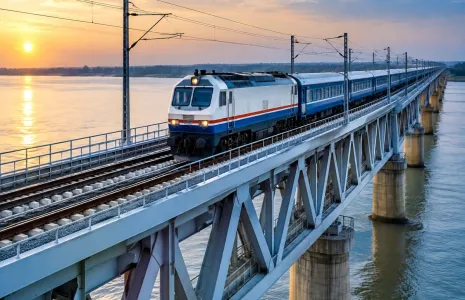
The Railway Ministry has approved the construction of four new railway lines in West Bengal’s North 24 Parganas and Nadia districts, aimed at strengthening transport links in strategically important border areas. The approvals were issued by the Eastern Railway and cover routes that together span more than 53 km. The projects form part of a wider effort to enhance passenger movement and freight capacity in relatively underserved parts of the state. The plan also envisages a three point two kilometre (km) railway bridge across the Krishna River.

The approved routes comprise the 20 km Bangaon–Poramaheshtala line, the 11.5 km Bangaon–Chandabazar stretch, the 13.8 km Chandabazar–Bagdah line and the eight point seventeen km Ranaghat (Aranghata)–Duttaphulia connection. Each corridor has been designed to integrate with existing networks operated by the Eastern Railway and to provide new direct links between rural nodes and larger hubs. Construction timelines and tendering processes were indicated to follow standard railway procurement procedures.

Railway authorities noted that the projects carry strategic significance by strengthening connectivity near the India-Bangladesh border and by improving national security infrastructure in border districts. Officials stated that enhanced connectivity is expected to reduce travel times and to facilitate more efficient movement of personnel and equipment for both civilian and strategic needs. The works are also intended to improve evacuation options and logistical access in the event of emergencies along the frontier.

Beyond strategic considerations, the Eastern Railway indicated the new lines would stimulate local economies by lowering transportation costs and by widening market access for agricultural produce. Farmers and small traders in the border areas are likely to benefit from quicker and more affordable freight movement, which could raise incomes and encourage greater commercial activity. Project proponents expect these connectivity gains to support regional development while strengthening the resilience of supply chains across the districts.

The Railway Ministry has approved the construction of four new railway lines in West Bengal’s North 24 Parganas and Nadia districts, aimed at strengthening transport links in strategically important border areas. The approvals were issued by the Eastern Railway and cover routes that together span more than 53 km. The projects form part of a wider effort to enhance passenger movement and freight capacity in relatively underserved parts of the state. The plan also envisages a three point two kilometre (km) railway bridge across the Krishna River. The approved routes comprise the 20 km Bangaon–Poramaheshtala line, the 11.5 km Bangaon–Chandabazar stretch, the 13.8 km Chandabazar–Bagdah line and the eight point seventeen km Ranaghat (Aranghata)–Duttaphulia connection. Each corridor has been designed to integrate with existing networks operated by the Eastern Railway and to provide new direct links between rural nodes and larger hubs. Construction timelines and tendering processes were indicated to follow standard railway procurement procedures. Railway authorities noted that the projects carry strategic significance by strengthening connectivity near the India-Bangladesh border and by improving national security infrastructure in border districts. Officials stated that enhanced connectivity is expected to reduce travel times and to facilitate more efficient movement of personnel and equipment for both civilian and strategic needs. The works are also intended to improve evacuation options and logistical access in the event of emergencies along the frontier. Beyond strategic considerations, the Eastern Railway indicated the new lines would stimulate local economies by lowering transportation costs and by widening market access for agricultural produce. Farmers and small traders in the border areas are likely to benefit from quicker and more affordable freight movement, which could raise incomes and encourage greater commercial activity. Project proponents expect these connectivity gains to support regional development while strengthening the resilience of supply chains across the districts.

Next Story
Infrastructure Transport

MMRDA advances 250 m on Orange Gate–Marine Drive tunnel

The Mumbai Metropolitan Region Development Authority (MMRDA) has completed 250 m of underground tunnelling for the Orange Gate–Marine Drive Urban Road Tunnel using India’s largest slurry shield tunnel boring machine (TBM) deployed for an urban road project.The project involves twin tunnels extending over 7 km beneath critical transport corridors, including Central Railway, Western Railway and Metro Line 3. The work requires high-precision engineering to navigate densely developed urban infrastructure.Once completed, the tunnel is expected to reduce travel time between Orange Gate and Marin..

Next Story
Infrastructure Urban

Hindustan Zinc Pays Rs 188.46 Billion in FY26

Hindustan Zinc contributed Rs 188.46 billion to the public exchequer in FY 2025-26, according to its 9th Tax Transparency Report. The contribution, equivalent to 46 per cent of the company’s revenue, included direct and indirect taxes, government royalties, dividends to the Government of India, withholding taxes and other statutory levies.The company’s five-year cumulative contribution to the exchequer stood at Rs 915.72 billion. In FY26, Hindustan Zinc reported revenue of Rs 408.44 billion, EBITDA of Rs 221.62 billion and profit after tax of Rs 138.32 billion. It also achieved its highest..

Next Story
Infrastructure Urban

World of Concrete India 2026 Opens in Mumbai

Informa Markets in India will host the 12th edition of World of Concrete India 2026 from 3–5 June 2026 at the Bombay Exhibition Centre, Mumbai. The specialised B2B exhibition will bring together manufacturers, suppliers, contractors, developers, architects, consultants, infrastructure companies, project leaders and government stakeholders.The event is expected to feature over 350 brands and more than 18,000 trade professionals. It will cover concrete and cement, dry mortar, precast technologies, formwork, construction chemicals, industrial and commercial flooring, scaffolding, safety solutio..

Advertisement

Subscribe to Our Newsletter

Get daily newsletters around different themes from Construction world.

STAY CONNECTED

Advertisement

Advertisement

Advertisement