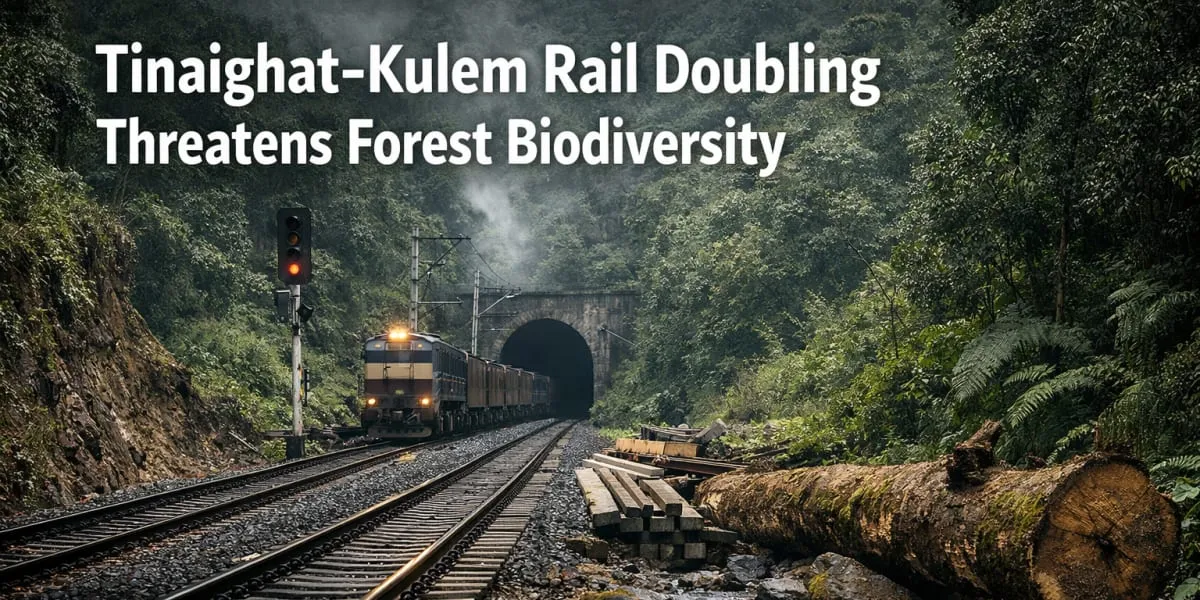
Tinaighat-Kulem Rail Doubling Threatens Forest Biodiversity
RAILWAYS & METRO RAIL

Tinaighat-Kulem Rail Doubling Threatens Forest Biodiversity

A peer-reviewed study by 20 scientists has challenged the cumulative environmental impact assessment prepared by the Wildlife Institute of India for the proposed doubling of the Tinaighat-Kulem railway line in Karnataka and Goa. The study says the assessment overlooks biodiversity and ecological impacts across one of the region's most sensitive forest landscapes. The authors describe the matter as urgent given the scale of planned infrastructure.

The review was published in the Journal of Threatened Taxa and was carried out by a multidisciplinary team of ecologists, social scientists, conservationists and independent researchers. The team assessed the 2025 environmental impact assessment and found methodological gaps, incomplete baseline data and absence of cumulative impact analysis. The authors call for independent scrutiny before environmental clearance is finalised.

Nearly 26 km of the line passes through the Kali tiger reserve and Goa's Bhagwan Mahavir wildlife sanctuary and national park, raising conservation concerns. The doubling is part of a 342-km expansion intended to improve connectivity between Karnataka's mining hinterland and the port of Vasco in Goa. Reviewers warn that proximity to protected areas increases ecological risk if mitigation is inadequate.

The paper notes that habitat fragmentation, disruption of wildlife corridors and disturbance to endemic flora and fauna are not adequately quantified in the EIA. It says cumulative effects from ancillary infrastructure, increased train frequency and construction activity require landscape-level assessment. The reviewers recommend scenario modelling and long-term monitoring frameworks to guide decisions.

Local ecological networks and species reliant on contiguous forest tracts are described as vulnerable to altered movement patterns and habitat loss. The study emphasises integrating conservation planning with transport development to minimise irreversible losses. It warns that decisions will determine the persistence of key populations in the region.

The authors urge authorities to commission independent audits and to revisit mitigation planning to incorporate robust scientific inputs and community safeguards. They recommend that any clearance be conditional on demonstrable measures to avoid cumulative damage and on binding monitoring commitments. The review frames the choice as a test of how development and conservation are balanced in biodiverse landscapes.

A peer-reviewed study by 20 scientists has challenged the cumulative environmental impact assessment prepared by the Wildlife Institute of India for the proposed doubling of the Tinaighat-Kulem railway line in Karnataka and Goa. The study says the assessment overlooks biodiversity and ecological impacts across one of the region's most sensitive forest landscapes. The authors describe the matter as urgent given the scale of planned infrastructure. The review was published in the Journal of Threatened Taxa and was carried out by a multidisciplinary team of ecologists, social scientists, conservationists and independent researchers. The team assessed the 2025 environmental impact assessment and found methodological gaps, incomplete baseline data and absence of cumulative impact analysis. The authors call for independent scrutiny before environmental clearance is finalised. Nearly 26 km of the line passes through the Kali tiger reserve and Goa's Bhagwan Mahavir wildlife sanctuary and national park, raising conservation concerns. The doubling is part of a 342-km expansion intended to improve connectivity between Karnataka's mining hinterland and the port of Vasco in Goa. Reviewers warn that proximity to protected areas increases ecological risk if mitigation is inadequate. The paper notes that habitat fragmentation, disruption of wildlife corridors and disturbance to endemic flora and fauna are not adequately quantified in the EIA. It says cumulative effects from ancillary infrastructure, increased train frequency and construction activity require landscape-level assessment. The reviewers recommend scenario modelling and long-term monitoring frameworks to guide decisions. Local ecological networks and species reliant on contiguous forest tracts are described as vulnerable to altered movement patterns and habitat loss. The study emphasises integrating conservation planning with transport development to minimise irreversible losses. It warns that decisions will determine the persistence of key populations in the region. The authors urge authorities to commission independent audits and to revisit mitigation planning to incorporate robust scientific inputs and community safeguards. They recommend that any clearance be conditional on demonstrable measures to avoid cumulative damage and on binding monitoring commitments. The review frames the choice as a test of how development and conservation are balanced in biodiverse landscapes.

Related Stories

Gold Stories

Next Story
Infrastructure Transport

Innovision Wins NHAI Toll Collection Contract at Aashpur Fee Plaza

Innovision Limited has informed stock exchanges that it has been awarded a user fee collection and facility maintenance contract by the National Highways Authority of India (NHAI). The letter of award was issued on 10 August 2026 for operations at Aashpur Fee Plaza at design kilometre 231.100 on National Highway number 91 between Aligarh and Kanpur in Uttar Pradesh. The engagement covers collection of user fees for four and more lane sections and the upkeep and maintenance of adjacent toilet blocks including replenishment of consumable items. The contract was secured through a competitive e-te..

Next Story
Infrastructure Urban

Bharat Electronics Secures Rs.5,410 mn In Orders

Bharat Electronics Limited (BEL), a Navratna Defence Public Sector Undertaking, has secured additional orders worth Rs.5,410 million (mn) since the last disclosure on 31 July 2026. The fresh awards raise the company's recently reported intake and were announced by way of a regulatory filing on 10 August 2026. The orders span multiple business verticals and are incremental to contracts already under execution. The update follows the company's routine disclosure obligations to the stock exchanges. Major orders received include communication equipment, electro optics, ammunition fuzes, Chemical B..

Next Story
Infrastructure Urban

United Drilling Tools Receives US Order For Gas Lift Mandrel

United Drilling Tools Limited said it has received an order from Tri Lift Services Inc of the United States for the supply of a gas lift mandrel to be used in the oil and gas industry. The company said the disclosure was made to listing authorities under the Securities and Exchange Board of India listing rules and the SEBI master circular of November 2024. The notice set out the nature of the contract as commercial and awarded by an international entity. The order is to be executed in the ordinary course of business and carries an estimated contract value of Rs four point eight three million (..

Advertisement

Subscribe to Our Newsletter

Get daily newsletters around different themes from Construction world.

STAY CONNECTED

Advertisement

Advertisement

Advertisement