CDS Opens First Tri Services Academia Technology Symposium in New Delhi
DEFENSE

CDS Opens First Tri Services Academia Technology Symposium in New Delhi

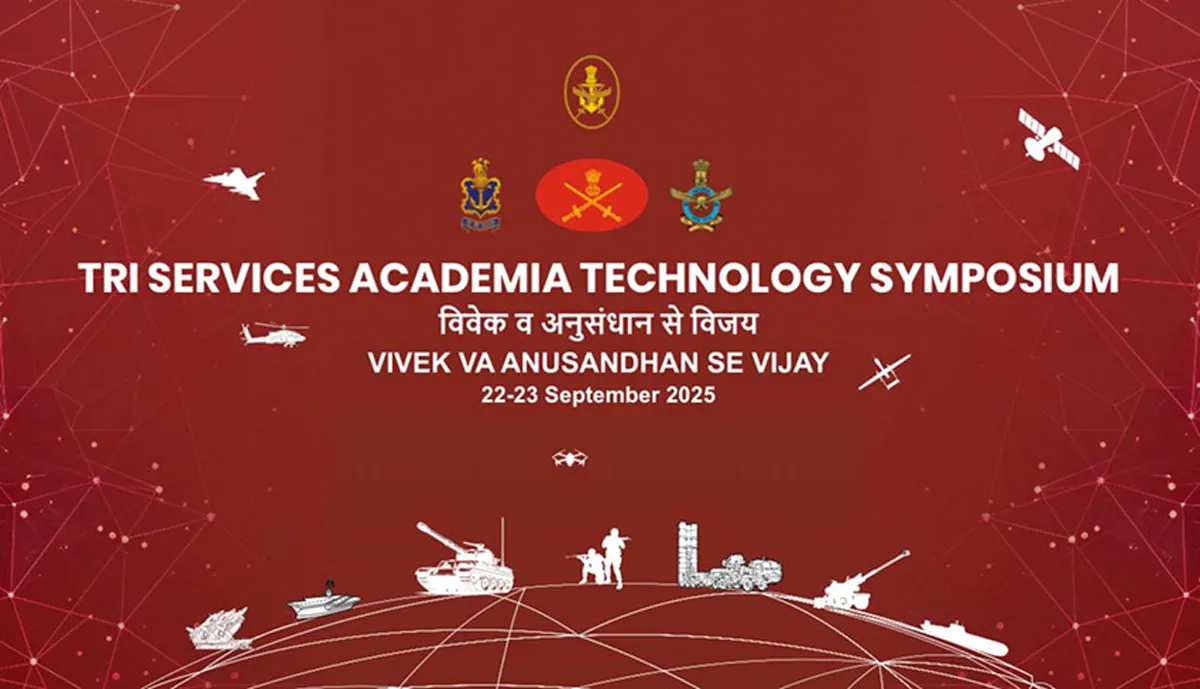
Chief of Defence Staff (CDS) General Anil Chauhan inaugurated the first edition of the Tri Services Academia Technology Symposium (T-SATS) at the Manekshaw Centre, New Delhi, on September 22, 2025. The two-day symposium aims to strengthen collaboration between academia, R&D institutions, and the Armed Forces to develop futuristic technologies for national defence.

The event brought together Directors, Heads of Departments, and students from 62 premier institutions, including IISc, IITs, IIITs, and leading private technology institutes. In his address, the CDS underlined the changing nature of modern warfare, shaped by convergence across kinetic and non-kinetic domains, and stressed the importance of indigenous, integrated technological solutions. He urged academia, startups, and industry to adopt a whole-of-nation approach in scaling innovation and advancing India’s position as a global leader in defence technologies.

As part of the symposium, the CDS inaugurated a Technology Exhibition featuring 43 innovative projects developed by academic institutions. These exhibits were evaluated by subject matter experts from the three Services for potential military applications, with promising projects to be considered for R&D collaboration and funding support.

A key highlight of the day was a series of 95 structured One-on-One meetings between academic innovators and service representatives. These closed-door sessions provided a platform for pitching proposals, receiving feedback, and shaping ideas into practical military-use cases. The discussions will continue on September 23, 2025, reinforcing T-SATS as a dynamic forum for defence innovation.

News source: PIB

Chief of Defence Staff (CDS) General Anil Chauhan inaugurated the first edition of the Tri Services Academia Technology Symposium (T-SATS) at the Manekshaw Centre, New Delhi, on September 22, 2025. The two-day symposium aims to strengthen collaboration between academia, R&D institutions, and the Armed Forces to develop futuristic technologies for national defence.The event brought together Directors, Heads of Departments, and students from 62 premier institutions, including IISc, IITs, IIITs, and leading private technology institutes. In his address, the CDS underlined the changing nature of modern warfare, shaped by convergence across kinetic and non-kinetic domains, and stressed the importance of indigenous, integrated technological solutions. He urged academia, startups, and industry to adopt a whole-of-nation approach in scaling innovation and advancing India’s position as a global leader in defence technologies.As part of the symposium, the CDS inaugurated a Technology Exhibition featuring 43 innovative projects developed by academic institutions. These exhibits were evaluated by subject matter experts from the three Services for potential military applications, with promising projects to be considered for R&D collaboration and funding support.A key highlight of the day was a series of 95 structured One-on-One meetings between academic innovators and service representatives. These closed-door sessions provided a platform for pitching proposals, receiving feedback, and shaping ideas into practical military-use cases. The discussions will continue on September 23, 2025, reinforcing T-SATS as a dynamic forum for defence innovation.News source: PIB

Next Story
Technology

AI-Enabled Workflows Lift Profitability and Productivity

Organisations modernising frontline workflows with artificial intelligence, automation and real-time data are reporting stronger financial performance, higher productivity and improved employee engagement, according to a global study by Zebra Technologies and Oxford Economics.The research covered 1,000 senior leaders across retail, manufacturing, transportation and logistics in the US, Mexico, the UK, Germany, India, Japan, Australia and New Zealand.In transportation and logistics, 54 per cent of companies that improved picking and packing operations reported faster operational performance, wh..

Next Story
Real Estate

India Leads Global AI Readiness but Implementation Lags

Indian companies lead global averages across all eight artificial intelligence readiness indicators tracked by JLL, but only 19 per cent have started making changes to their workplaces, according to the JLL 2026 Future of Work Survey.The study found that 77 per cent of Indian business leaders expect AI to change their office requirements, creating a 58-percentage-point gap between awareness and implementation. The survey covered more than 2,200 CEOs, CFOs and real estate leaders across 21 countries during the first quarter of 2026.Despite concerns over automation, 58 per cent of Indian leaders..

Next Story
Equipment

Three WOLFF Cranes Build Riyadh Cable-Stayed Bridges

Three WOLFF 180 B luffing jib cranes are supporting the construction of two cable-stayed bridges alongside the existing Wadi Laban Bridge in Riyadh, Saudi Arabia. The project is being developed for the Royal Commission for Riyadh City and executed by the ICRC joint venture comprising IC Ictas and Al Rashid Trading & Contracting Company.The cranes are handling lifting operations including formwork, reinforcement, concrete placement, work platforms, surveying equipment and other construction materials. Each crane is fitted with a 40 m jib, reaches a hook height of 157 m and offers a maximum ..

Advertisement

Subscribe to Our Newsletter

Get daily newsletters around different themes from Construction world.

STAY CONNECTED

Advertisement

Advertisement

Advertisement