Budget 2026-27 Pushes Rs 12.2 Trillion Capex, Green Mobility
SMART CITIES

Budget 2026-27 Pushes Rs 12.2 Trillion Capex, Green Mobility

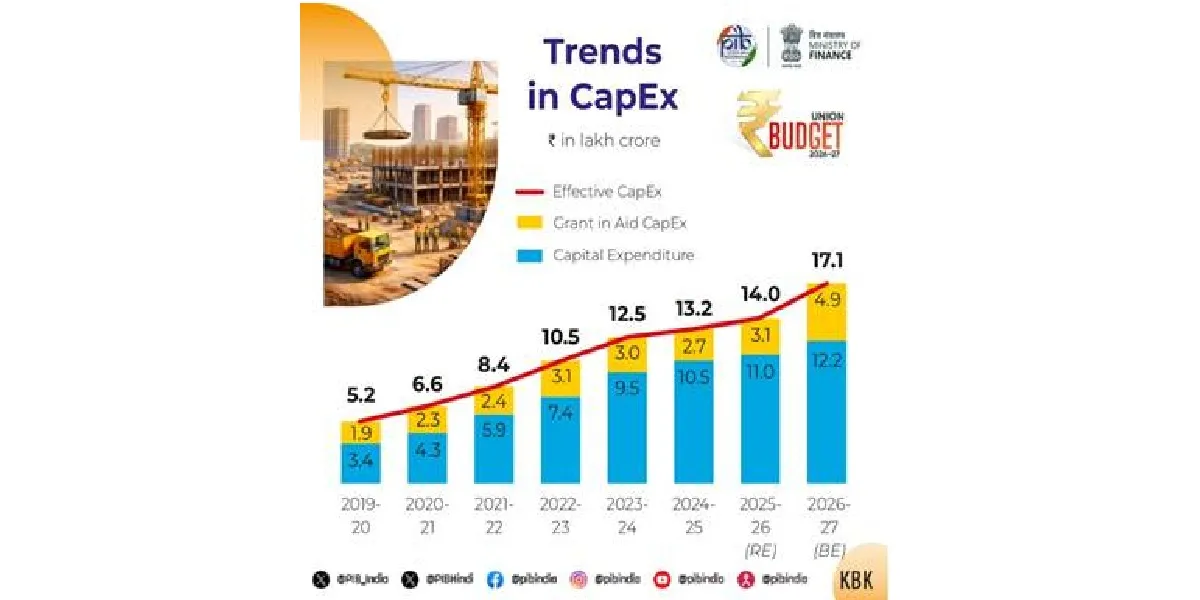
Presenting the Union Budget 2026-27 in Parliament recently, Union Minister for Finance and Corporate Affairs Nirmala Sitharaman said the government’s foremost kartavya is to accelerate and sustain economic growth by boosting productivity, competitiveness and resilience amid global volatility. The Finance Minister highlighted a sharp rise in public capital expenditure from Rs 2 trillion in FY2014-15 to Rs 11.2 trillion in BE 2025-26, proposing a further increase to Rs 12.2 trillion in FY2026-27 to sustain infrastructure momentum. Over the past decade, large-scale public infrastructure has been supported through new financing instruments such as Infrastructure Investment Trusts and Real Estate Investment Trusts, alongside institutions including NIIF and NABFID. The Budget proposes faster recycling of CPSE real estate assets through dedicated REITs. To strengthen private sector confidence during the construction phase, the government will set up an Infrastructure Risk Guarantee Fund, offering calibrated partial credit guarantees to lenders. For environmentally sustainable cargo movement, new Dedicated Freight Corridors are proposed between Dankuni and Surat, along with the operationalisation of 20 National Waterways over five years, starting with NW-5 in Odisha. A Coastal Cargo Promotion Scheme aims to raise the share of inland waterways and coastal shipping from 6 per cent to 12 per cent by 2047. The Budget also proposes seven high-speed rail corridors linking key city pairs, incentives for indigenous seaplane manufacturing through a Viability Gap Funding scheme, and an outlay of Rs 200 billion over five years for Carbon Capture Utilisation and Storage across power, steel, cement, refining and chemicals sectors. Focusing on urban growth, the government will map City Economic Regions across Tier II and Tier III cities and temple towns, with an allocation of Rs 50 billion per region over five years to strengthen agglomeration-led development.

"Join industry leaders at RAHSTA Expo, India's premier platform for roads, highways and traffic infrastructure. Register now to explore innovations, network with experts and shape the future of mobility."

Presenting the Union Budget 2026-27 in Parliament recently, Union Minister for Finance and Corporate Affairs Nirmala Sitharaman said the government’s foremost kartavya is to accelerate and sustain economic growth by boosting productivity, competitiveness and resilience amid global volatility. The Finance Minister highlighted a sharp rise in public capital expenditure from Rs 2 trillion in FY2014-15 to Rs 11.2 trillion in BE 2025-26, proposing a further increase to Rs 12.2 trillion in FY2026-27 to sustain infrastructure momentum. Over the past decade, large-scale public infrastructure has been supported through new financing instruments such as Infrastructure Investment Trusts and Real Estate Investment Trusts, alongside institutions including NIIF and NABFID. The Budget proposes faster recycling of CPSE real estate assets through dedicated REITs. To strengthen private sector confidence during the construction phase, the government will set up an Infrastructure Risk Guarantee Fund, offering calibrated partial credit guarantees to lenders. For environmentally sustainable cargo movement, new Dedicated Freight Corridors are proposed between Dankuni and Surat, along with the operationalisation of 20 National Waterways over five years, starting with NW-5 in Odisha. A Coastal Cargo Promotion Scheme aims to raise the share of inland waterways and coastal shipping from 6 per cent to 12 per cent by 2047. The Budget also proposes seven high-speed rail corridors linking key city pairs, incentives for indigenous seaplane manufacturing through a Viability Gap Funding scheme, and an outlay of Rs 200 billion over five years for Carbon Capture Utilisation and Storage across power, steel, cement, refining and chemicals sectors. Focusing on urban growth, the government will map City Economic Regions across Tier II and Tier III cities and temple towns, with an allocation of Rs 50 billion per region over five years to strengthen agglomeration-led development.

Next Story
Resources

G R Infraprojects Founder Vinod Agarwal Passes Away

Vinod Kumar Agarwal, Founder and Promoter of G R Infraprojects, has passed away. He had been associated with the company since its inception in 1995. His vision, determination and entrepreneurial acumen laid the foundation for the company and helped shape its growth into a leading name in India’s infrastructure sector.Agarwal served as Managing Director from 2008 to 2021 and later as Chairman and Whole-time Director from 2021 to 2025. He stepped down from the office of Director on 10 November 2025. During his leadership tenure, the company moved through significant phases of growth, operatio..

Next Story
Infrastructure Energy

Centre Prioritising Energy Security With Coal Gasification

Union minister for Coal and Mines G Kishan Reddy said the Centre is prioritising energy security through a strategic shift to coal gasification and has announced incentives totalling Rs 460 billion (bn) to support the effort. He said more than 35 companies will start coal gasification activities in India within two months and that the government is encouraging firms that bring technology to close the domestic technology gap. The minister described the initiative as aimed at reducing import dependence and developing indigenous capacity. India has the fifth-largest coal reserve in the world, and..

Next Story
Infrastructure Urban

BHEL and Coal India Invest Rs 250 bn in Odisha Gasification

Bharat Heavy Electricals (BHEL) and Coal India (CIL) are jointly investing Rs 250 billion in a coal gasification project in Odisha, with the Prime Minister laying the foundation stone in Jharsuguda. Union Coal and Mines Minister G Kishan Reddy described the initiative as a transformative shift in coal utilisation that will open industrial avenues for the state. The project moves coal beyond conventional power generation to industrial feedstocks. Coal gasification will convert coal into synthesis gas, a versatile feedstock for chemicals, fertilisers and synthetic fuels, and the technology is ex..

Advertisement

Subscribe to Our Newsletter

Get daily newsletters around different themes from Construction world.

STAY CONNECTED

Advertisement

Advertisement

Advertisement