
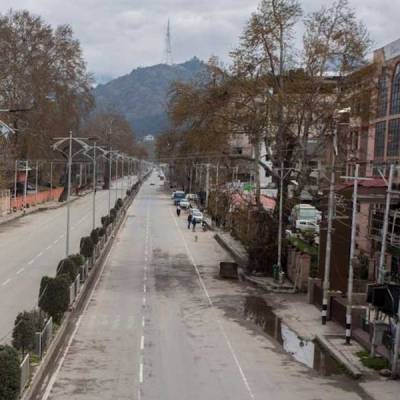


NC’s Tanvir Sadiq Slams Srinagar Smart City Planning
SMART CITIES

NC’s Tanvir Sadiq Slams Srinagar Smart City Planning

National Conference Chief Spokesperson and Zadibal MLA Tanvir Sadiq recently criticised the Srinagar Smart City Project, describing it as ill-conceived and lacking a futuristic approach to urban planning. He said planners should have integrated stormwater and sewerage systems and adopted stronger infrastructure measures.

Sadiq said limited progress has been achieved in Downtown Srinagar under the project, adding that roads have been narrowed while footpaths were widened without adequate planning. He stressed that a city can be termed smart only when its sewage and drainage systems function efficiently, noting that cosmetic changes alone do not meet the objective of smart urban development.

He also questioned the outcomes of initiatives such as public bicycle usage, claiming that many of the cycles introduced under the project are now lying unused. He added that corrective measures would be undertaken to address existing shortcomings.

On the issue of the Combined Competitive Examination, Sadiq said there was no ambiguity regarding his party’s position and maintained that procedures followed in earlier years remain valid. He stated that approvals sent to Raj Bhawan should have been cleared without delay, adding that queries raised have been referred by the General Administration Department to the JKPSC and are expected to be resolved.

Responding to criticism from People’s Conference Chairman Sajad Lone, Sadiq said he respects him as a senior politician but accused him of focusing on mockery rather than constituency-level issues. He alleged that criticism has been selectively directed at the Chief Minister while sparing other authorities.

National Conference Chief Spokesperson and Zadibal MLA Tanvir Sadiq recently criticised the Srinagar Smart City Project, describing it as ill-conceived and lacking a futuristic approach to urban planning. He said planners should have integrated stormwater and sewerage systems and adopted stronger infrastructure measures. Sadiq said limited progress has been achieved in Downtown Srinagar under the project, adding that roads have been narrowed while footpaths were widened without adequate planning. He stressed that a city can be termed smart only when its sewage and drainage systems function efficiently, noting that cosmetic changes alone do not meet the objective of smart urban development. He also questioned the outcomes of initiatives such as public bicycle usage, claiming that many of the cycles introduced under the project are now lying unused. He added that corrective measures would be undertaken to address existing shortcomings. On the issue of the Combined Competitive Examination, Sadiq said there was no ambiguity regarding his party’s position and maintained that procedures followed in earlier years remain valid. He stated that approvals sent to Raj Bhawan should have been cleared without delay, adding that queries raised have been referred by the General Administration Department to the JKPSC and are expected to be resolved. Responding to criticism from People’s Conference Chairman Sajad Lone, Sadiq said he respects him as a senior politician but accused him of focusing on mockery rather than constituency-level issues. He alleged that criticism has been selectively directed at the Chief Minister while sparing other authorities.

Next Story
Real Estate

A Paradigm Shift

The Indian real-estate and construction sector, which employs a significant number of organised and unorganised workers in the country, has embarked on a paradigm shift in its regulatory framework from an employment law perspective. With the four Labour Codes – the Code on Wages, 2019 (Wage Code); the Industrial Relations Code, 2020 (IR Code); the Code on Social Security, 2020 (SS Code) and the Occupational Safety, Health and Working Conditions Code, 2020 (OSH Code) – coming into effect in India from November 21, 2025, the industry is shifting away from a fragmented, contractor- driven com..

Next Story
Technology

We offer end-to-end traceability at scale

mjunction has evolved from an e-auction pioneer into a multi-vertical digital commerce platform with deep expertise in complex steel and coal supply chains. Its end-to-end, AI-led architecture focuses on price discovery, traceability, compliance and scalability, enabling transparent procurement, efficient logistics and data-driven decision-making across geographies. Vinaya Varma, MD, shares more about the company in conversation with CW.From a technology standpoint, what are the core USPs of mjunction today that differentiate it in steel and coal supply chains?mjunction has evolved b..

Next Story
Infrastructure Urban

Henkel, Rotary Recycle PoP Ganesha Idols Under Project HARMONY

Henkel India, in partnership with the Rotary Club of Navi Mumbai – Joy of Giving and with support from the Navi Mumbai Municipal Corporation (NMMC), has advanced circular sustainability through Project HARMONY by recycling Plaster of Paris (PoP) Ganesha idols into community learning assets. The initiative highlights an integrated approach to environmental restoration and social impact.As part of the project, materials collected after Ganesh Visarjan 2025 at Nerul were responsibly diverted from land and water bodies and processed at an authorised recycling facility, with on-ground execution s..

Advertisement

Subscribe to Our Newsletter

Get daily newsletters around different themes from Construction world.

STAY CONNECTED

Advertisement

Advertisement

Advertisement

Advertisement

Open In App