Centre, States Focus on Sustainable O&M Under Jal Jeevan Mission
WATER & WASTE

Centre, States Focus on Sustainable O&M Under Jal Jeevan Mission

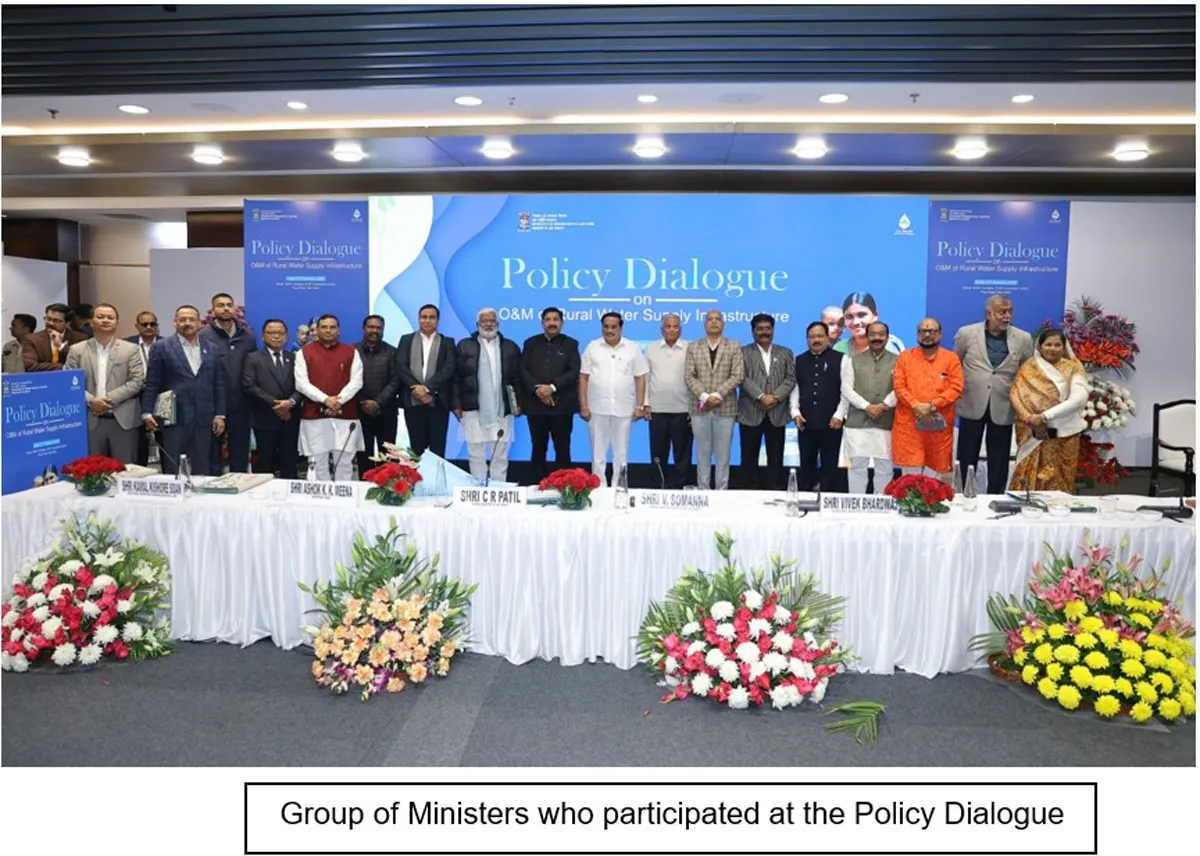
The Department of Drinking Water and Sanitation (DDWS), Ministry of Jal Shakti, recently organised a Minister-level Policy Dialogue in New Delhi to strengthen sustainable Operation and Maintenance (O&M) of rural drinking water services under the Jal Jeevan Mission (JJM). The dialogue brought together Union and State Ministers, senior officials and sector experts to deliberate on long-term sustainability of rural piped water supply systems.

The discussions marked a shift in JJM’s focus from infrastructure creation to reliable, citizen-centric service delivery. Emphasis was placed on strong institutional frameworks, predictable financing, empowered Gram Panchayats and digital monitoring systems, with local governments positioned at the centre of long-term drinking water governance.

Addressing the dialogue, Rajiv Ranjan Singh underlined the need to prioritise O&M alongside asset creation, calling for Gram Panchayats to play a central role in service sustainability. He stressed integrating drinking water services into Gram Panchayat Development Plans, supported by transparent digital financial systems and Gram Sabha oversight.

C. R. Patil highlighted implementation discipline and financial prudence in the next phase of JJM. He noted that future fund releases would be linked to continuous water supply performance and urged States to rationalise project designs, strengthen water sources and enhance recharge and conservation efforts.

Minister of State V. Somanna emphasised the transition towards state-driven and IoT-enabled monitoring systems to improve accountability and long-term service delivery.

Setting the context, Ashok K.K. Meena, Secretary, DDWS, said that O&M is now central to water governance under JJM. He highlighted the need for legal recognition of Village Water & Sanitation Committees, asset ownership by Gram Panchayats, ring-fenced user charges and robust digital public infrastructure to ensure transparency and accountability.

The dialogue also reviewed national initiatives such as Jal Arpan, Jal Utsav, Jal Seva Aankalan, source sustainability measures and GIS-based asset mapping, alongside a 19-point advisory on O&M reforms. State-level discussions showcased best practices, including Karnataka’s Cabinet-approved O&M policy adopted by over 5,500 Gram Panchayats.

The policy dialogue reaffirmed that sustained rural drinking water services require community ownership, institutional convergence and clear accountability, with Gram Panchayats and local institutions leading day-to-day operations to ensure reliable and resilient water supply over the long term.

The Department of Drinking Water and Sanitation (DDWS), Ministry of Jal Shakti, recently organised a Minister-level Policy Dialogue in New Delhi to strengthen sustainable Operation and Maintenance (O&M) of rural drinking water services under the Jal Jeevan Mission (JJM). The dialogue brought together Union and State Ministers, senior officials and sector experts to deliberate on long-term sustainability of rural piped water supply systems. The discussions marked a shift in JJM’s focus from infrastructure creation to reliable, citizen-centric service delivery. Emphasis was placed on strong institutional frameworks, predictable financing, empowered Gram Panchayats and digital monitoring systems, with local governments positioned at the centre of long-term drinking water governance. Addressing the dialogue, Rajiv Ranjan Singh underlined the need to prioritise O&M alongside asset creation, calling for Gram Panchayats to play a central role in service sustainability. He stressed integrating drinking water services into Gram Panchayat Development Plans, supported by transparent digital financial systems and Gram Sabha oversight. C. R. Patil highlighted implementation discipline and financial prudence in the next phase of JJM. He noted that future fund releases would be linked to continuous water supply performance and urged States to rationalise project designs, strengthen water sources and enhance recharge and conservation efforts. Minister of State V. Somanna emphasised the transition towards state-driven and IoT-enabled monitoring systems to improve accountability and long-term service delivery. Setting the context, Ashok K.K. Meena, Secretary, DDWS, said that O&M is now central to water governance under JJM. He highlighted the need for legal recognition of Village Water & Sanitation Committees, asset ownership by Gram Panchayats, ring-fenced user charges and robust digital public infrastructure to ensure transparency and accountability. The dialogue also reviewed national initiatives such as Jal Arpan, Jal Utsav, Jal Seva Aankalan, source sustainability measures and GIS-based asset mapping, alongside a 19-point advisory on O&M reforms. State-level discussions showcased best practices, including Karnataka’s Cabinet-approved O&M policy adopted by over 5,500 Gram Panchayats. The policy dialogue reaffirmed that sustained rural drinking water services require community ownership, institutional convergence and clear accountability, with Gram Panchayats and local institutions leading day-to-day operations to ensure reliable and resilient water supply over the long term.

Next Story
Infrastructure Urban

PM Modi Addresses India-EU Business Forum in New Delhi

Prime Minister Shri Narendra Modi recently addressed the India–European Union Business Forum at Bharat Mandapam, New Delhi, describing the current phase as a new era of alignment in India-EU relations. He noted that the presence of EU leaders as Chief Guests at India’s Republic Day and the conclusion of the largest Free Trade Agreement in India’s history reflect unprecedented strategic convergence between the two democratic partners. Highlighting economic ties, the Prime Minister said bilateral trade has doubled over the past decade to 180 billion euros, with EU investments in India exc..

Next Story
Infrastructure Energy

PM Modi Highlights Energy Opportunities at India Energy Week 2026

Prime Minister Narendra Modi recently addressed the inaugural ceremony of India Energy Week 2026 via video conferencing, describing India as a land of immense opportunity for the global energy sector. He noted that representatives from nearly 125 countries had gathered to deliberate on building an energy-secure and sustainable future, underlining the event’s growing stature as a global platform for dialogue and action. The Prime Minister highlighted that India’s position as the world’s fastest-growing major economy is driving sustained growth in energy demand, while also creating opport..

Next Story
Infrastructure Energy

India–EU Free Trade Agreement Marks Strategic Trade Breakthrough

India and the European Union have recently concluded the India–EU Free Trade Agreement (FTA), marking a major milestone in bilateral economic engagement. The agreement was jointly announced at the 16th India–EU Summit by Narendra Modi and Ursula von der Leyen, positioning the two blocs as trusted partners committed to open, rules-based and inclusive growth. The FTA follows sustained negotiations since talks were relaunched in 2022 and reflects a shared strategic vision between the world’s fourth- and second-largest economies, together accounting for about 25 per cent of global GDP and n..

Advertisement

Subscribe to Our Newsletter

Get daily newsletters around different themes from Construction world.

STAY CONNECTED

Advertisement

Advertisement

Advertisement

Advertisement

Open In App