+
Himachal Pradesh Launches Awareness Drive on Solid Waste Rules
WATER & WASTE

Himachal Pradesh Launches Awareness Drive on Solid Waste Rules

The Himachal Pradesh State Pollution Control Board held a press conference in Shimla on September 23 as part of a nationwide campaign to raise awareness about the Solid Waste Management Rules, 2026. The rules came into force on April 1, 2026, replacing the 2016 framework and covering urban, rural, commercial, institutional and government establishments.

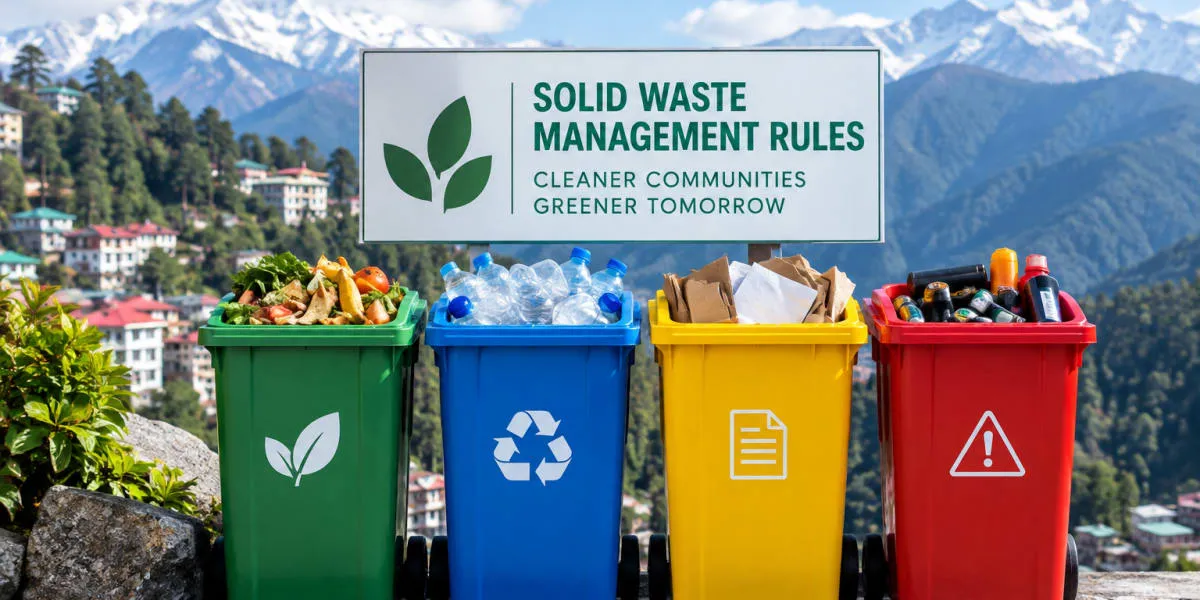
Sushil Kumar Singla, Secretary-cum-Member Secretary of the board, said the rules require waste to be segregated at source into four streams. Wet waste covers biodegradable kitchen, food and organic waste, while dry waste includes recyclable paper, cardboard, plastics, glass and metals. Sanitary waste must be securely wrapped before being handed over, while special care waste includes items such as bulbs, expired medicines, paint cans, syringes, mercury thermometers and batteries.

The board said the Supreme Court is monitoring implementation under its August 18, 2026 order in Civil Appeal No. 6174 of 2023. Burning, burying, dumping or littering waste in drains, water bodies and public spaces is prohibited, while individuals, institutions, schools, commercial establishments and government departments are required to segregate waste and ensure its safe processing and disposal.

Deputy Commissioners, working with local bodies, have been directed to identify bulk waste generators within six weeks. Local bodies will then issue notices to those identified, and non-compliant generators could face temporary disconnection of electricity and water supplies through the District Collector’s Special Cell. In rural areas, Gram Panchayats and other local bodies will oversee door-to-door collection, segregation, processing, home composting where feasible and action against open dumping and burning.

The School and Higher Education Department is integrating theoretical and practical waste-management modules into the curriculum. Students will be trained as Household Supervisors to promote 100% segregation at home, supported by periodic audits. Daily audits of processing facilities and monitoring of interstate waste movement will also be undertaken, while state and district committees constituted in April will supervise implementation across the state.

The Himachal Pradesh State Pollution Control Board held a press conference in Shimla on September 23 as part of a nationwide campaign to raise awareness about the Solid Waste Management Rules, 2026. The rules came into force on April 1, 2026, replacing the 2016 framework and covering urban, rural, commercial, institutional and government establishments. Sushil Kumar Singla, Secretary-cum-Member Secretary of the board, said the rules require waste to be segregated at source into four streams. Wet waste covers biodegradable kitchen, food and organic waste, while dry waste includes recyclable paper, cardboard, plastics, glass and metals. Sanitary waste must be securely wrapped before being handed over, while special care waste includes items such as bulbs, expired medicines, paint cans, syringes, mercury thermometers and batteries. The board said the Supreme Court is monitoring implementation under its August 18, 2026 order in Civil Appeal No. 6174 of 2023. Burning, burying, dumping or littering waste in drains, water bodies and public spaces is prohibited, while individuals, institutions, schools, commercial establishments and government departments are required to segregate waste and ensure its safe processing and disposal. Deputy Commissioners, working with local bodies, have been directed to identify bulk waste generators within six weeks. Local bodies will then issue notices to those identified, and non-compliant generators could face temporary disconnection of electricity and water supplies through the District Collector’s Special Cell. In rural areas, Gram Panchayats and other local bodies will oversee door-to-door collection, segregation, processing, home composting where feasible and action against open dumping and burning. The School and Higher Education Department is integrating theoretical and practical waste-management modules into the curriculum. Students will be trained as Household Supervisors to promote 100% segregation at home, supported by periodic audits. Daily audits of processing facilities and monitoring of interstate waste movement will also be undertaken, while state and district committees constituted in April will supervise implementation across the state.

Related Stories

Gold Stories

Next Story
Real Estate

Ajyal Holding Acquires 25% Stake in Sterling Ark

Sterling Ark, an independent integrated real estate advisory and project delivery firm, has announced a strategic alliance with Abu Dhabi-headquartered Ajyal Holding. Under the agreement, Ajyal Holding has acquired a 25 per cent stake in Sterling Ark.The alliance is expected to provide Sterling Ark with a broader platform to pursue opportunities and expand its presence across the region. Ajyal Holding operates across real estate, contracting, fit-out, building materials and technology, among other sectors.Sterling Ark provides end-to-end advisory and project delivery capabilities across real e..

Next Story
Infrastructure Urban

YEIDA Allots Land for Five Projects Worth Rs 4.69 bn

A significant step towards converting industrial investment proposals into on-ground projects was taken at the inauguration of the Uttar Pradesh International Trade Show (UPITS) 2026. Union Home and Cooperation Minister Amit Shah presented Letters of Allotment to representatives of five companies investing in the Yamuna Expressway Industrial Development Authority (YEIDA) region.The five projects have been allotted a total of 71,190 sq m of land and involve a proposed investment of Rs 4.69 bn, with the potential to generate 4,625 employment opportunities.C&R Textiles Private Limited has bee..

Next Story
Infrastructure Energy

Hindustan Zinc Restores 1,105 Hectares of Land

Hindustan Zinc Limited has restored 1,105 hectares of land as part of its efforts to integrate ecological restoration with responsible mining. The rehabilitated area, equivalent to more than 1,500 football fields, covers mining and operational landscapes restored through reclamation, plantation, biodiversity enhancement and sustainable land-use practices.The initiatives form part of Hindustan Zinc’s Sustainability Goals 2030 and its broader focus on creating long-term ecological value alongside business growth.Amarendu Prakash, CEO, Hindustan Zinc, said: “The future of mining will increasi..

Advertisement

Subscribe to Our Newsletter

Get daily newsletters around different themes from Construction world.

STAY CONNECTED

Advertisement

SPECIAL OFFER
QR Code