+
Himachal Pradesh Sets Six-Week Drive to Identify Waste Generators
WATER & WASTE

Himachal Pradesh Sets Six-Week Drive to Identify Waste Generators

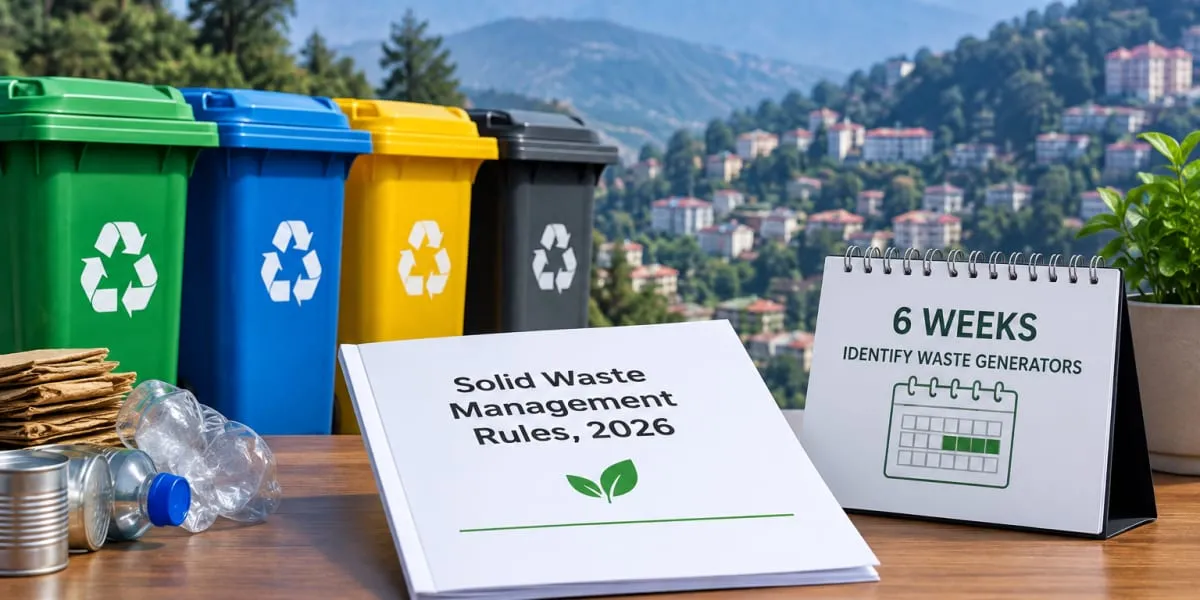
Shimla, 23 September: The Himachal Pradesh State Pollution Control Board held a press conference as part of a nationwide campaign to explain the Solid Waste Management Rules, 2026 and support their implementation across the state. The rules came into force on 1 April 2026, replacing the 2016 framework and covering urban, rural, commercial, institutional and government establishments.

Sushil Kumar Singla, Secretary-cum-Member Secretary of the state pollution control board, said the rules require mandatory segregation at source into four streams. These comprise wet waste, including biodegradable kitchen and food waste; dry waste, including paper, plastics, glass and metals; sanitary waste, such as used diapers and sanitary pads; and special care waste, including medicines, paint cans, syringes, mercury thermometers, bulbs and batteries.

The board said the Supreme Court is monitoring implementation under its order dated 18 August 2026 in Civil Appeal No. 6174 of 2023. Burning, burying, dumping or littering waste in drains, water bodies and public places is prohibited, while individuals, institutions, commercial establishments, schools and government departments are required to segregate waste and hand it over for safe processing and disposal.

District Deputy Commissioners, working with local bodies, have been directed to identify Bulk Waste Generators, or BWGs, within six weeks. Local bodies will issue written notices to identified BWGs, and those failing to segregate, process or manage waste in accordance with the rules will face temporary disconnection of electricity and water supplies through the District Collector’s Special Cell.

The board also stressed the role of rural local bodies in door-to-door collection, segregation and scientific processing, including home composting where feasible. Schools are integrating practical and theoretical waste-management modules, with students to be trained as Household Supervisors to promote 100 per cent segregation at home. Daily audits of processing facilities and monitoring of interstate waste movement will support oversight by state and district implementation committees.

Shimla, 23 September: The Himachal Pradesh State Pollution Control Board held a press conference as part of a nationwide campaign to explain the Solid Waste Management Rules, 2026 and support their implementation across the state. The rules came into force on 1 April 2026, replacing the 2016 framework and covering urban, rural, commercial, institutional and government establishments. Sushil Kumar Singla, Secretary-cum-Member Secretary of the state pollution control board, said the rules require mandatory segregation at source into four streams. These comprise wet waste, including biodegradable kitchen and food waste; dry waste, including paper, plastics, glass and metals; sanitary waste, such as used diapers and sanitary pads; and special care waste, including medicines, paint cans, syringes, mercury thermometers, bulbs and batteries. The board said the Supreme Court is monitoring implementation under its order dated 18 August 2026 in Civil Appeal No. 6174 of 2023. Burning, burying, dumping or littering waste in drains, water bodies and public places is prohibited, while individuals, institutions, commercial establishments, schools and government departments are required to segregate waste and hand it over for safe processing and disposal. District Deputy Commissioners, working with local bodies, have been directed to identify Bulk Waste Generators, or BWGs, within six weeks. Local bodies will issue written notices to identified BWGs, and those failing to segregate, process or manage waste in accordance with the rules will face temporary disconnection of electricity and water supplies through the District Collector’s Special Cell. The board also stressed the role of rural local bodies in door-to-door collection, segregation and scientific processing, including home composting where feasible. Schools are integrating practical and theoretical waste-management modules, with students to be trained as Household Supervisors to promote 100 per cent segregation at home. Daily audits of processing facilities and monitoring of interstate waste movement will support oversight by state and district implementation committees.

Related Stories

Gold Stories

Next Story
Infrastructure Transport

Mumbai-Ahmedabad Bullet Train’s Surat-Vapi Section Set for 2027

The first section of the Mumbai-Ahmedabad Bullet Train corridor, linking Surat and Vapi, is targeted to begin services in 2027. Construction is expected to be completed by December 2026, while Railway Minister Ashwini Vaishnaw has indicated that an inauguration could take place around the middle of 2027. The National High Speed Rail Corporation (NHSRCL) said the train being manufactured in India is expected to reach the tracks around April or May 2027. The train will undergo extensive testing before the section is opened for passenger services. The project began construction in 2021 and includ..

Next Story
Infrastructure Transport

Indian Railways Approves Four Projects Worth Rs. 7.36 bn Across Four States

Indian Railways has approved four projects with a combined value of Rs. 7.36 bn across Uttar Pradesh, Maharashtra, Andhra Pradesh and Gujarat. The programme covers train protection, signalling, electric traction supply and a road overbridge, with each project assigned to a different railway zone. In Uttar Pradesh, Rs. 2.52 bn has been approved to extend the Kavach 4.0 automatic train protection system across 607.7 km in the Lucknow Division of North Eastern Railway. The system monitors train movements and can apply the brakes if a driver fails to observe a signal or exceeds a safe speed. The w..

Next Story
Infrastructure Urban

Chandru Raheja Sells 1.49% Stake in Mindspace REIT for Rs. 5 bn

Billionaire Chandru Lachmandas Raheja has sold a 1.49 per cent holding in Mindspace Business Parks REIT for Rs. 5 bn through a bulk deal on the BSE. The transaction involved 9.9 mn units and was executed at an average price of Rs. 505 per unit, according to exchange data. Following the sale, units of Mindspace Business Parks REIT were trading 0.18 per cent lower at Rs. 504.05 on Tuesday. Exchange data did not identify the buyers involved in the transaction. Raheja is the chairman of real estate company K Raheja Corp. The sale involved 99,00,990 units, representing 1.49 per cent of the Mumbai-b..

Advertisement

Subscribe to Our Newsletter

Get daily newsletters around different themes from Construction world.

STAY CONNECTED

Advertisement

SPECIAL OFFER
QR Code