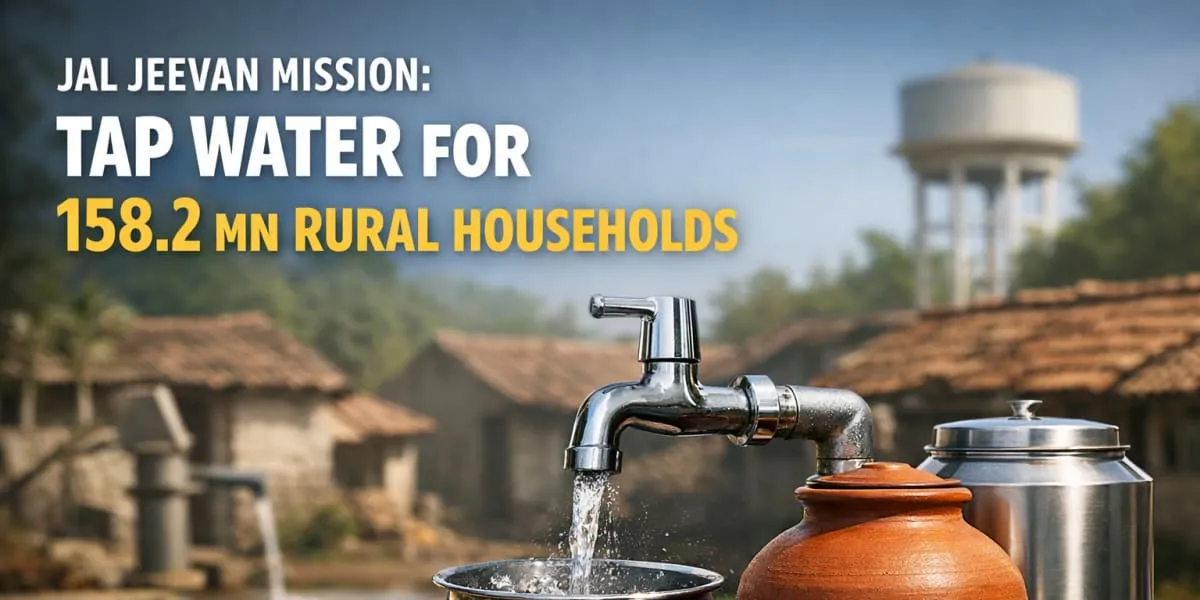
Jal Jeevan Mission Reports Tap Water For 158.2 mn Rural Households
WATER & WASTE

Jal Jeevan Mission Reports Tap Water For 158.2 mn Rural Households

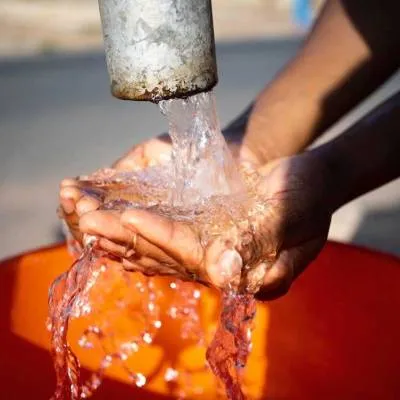
Since August 2019 the Government of India, in partnership with states, has been implementing the Jal Jeevan Mission (JJM) to enable every rural household to have assured potable water through tap connections. The mission is overseen by the Ministry of Jal Shakti and seeks regular long term supply of prescribed quality water.

At the launch only 3.23 Crore, equivalent to 32.3 million (mn), or 16.7 per cent, of rural households had tap connections. As reported by states and union territories on three March 2026 an additional 12.58 Crore, or 125.8 mn households, have been provided connections bringing the total to around 19.36 Crore, about 193.6 mn households, of which approximately 158.2 mn, or 81.71 per cent, are reported to have tap water supply at home.

The Department conducted an independent functionality assessment in 2024 using standard statistical sampling and third party agencies. The assessment found 98.1 per cent of households in surveyed villages had tap connections and 87 per cent of those reported receiving water in the past week, indicating overall progress. 84 per cent of households receive water as per schedule and 80 per cent receive the minimum 55 LPCD, while 76 per cent of households were free from bacteriological contamination and 81 per cent of supply sources were free from chemical contamination. Considering quantity, quality and regularity, 76 per cent of household tap connections were found to be functional.

Measures to accelerate implementation include regular reviews, capacity building workshops and field visits by multidisciplinary teams. States have been issued operational guidelines and a Margdarshika for gram panchayats and village water and sanitation committees to support safe drinking water delivery. For online monitoring the JJM Integrated Management Information System (IMIS) and a dashboard have been established along with financial management via the Public Financial Management System (PFMS).

Further steps include village and district dashboards linked to eGramswaraj, District Collectors' Peyjal Samvad and institutionalising national WASH experts through an IMIS module. The Minister of State for Jal Shakti V. Somanna provided the information in a reply to the Rajya Sabha.

Since August 2019 the Government of India, in partnership with states, has been implementing the Jal Jeevan Mission (JJM) to enable every rural household to have assured potable water through tap connections. The mission is overseen by the Ministry of Jal Shakti and seeks regular long term supply of prescribed quality water. At the launch only 3.23 Crore, equivalent to 32.3 million (mn), or 16.7 per cent, of rural households had tap connections. As reported by states and union territories on three March 2026 an additional 12.58 Crore, or 125.8 mn households, have been provided connections bringing the total to around 19.36 Crore, about 193.6 mn households, of which approximately 158.2 mn, or 81.71 per cent, are reported to have tap water supply at home. The Department conducted an independent functionality assessment in 2024 using standard statistical sampling and third party agencies. The assessment found 98.1 per cent of households in surveyed villages had tap connections and 87 per cent of those reported receiving water in the past week, indicating overall progress. 84 per cent of households receive water as per schedule and 80 per cent receive the minimum 55 LPCD, while 76 per cent of households were free from bacteriological contamination and 81 per cent of supply sources were free from chemical contamination. Considering quantity, quality and regularity, 76 per cent of household tap connections were found to be functional. Measures to accelerate implementation include regular reviews, capacity building workshops and field visits by multidisciplinary teams. States have been issued operational guidelines and a Margdarshika for gram panchayats and village water and sanitation committees to support safe drinking water delivery. For online monitoring the JJM Integrated Management Information System (IMIS) and a dashboard have been established along with financial management via the Public Financial Management System (PFMS). Further steps include village and district dashboards linked to eGramswaraj, District Collectors' Peyjal Samvad and institutionalising national WASH experts through an IMIS module. The Minister of State for Jal Shakti V. Somanna provided the information in a reply to the Rajya Sabha.

Next Story
Infrastructure Urban

Centre Examines Duty Relief Under MOOWR For Battery Storage Imports

The finance ministry is examining whether to continue customs warehousing benefits under the Manufacture and Other Operations in Warehouse Regulations, 2019 framework for imported battery energy storage systems. It plans consultations with the ministries of power and new and renewable energy to decide on the future scope of duty and GST deferment for such imports. The review follows concerns from the renewable energy sector that the current approach is creating an uneven playing field. Under the regulations, companies may import goods without paying customs duty or goods and services tax upfro..

Next Story
Infrastructure Urban

Jamshedpur MP Seeks Rs 4,820 Million Plan For Tatanagar Platforms

Member of Parliament Bidyut Baran Mahato held a meeting with Vikas Jain, Executive Director (Public Grievances) of the Railway Board, following a special session of Parliament to press for accelerated rail infrastructure work around Jamshedpur and Tatanagar. The discussions addressed a range of projects that the ministry is prioritising for the area. Final Location Surveys for the construction of the fourth and fifth railway lines between Pandrasali and Kandra and for the development of a satellite station near Tatanagar have already been approved, clearing the way for detailed planning. Mahat..

Next Story
Infrastructure Energy

Final Batch Of Two 3,300 HP Locomotives Reach Mozambique

The final batch of two 3,300 horsepower (hp) locomotives manufactured by Banaras Locomotive Works (BLW) has reached Mozambique, marking completion of an export consignment. The locomotives arrived at Maputo harbour and were cleared for onward movement to the national rail operator. The shipment closes a programme that began with earlier consignments delivered over the past months. Banaras Locomotive Works, a production unit of Indian Railways, built the locomotives under a contract with the Mozambican rail authority and managed the final inspections and commissioning preparations prior to disp..

Advertisement

Subscribe to Our Newsletter

Get daily newsletters around different themes from Construction world.

STAY CONNECTED

Advertisement

Advertisement

Advertisement