Over 81.71 Per Cent Rural Households Have Tap Water Under JJM
WATER & WASTE

Over 81.71 Per Cent Rural Households Have Tap Water Under JJM

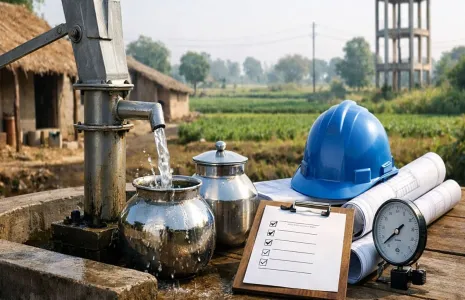
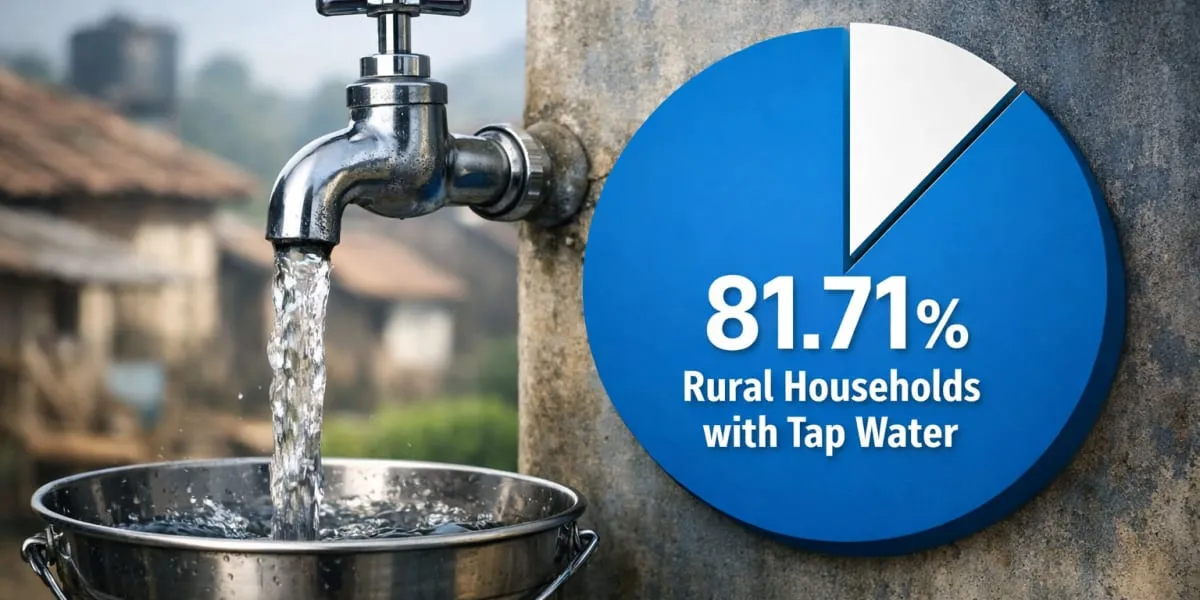
Since August 2019 the Government of India and states have implemented the Jal Jeevan Mission to provide potable tap water to every rural household. At the start of the mission only 32.3 million (mn) rural households had tap connections, representing 16.7 per cent. States and union territories report that more than 125.8 mn additional rural households have been provided with connections. As on 03.03.2026 about 158.2 mn households, or 81.71 per cent of the approximately 193.6 mn rural households, are reported to have tap water at home.

The remaining 35.4 mn households are at various stages of implementation in respective states and union territories. State, district and village level status of tap connections is publicly available on the mission dashboard. Drinking water being a state subject, planning, approval, implementation and maintenance of supply schemes lie with state and union territory governments, with central government providing technical and financial assistance. Concurrent projects for storage, distribution and purification are maintained at the state level.

The department undertakes independent third party assessments of functionality using statistical sampling. The 2024 assessment found that 98.1 per cent of households in surveyed villages had tap connections and that 87 per cent of households with connections reported receiving water in the previous week. It further reported that 84 per cent receive water as per schedule, 80 per cent receive the minimum 55 LPCD and 76 per cent of household supplies were free from bacteriological contamination. Considering quantity, quality and regularity, 76 per cent of household tap connections were found to be functional.

States reported challenges such as scarce water sources, geogenic contamination, difficult terrain, scattered habitations and rising material costs. To complete ongoing works a budgetary allocation of Rs 676.7 billion (bn) has been made for fiscal year 2026-27. The government has introduced measures and strengthened monitoring. The information was provided by the Minister of State for Jal Shakti in a written reply to the Rajya Sabha.

Since August 2019 the Government of India and states have implemented the Jal Jeevan Mission to provide potable tap water to every rural household. At the start of the mission only 32.3 million (mn) rural households had tap connections, representing 16.7 per cent. States and union territories report that more than 125.8 mn additional rural households have been provided with connections. As on 03.03.2026 about 158.2 mn households, or 81.71 per cent of the approximately 193.6 mn rural households, are reported to have tap water at home. The remaining 35.4 mn households are at various stages of implementation in respective states and union territories. State, district and village level status of tap connections is publicly available on the mission dashboard. Drinking water being a state subject, planning, approval, implementation and maintenance of supply schemes lie with state and union territory governments, with central government providing technical and financial assistance. Concurrent projects for storage, distribution and purification are maintained at the state level. The department undertakes independent third party assessments of functionality using statistical sampling. The 2024 assessment found that 98.1 per cent of households in surveyed villages had tap connections and that 87 per cent of households with connections reported receiving water in the previous week. It further reported that 84 per cent receive water as per schedule, 80 per cent receive the minimum 55 LPCD and 76 per cent of household supplies were free from bacteriological contamination. Considering quantity, quality and regularity, 76 per cent of household tap connections were found to be functional. States reported challenges such as scarce water sources, geogenic contamination, difficult terrain, scattered habitations and rising material costs. To complete ongoing works a budgetary allocation of Rs 676.7 billion (bn) has been made for fiscal year 2026-27. The government has introduced measures and strengthened monitoring. The information was provided by the Minister of State for Jal Shakti in a written reply to the Rajya Sabha.

Next Story
Infrastructure Energy

Indian Urea Producers Shut Plants As Iran War Cuts Qatari LNG Supplies

Indian urea producers have shut several plants after the war involving Iran led to cuts in Qatari supplies of liquefied natural gas (LNG), industry participants said. The reduction in LNG shipments has constrained feedstock availability and raised operational pressures at ammonia and urea units across the country, complicating production scheduling and maintenance plans. Producers have scaled back output in response to fuel shortages and logistical challenges affecting domestic fertiliser production and have implemented staggered shutdowns to manage inventories. The disruptions have heightened..

Next Story
Infrastructure Urban

Adani Plans Rs 600 bn Investment In Schools And Hospitals

Adani Group plans a Rs 600 billion (Rs 600 bn) social investment to construct 300 schools and 30 hospitals across India, aimed at expanding educational and healthcare infrastructure nationwide. The initiative is presented as a long term commitment to strengthen community services and address gaps in access to quality education and primary healthcare. The group highlighted investment in both physical infrastructure and associated services to ensure schools and hospitals are functional from opening. The programme will focus on building resilient facilities that meet prevailing regulatory standar..

Next Story
Infrastructure Transport

PM Launches Development Projects Worth Rs 235.5 Billion (bn) From Silchar

The Prime Minister launched development projects worth Rs 235.5 billion (bn) from Silchar in Assam and performed the bhumi pujan for three projects in the Barak Valley. The schemes comprise the Silchar High-Speed Corridor at an estimated cost of Rs 228.6 bn, the Silchar Town Flyover at about Rs 5.65 bn and the Patharkandi College of Agriculture at about Rs 1.22 bn. The announcement was made at a public ceremony in Cachar district. He said that southern Assam's Barak Valley is emerging as a strategic link to Southeast Asia and that the North East is taking a lead in the government's Act East po..

Advertisement

Subscribe to Our Newsletter

Get daily newsletters around different themes from Construction world.

STAY CONNECTED

Advertisement

Advertisement

Advertisement