HeidelbergCement India Receives Consent For Khandwa Grinding Unit
Cement

HeidelbergCement India Receives Consent For Khandwa Grinding Unit

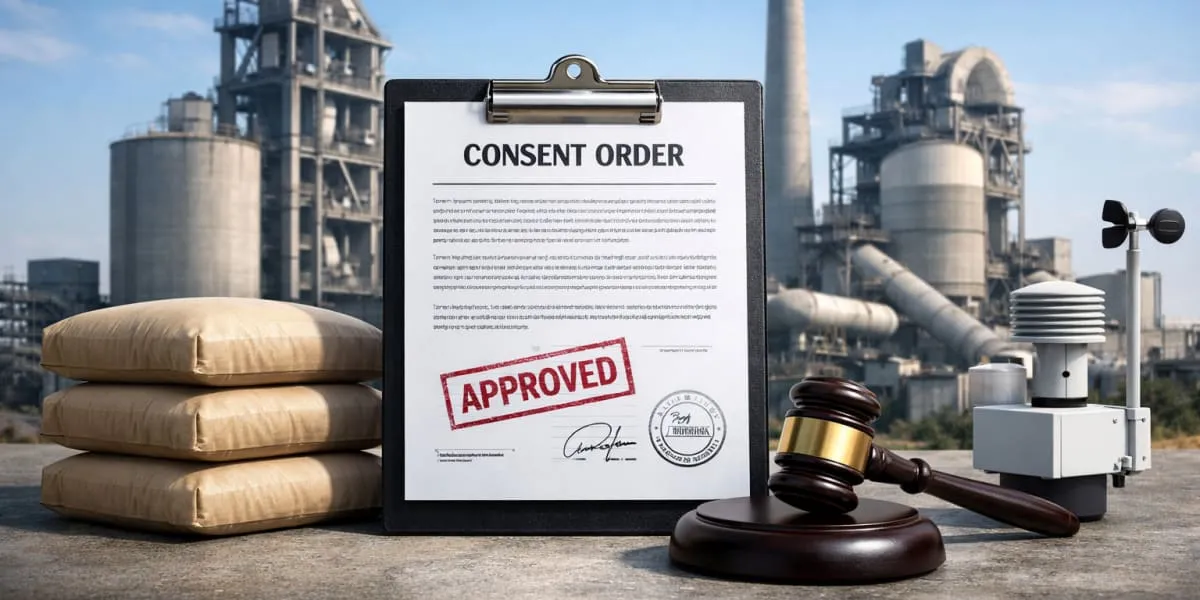
HeidelbergCement India (HeidelbergCement India) has received regulatory consent to establish a cement blending and grinding unit at Village Dongaliya, Tehsil Punasa, District Khandwa in Madhya Pradesh. The consent was granted by the Madhya Pradesh Pollution Control Board under the Water (Prevention & Control of Pollution) Act, 1974 and the Air (Prevention & Control of Pollution) Act, 1981 and is dated 17 May 2026. The company disclosed the development in a filing made under Regulation 30 of the SEBI (Listing Obligations and Disclosure Requirements) Regulations, 2015.

The project plan envisages procurement of long term availability of fly ash and the allotment of land on lease for setting up the unit. The proposed facility is described as a blending and grinding installation which will process cementitious materials sourced from nearby operations and suppliers. Company filings state the measures required to secure raw material logistics and statutory compliance before commencing construction.

The addition of a grinding unit in Khandwa is intended to strengthen regional supply and improve logistical efficiency by reducing haulage distances for finished product. The unit is expected to complement existing capacities in central India and to offer flexibility in product mix through blending operations. The reliance on fly ash as a supplementary cementitious material will necessitate long term supply agreements with thermal power producers and coordination with waste utilisation policies.

The disclosure to the regulator and to the stock exchanges follows standard corporate governance practice and aims to keep investors apprised of capital expenditure initiatives. The company indicated that subsequent permits and clearances would be sought in accordance with applicable environmental and land use rules. The project is presented as part of HeidelbergCement India's broader strategy to optimise capacity distribution and to respond to regional demand dynamics.

"Join industry leaders at RAHSTA Expo, India's premier platform for roads, highways and traffic infrastructure. Register now to explore innovations, network with experts and shape the future of mobility."

HeidelbergCement India (HeidelbergCement India) has received regulatory consent to establish a cement blending and grinding unit at Village Dongaliya, Tehsil Punasa, District Khandwa in Madhya Pradesh. The consent was granted by the Madhya Pradesh Pollution Control Board under the Water (Prevention & Control of Pollution) Act, 1974 and the Air (Prevention & Control of Pollution) Act, 1981 and is dated 17 May 2026. The company disclosed the development in a filing made under Regulation 30 of the SEBI (Listing Obligations and Disclosure Requirements) Regulations, 2015. The project plan envisages procurement of long term availability of fly ash and the allotment of land on lease for setting up the unit. The proposed facility is described as a blending and grinding installation which will process cementitious materials sourced from nearby operations and suppliers. Company filings state the measures required to secure raw material logistics and statutory compliance before commencing construction. The addition of a grinding unit in Khandwa is intended to strengthen regional supply and improve logistical efficiency by reducing haulage distances for finished product. The unit is expected to complement existing capacities in central India and to offer flexibility in product mix through blending operations. The reliance on fly ash as a supplementary cementitious material will necessitate long term supply agreements with thermal power producers and coordination with waste utilisation policies. The disclosure to the regulator and to the stock exchanges follows standard corporate governance practice and aims to keep investors apprised of capital expenditure initiatives. The company indicated that subsequent permits and clearances would be sought in accordance with applicable environmental and land use rules. The project is presented as part of HeidelbergCement India's broader strategy to optimise capacity distribution and to respond to regional demand dynamics.

Next Story
Real Estate

The Workplace Reset

If the past few years have seen sustainability emerge as a buzzword in the design of commercial spaces, the next few years will see the focus shift to ‘experience’. Workplaces that prioritise superior employee experiences consistently report stronger talent attraction and higher retention rates and productivity, while using resources sustainably.First things first; what sort of experiences are expected from a workplace?As Vandana Dhawan Saxena, Founder and Design Principal, Studio IV Designs, explains, “Offices have grown into environments that need to support various kinds of experience..

Next Story
Infrastructure Urban

Designing Human-Centric High-Rises

The Institution of Engineers (India) (IEI), Navi Mumbai Local Centre, under the aegis of the Architectural Engineering Division Board, organised a one-day national seminar, ‘Reaching New Heights – Overcoming High-Rise Construction Challenges’, at CBD Belapur, Navi Mumbai.The seminar brought together architects, engineers, planners, developers, academicians and industry professionals to deliberate on the design, construction, operation and sustainability of tall buildings in rapidly urbanising cities...To read the full article Click Here ..

Next Story
Infrastructure Urban

Carbon-negative and ultra-low carbon are not just claims!

In an interaction with Construction World, Tarun Jami, Founder, GreenJams, explains how the company is cutting cement’s carbon footprint by 80 per cent through Binder, while scaling innovations such as Agrocrete® and Novastone to make buildings lighter, faster and carbon-negative.Agrocrete® is positioned as a carbon-negative material. What does this mean for developers?For developers, Agrocrete® offers a practical way to reduce embodied carbon at the material level. Since walling forms a significant part of a building’s material footprint, using carbon-negative blocks can bring the net ..

Advertisement

Subscribe to Our Newsletter

Get daily newsletters around different themes from Construction world.

STAY CONNECTED

Advertisement

Advertisement

Advertisement