
+
Kerala Opposes Mines And Minerals Amendment Bill
COAL & MINING

Kerala Opposes Mines And Minerals Amendment Bill

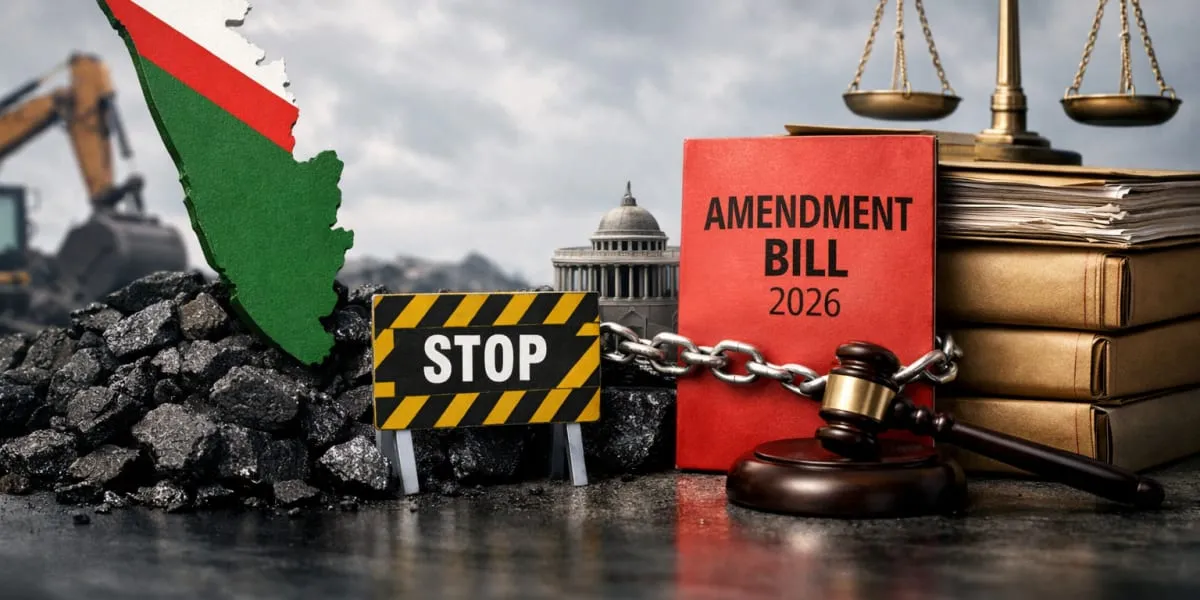
Kerala has strongly opposed the Mines and Minerals (Development and Regulation) Amendment Bill, 2026, which was passed by both Houses of Parliament, arguing that the measure transfers states' rights and authority over land to the jurisdiction of the Union government. The Union government has presented the amendment as a mechanism to ensure uniform mineral rates across the country. Opposition parties in Parliament criticised the legislation for seeking to restrict the powers of states to impose taxes on mineral rights and on mineral-rich lands.

Chief Minister VD Satheesan said after the state cabinet meeting that the legislation encroaches upon powers that belong to the states under the Constitution. He highlighted item 18 of the State List and noted that the right to grant mining leases and to determine non-royalty fees payable to the state has traditionally rested with the state. Satheesan argued that the bill effectively shifts those authorities to the Union.

The amendment defines land as mineral-bearing and does not explicitly exclude forests and coastal areas, a point that the state government described as deeply troubling. Kerala officials warned that treating wide swathes of territory as falling under Union jurisdiction could have implications for land management, environmental safeguards and local governance. The state characterised the move as contrary to federal principles.

Kerala has said it will oppose the legislation and will formally convey its displeasure to the Union government. The state government indicated that it would pursue all available constitutional and political avenues to defend state rights.

The dispute centres on competing claims over land and mineral regulation and will shape debates about centre-state relations and resource governance. Kerala's position underscores the broader tensions that can arise when national reforms intersect with state powers.

Kerala has strongly opposed the Mines and Minerals (Development and Regulation) Amendment Bill, 2026, which was passed by both Houses of Parliament, arguing that the measure transfers states' rights and authority over land to the jurisdiction of the Union government. The Union government has presented the amendment as a mechanism to ensure uniform mineral rates across the country. Opposition parties in Parliament criticised the legislation for seeking to restrict the powers of states to impose taxes on mineral rights and on mineral-rich lands. Chief Minister VD Satheesan said after the state cabinet meeting that the legislation encroaches upon powers that belong to the states under the Constitution. He highlighted item 18 of the State List and noted that the right to grant mining leases and to determine non-royalty fees payable to the state has traditionally rested with the state. Satheesan argued that the bill effectively shifts those authorities to the Union. The amendment defines land as mineral-bearing and does not explicitly exclude forests and coastal areas, a point that the state government described as deeply troubling. Kerala officials warned that treating wide swathes of territory as falling under Union jurisdiction could have implications for land management, environmental safeguards and local governance. The state characterised the move as contrary to federal principles. Kerala has said it will oppose the legislation and will formally convey its displeasure to the Union government. The state government indicated that it would pursue all available constitutional and political avenues to defend state rights. The dispute centres on competing claims over land and mineral regulation and will shape debates about centre-state relations and resource governance. Kerala's position underscores the broader tensions that can arise when national reforms intersect with state powers.

Related Stories

Gold Stories

Next Story
Real Estate

The Energy-Smart Buildings

Passive design is an integral part of energy-efficient architecture. Sophisticated building systems also contribute to this end. But what role do materials play in enhancing a building’s energy-efficiency?“Material selection is one of the earliest opportunities to influence how a building performs,” says Tejbeer Singh, Principal Architect & Founder, Expressionist by Tejbeer Singh. “The objective is not simply to select materials that look appropriate but to understand how they behave within the climate and construction system.”To read the full article Click Here ..

Next Story
Infrastructure Transport

When the Lowest Bid Comes at a Cost

India's infrastructure sector is building at a scale few markets can match. New highways, expressways, metros, bridges and complex engineering projects are transforming the country's landscape. Yet, behind this rapid expansion is a growing concern within the contracting community: Can infrastructure be delivered sustainably when competition pushes prices below commercially viable levels?For Praveen Sethia, Founder & Director, Infra Advisors, who moderated the discussion, the question goes beyond the contractor's commercial interests. Contractors may be one of the two parties to a contract,..

Next Story
Real Estate

Ultra-Luxury Projects Reshape Gurugram’s Housing Market

Gurugram’s luxury housing market has expanded beyond its traditional prime locations, with corridors such as Dwarka Expressway and Golf Course Extension Road emerging as key centres for premium residential development. Larger homes, integrated developments and amenity-led communities are attracting demand from end-users and investors.A 2025 report by Sotheby’s International Realty in collaboration with CRE Matrix identified Gurugram as India’s fastest-growing ultra-luxury housing market. The city overtook Mumbai in total sales value for homes priced above Rs 10 crore, recording nearly Rs..

Advertisement

Subscribe to Our Newsletter

Get daily newsletters around different themes from Construction world.

STAY CONNECTED

Advertisement

SPECIAL OFFER
QR Code