





+
Delhi Signs MoU For Compressed Bio?Gas Plants
OIL & GAS

Delhi Signs MoU For Compressed Bio?Gas Plants

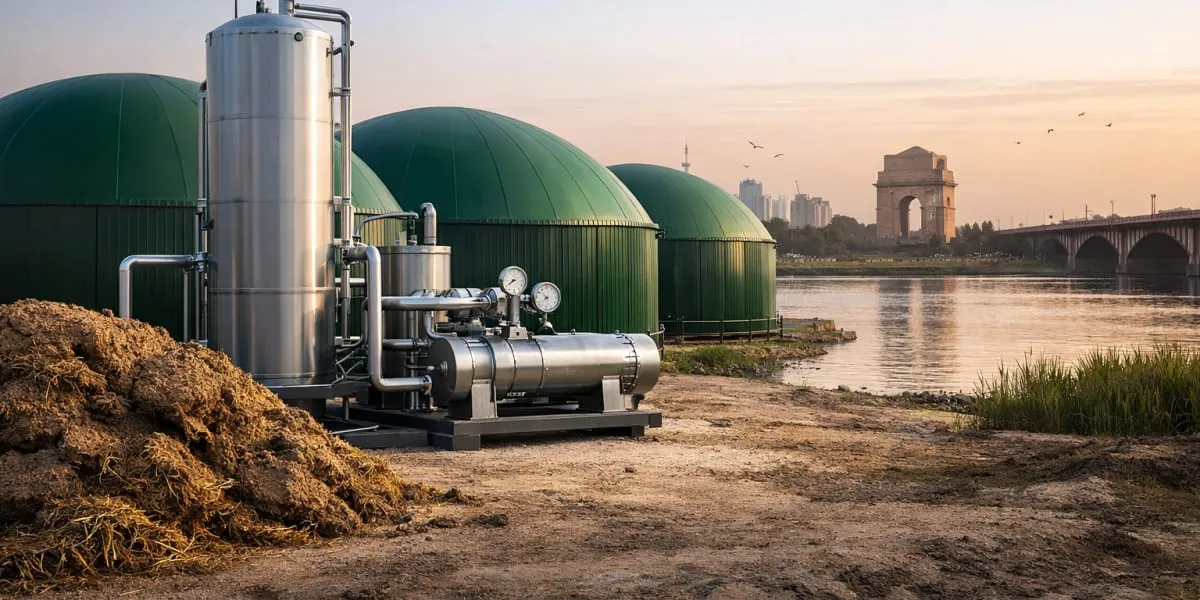
The Municipal Corporation of Delhi and the National Dairy Development Board have signed a memorandum of understanding to establish Compressed Bio?Gas (CBG) plants in the national capital to ensure proper utilisation of cow dung and support river restoration efforts. The pact, endorsed in the presence of Union Home Minister Amit Shah, is intended to aid the government objective of preventing any dirty water from flowing into the Yamuna by December 2028. The initiative is described as aiming simultaneously to improve urban cleanliness, generate Compressed Bio?Gas and give a strong boost to organic farming while increasing the income of livestock farmers.

The agreement includes a provision to pay livestock farmers Rs one per kilogram (kg) of cow dung, and authorities said work has already started on approximately 80 treatment plants for the purification of sewer water and industrial waste. Processing of cow dung will be undertaken at the Nangli, Ghoga?Goyla and Ghazipur waste disposal plants, according to the document accompanying the pact. Officials framed the measure as part of an integrated waste management approach intended to prevent solid and liquid waste from reaching the river system.

The Home Minister indicated that the target of stopping discharge into the Yamuna cannot be realised without an effective system to handle waste generated by zero point one two five million (0.125 mn) cattle in the city, and asserted that by December 2028 the government would ensure that not a single litre of dirty water enters the river. He characterised the agreement as a model for making major cities across the country clean and said the symbolic nature of the initiative was important for urban sanitation. The statement linked cow dung processing explicitly to increased income for livestock farmers and to wider benefits for organic farming.

Senior officials from the central and Delhi governments were present at the signing. Authorities said monitoring and scaling would be central to achieving the planned environmental and economic outcomes.

The Municipal Corporation of Delhi and the National Dairy Development Board have signed a memorandum of understanding to establish Compressed Bio?Gas (CBG) plants in the national capital to ensure proper utilisation of cow dung and support river restoration efforts. The pact, endorsed in the presence of Union Home Minister Amit Shah, is intended to aid the government objective of preventing any dirty water from flowing into the Yamuna by December 2028. The initiative is described as aiming simultaneously to improve urban cleanliness, generate Compressed Bio?Gas and give a strong boost to organic farming while increasing the income of livestock farmers. The agreement includes a provision to pay livestock farmers Rs one per kilogram (kg) of cow dung, and authorities said work has already started on approximately 80 treatment plants for the purification of sewer water and industrial waste. Processing of cow dung will be undertaken at the Nangli, Ghoga?Goyla and Ghazipur waste disposal plants, according to the document accompanying the pact. Officials framed the measure as part of an integrated waste management approach intended to prevent solid and liquid waste from reaching the river system. The Home Minister indicated that the target of stopping discharge into the Yamuna cannot be realised without an effective system to handle waste generated by zero point one two five million (0.125 mn) cattle in the city, and asserted that by December 2028 the government would ensure that not a single litre of dirty water enters the river. He characterised the agreement as a model for making major cities across the country clean and said the symbolic nature of the initiative was important for urban sanitation. The statement linked cow dung processing explicitly to increased income for livestock farmers and to wider benefits for organic farming. Senior officials from the central and Delhi governments were present at the signing. Authorities said monitoring and scaling would be central to achieving the planned environmental and economic outcomes.

Related Stories

Gold Stories
Next Story
Infrastructure Energy

L&T Delivers 110 Modules for Australia’s Largest Urea Plant

Larsen & Toubro (L&T) has completed the fabrication and delivery of 110 modules for Project CERES, Australia’s largest urea manufacturing plant, marking a significant milestone in the execution of the 2.3 MTPA facility. The project is being developed by Perdaman Chemicals & Fertilisers in Karratha, Western Australia, under the Saipem-Clough Joint Venture. L&T’s scope comprised 47 Pre-assembled Units and 63 Pre-assembled Racks, with the modules weighing approximately 64,000 metric tonnes. Fabricated at the company’s Modular Fabrication Facility at Kattupalli near Chennai, the modules wer..

Next Story
Infrastructure Urban

EPFO Wage Ceiling Raised to Rs 25,000 per Month

The Union Cabinet has approved the proposal to increase the wage ceiling for mandatory coverage under the Employees’ Provident Fund Organisation (EPFO) from Rs 15,000 to Rs 25,000 per month. The move is expected to bring over 51 lakh additional employees under the EPFO social security framework.The revised ceiling will extend access to provident fund savings, pension benefits under the Employees’ Pension Scheme (EPS) and insurance coverage under the Employees’ Deposit Linked Insurance Scheme (EDLI) to a wider section of employees earning between Rs 15,000 and Rs 25,000 per month.The EPFO..

Next Story
Infrastructure Transport

Maharashtra to Get Rs 270 Billion Shipbuilding Cluster

Mazagon Dock Shipbuilders Ltd (MDL) will invest around Rs 27,000 crore to develop a greenfield shipbuilding cluster at Dighi Port in Maharashtra’s Raigad district. The project is expected to create nearly 90,000 employment opportunities, according to the state government.MDL has signed a memorandum of understanding (MoU) with National Shipbuilding and Heavy Industries Park Maharashtra Ltd (NSHIPML) for the development of the project in the presence of Maharashtra Chief Minister Devendra Fadnavis.Under the agreement, MDL aims to establish an annual shipbuilding capacity of at least 2 million ..

Advertisement

Subscribe to Our Newsletter

Get daily newsletters around different themes from Construction world.

STAY CONNECTED

Advertisement

SPECIAL OFFER
QR Code












