+
India Records Second Consecutive Month Of Russian Crude Imports
OIL & GAS

India Records Second Consecutive Month Of Russian Crude Imports

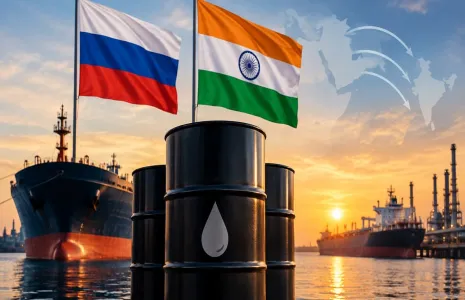
India's imports of Russian crude oil reached a record for the second consecutive month in July, reflecting continued reliance on discounted Russian supplies despite tighter Western sanctions. Indian buyers imported 5.5 billion (bn) euros of Russian crude in July, a rise of 2.1 per cent in volume from June, according to data compiled by the Centre for Research on Energy and Clean Air. Crude made up 87 per cent of India’s total Russian fossil fuel purchases that month.

The trend has accelerated since Russia’s full-scale invasion of Ukraine in February 2022, when sanctions and a retreat by European buyers prompted Moscow to offer deep discounts to Asian refiners. Russia supplied less than 100,000 barrels per day to India in 2021, about 2.5 per cent of its crude imports, rising to 740,000 bpd in 2022 and to nearly 1.8 million (mn) bpd in 2023, when Russia became India’s largest crude supplier with roughly 39 per cent of imports. Imports continued to grow, reaching a record 2.8 mn bpd in July 2026, or about 55.5 per cent of total crude imports of just over 5 mn bpd.

The Centre for Research on Energy and Clean Air reported that India was the second-largest buyer of Russian fossil fuels in July 2026, importing a total of 6.4 bn euros of hydrocarbons, of which crude constituted 5.5 bn euros. The monthly increase in July was driven mainly by higher shipments through smaller terminals rather than Jamnagar and Paradip, with HMEL Mundra volumes up 58 per cent, Vadinar rising 35 per cent and Mumbai up 37 per cent while Paradip fell 22 per cent. The shift in flows meant several other ports more than offset declines at major terminals.

Refineries in India and elsewhere exported a combined 633 million (mn) euros of oil products to sanctioning countries in July, of which CREA estimated 284 mn euros were refined from Russian crude. The data highlights India’s role as a refining and trading hub and the value of continued demand to Russian export revenues.

India's imports of Russian crude oil reached a record for the second consecutive month in July, reflecting continued reliance on discounted Russian supplies despite tighter Western sanctions. Indian buyers imported 5.5 billion (bn) euros of Russian crude in July, a rise of 2.1 per cent in volume from June, according to data compiled by the Centre for Research on Energy and Clean Air. Crude made up 87 per cent of India’s total Russian fossil fuel purchases that month. The trend has accelerated since Russia’s full-scale invasion of Ukraine in February 2022, when sanctions and a retreat by European buyers prompted Moscow to offer deep discounts to Asian refiners. Russia supplied less than 100,000 barrels per day to India in 2021, about 2.5 per cent of its crude imports, rising to 740,000 bpd in 2022 and to nearly 1.8 million (mn) bpd in 2023, when Russia became India’s largest crude supplier with roughly 39 per cent of imports. Imports continued to grow, reaching a record 2.8 mn bpd in July 2026, or about 55.5 per cent of total crude imports of just over 5 mn bpd. The Centre for Research on Energy and Clean Air reported that India was the second-largest buyer of Russian fossil fuels in July 2026, importing a total of 6.4 bn euros of hydrocarbons, of which crude constituted 5.5 bn euros. The monthly increase in July was driven mainly by higher shipments through smaller terminals rather than Jamnagar and Paradip, with HMEL Mundra volumes up 58 per cent, Vadinar rising 35 per cent and Mumbai up 37 per cent while Paradip fell 22 per cent. The shift in flows meant several other ports more than offset declines at major terminals. Refineries in India and elsewhere exported a combined 633 million (mn) euros of oil products to sanctioning countries in July, of which CREA estimated 284 mn euros were refined from Russian crude. The data highlights India’s role as a refining and trading hub and the value of continued demand to Russian export revenues.

Related Stories

Gold Stories

Next Story
Real Estate

Kamdhenu Realities acquires 4-acre Navi Mumbai land parcel

Kamdhenu Realities has acquired a 4-acre land parcel from RPG Life Sciences on Thane-Belapur Road for approximately Rs 1.5 billion, expanding its commercial real estate portfolio in Navi Mumbai.The parcel has a total developable potential of 1.8 million sq ft, on which Kamdhenu plans to develop a destination-scale commercial and lifestyle ecosystem. The proposed development will combine corporate office suites with high-street retail, F&B outlets, double-height lobbies, business infrastructure and lifestyle amenities.Located close to IKEA and opposite the upcoming Pawane Railway Station, t..

Next Story
Infrastructure Transport

97 Per Cent Of Rongjeng-Mangsang-Adokgre Road Nears Completion

Deputy Chief Minister in-charge of public works Prestone Tynsong said in Shillong on 26 August that 97 per cent physical progress had been achieved on the ongoing Rongjeng-Mangsang-Adokgre road being constructed under the Non-Lapsable Central Pool of Resources (NLCPR). He noted the project was sanctioned in 2017 and that the stipulated time for completion had been 24 months from issue of the final work order. The deputy chief minister informed the assembly that the government had decided to include the remaining work under a World Bank project. In reply to a query from Rongjeng MLA Jim M Sangm..

Next Story
Infrastructure Transport

First TBM Starts Digging Five Point Three Kilometre Tunnel Under SGNP

The Goregaon-Mulund Link Road (GMLR) Phase three (B) project has reached a key milestone as the first tunnel boring machine (TBM) began excavation of the first of two tunnels beneath the Sanjay Gandhi National Park (SGNP). The machine, named Tulsi, started cutting a five point three kilometre bore that will link Dadasaheb Phalke Chitranagari in Goregaon East with Amar Nagar in Mulund West. Officials issued a statement noting the commencement of tunnelling work under the protected green belt. The twin tunnels are being constructed using mechanised tunnelling methods that aim to limit surface di..

Advertisement

Subscribe to Our Newsletter

Get daily newsletters around different themes from Construction world.

STAY CONNECTED

Advertisement

SPECIAL OFFER
QR Code