Andhra Pradesh Approves SMR Assessment as Thermal Alternative
POWER & RENEWABLE ENERGY

Andhra Pradesh Approves SMR Assessment as Thermal Alternative

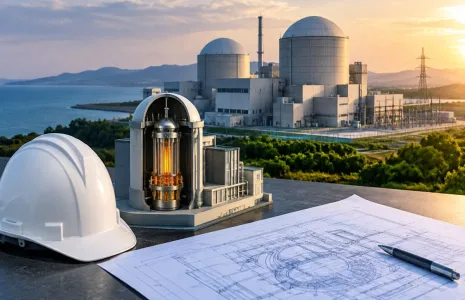
The Andhra Pradesh government has approved an initial assessment of nuclear power based on Small Modular Reactors (SMRs) as a possible alternative to thermal generation. The state will examine whether SMR-based plants can be deployed at thermal power units nearing retirement or at other suitable locations, according to a media report.

The proposal follows a request from Andhra Pradesh Power Generation Corporation (APGENCO) to explore nuclear generation as thermal units are phased out. K Vijayanand, Special Chief Secretary (Energy), indicated that the state would examine the option after SMR technology stabilises. The government has also allowed for private-sector participation in the development of any projects that may emerge from the assessment.

The approval does not represent a decision to construct a specific nuclear plant. It does not establish a project capacity, investment requirement, construction schedule or commissioning date. The next stage will involve assessing technology options, identifying suitable sites and reviewing regulatory, financing and safety requirements before any project can progress beyond exploration.

SMRs generally have a smaller generation capacity and physical footprint than conventional nuclear reactors. Their modular systems can be manufactured and assembled before being transported to a project site, while some designs require less frequent refuelling. These features could allow the state to evaluate whether existing power-generation locations can support a different technology as older thermal units retire.

Private participation could broaden the pool of potential developers and investors if Andhra Pradesh moves from technology assessment to project development. However, no private company, SMR design or location has been identified so far. The assessment will determine whether the technology can provide a practical replacement or supplementary source of generation capacity currently supplied by thermal plants, while also establishing whether existing sites and infrastructure are suitable for future deployment.

The Andhra Pradesh government has approved an initial assessment of nuclear power based on Small Modular Reactors (SMRs) as a possible alternative to thermal generation. The state will examine whether SMR-based plants can be deployed at thermal power units nearing retirement or at other suitable locations, according to a media report. The proposal follows a request from Andhra Pradesh Power Generation Corporation (APGENCO) to explore nuclear generation as thermal units are phased out. K Vijayanand, Special Chief Secretary (Energy), indicated that the state would examine the option after SMR technology stabilises. The government has also allowed for private-sector participation in the development of any projects that may emerge from the assessment. The approval does not represent a decision to construct a specific nuclear plant. It does not establish a project capacity, investment requirement, construction schedule or commissioning date. The next stage will involve assessing technology options, identifying suitable sites and reviewing regulatory, financing and safety requirements before any project can progress beyond exploration. SMRs generally have a smaller generation capacity and physical footprint than conventional nuclear reactors. Their modular systems can be manufactured and assembled before being transported to a project site, while some designs require less frequent refuelling. These features could allow the state to evaluate whether existing power-generation locations can support a different technology as older thermal units retire. Private participation could broaden the pool of potential developers and investors if Andhra Pradesh moves from technology assessment to project development. However, no private company, SMR design or location has been identified so far. The assessment will determine whether the technology can provide a practical replacement or supplementary source of generation capacity currently supplied by thermal plants, while also establishing whether existing sites and infrastructure are suitable for future deployment.

Related Stories

Gold Stories

Next Story
Infrastructure Energy

DMRC Invites Bids for Solar-Linked BESS Power Procurement

Delhi Metro Rail Corporation (DMRC) has invited bids for renewable energy from an Inter-State Transmission System (ISTS)-connected generating plant combining a solar photovoltaic (PV) system with a co-located Battery Energy Storage System (BESS). The procurement will be conducted through competitive bidding followed by an e-reverse auction. The last date for submitting online bids is December 10, 2026, at 3 PM. DMRC will open the technical bids on December 11, 2026, at 3 PM. The opening of financial bids and the e-reverse auction will be scheduled after completion of the technical evaluation. ..

Next Story
Infrastructure Energy

Solar Growth May Slow Beyond FY28 on Awards, Grid Constraints

India’s solar capacity growth could face headwinds beyond FY28 as slower renewable energy project awards, delays in signing power agreements and transmission constraints threaten expansion, according to a report by Yes Securities. Near-term additions remain supported by a construction pipeline exceeding 150 GW and rising rooftop installations, but weaker award activity could affect capacity additions and industry volumes in FY29 and FY30. Solar capacity additions nearly doubled to 44.61 GW in FY26 from 23.83 GW in FY25. Installations remained strong in the first half of FY27, when 21 GW of s..

Next Story
Infrastructure Transport

India’s First High-Speed Rail Service to Begin in 2027

India’s first high-speed rail service will commence in 2027, with the Surat-Vapi section of the Mumbai-Ahmedabad High-Speed Rail corridor scheduled to open first, Railway Minister Ashwini Vaishnaw said. The remaining sections to Mumbai will be opened in phases. Vaishnaw said 456 km of pier work and 371 km of viaduct construction had been completed by September. About 600,000 noise barriers had been installed along a 299 km stretch, while 9,300 overhead equipment masts had been erected across a 206 km viaduct. Four mountain tunnels have been excavated, and 5 km of the 21 km Maharashtra tunnel..

Advertisement

Subscribe to Our Newsletter

Get daily newsletters around different themes from Construction world.

STAY CONNECTED

Advertisement

SPECIAL OFFER
QR Code