Cabinet Approves PM Surya Sarovar Yojana For Floating Solar Projects
POWER & RENEWABLE ENERGY

Cabinet Approves PM Surya Sarovar Yojana For Floating Solar Projects

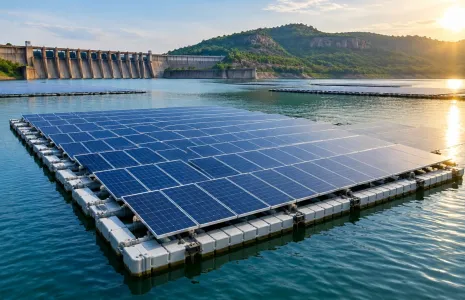
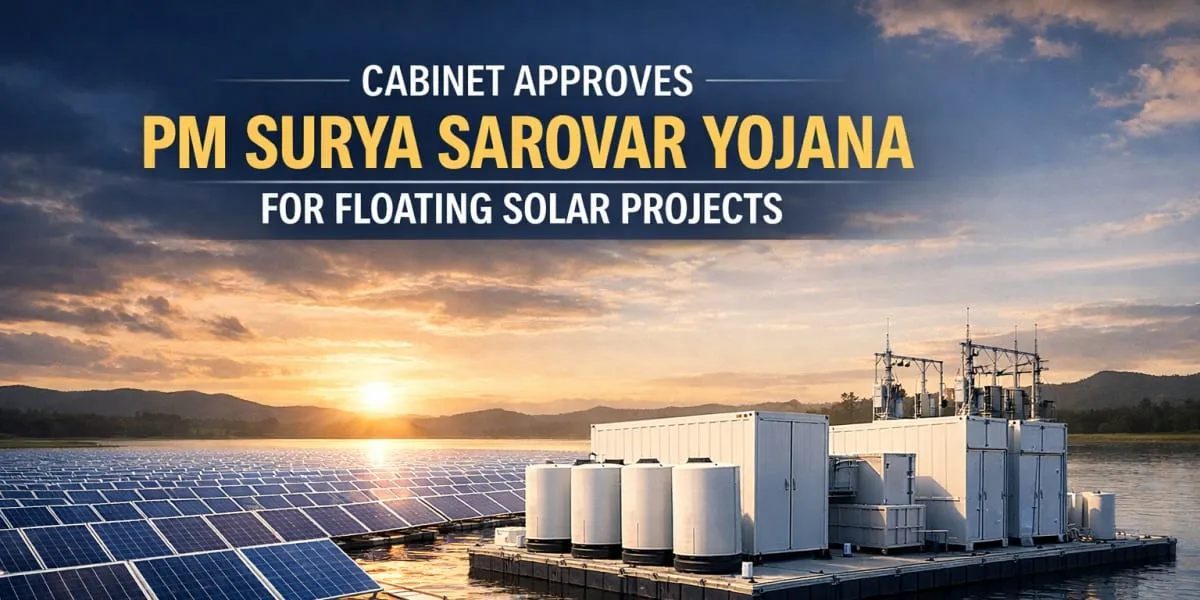
The Union Cabinet approved the Pradhan Mantri Surya Sarovar Yojana for development of floating solar photovoltaic projects with co-located energy storage systems, with a total outlay of Rs 50.7 billion (bn).

The scheme envisages development of 5,000 megawatt (MW) of floating solar photovoltaic projects with co-located energy storage systems having a minimum storage duration of two hours, equivalent to 10,000 MWh. Projects will be sanctioned in the financial years 2026-27 to 2030-31, with disbursement of financial support continuing up to 2032-33.

Central financial assistance will be provided at the rate of Rs 10 million (mn) per megawatt after successful commissioning, and an additional grant of up to Rs 5 million (mn) per project will be available for feasibility studies including bathymetry and hydrography assessments, environmental studies and preparatory activities. The scheme is designed to benefit all states and union territories and aims to expand floating solar capacity from the current roughly 700 MW to the planned target. The approval follows an assessment by the National Institute of Solar Energy on national floating solar potential.

The National Institute of Solar Energy has estimated floating solar potential of approximately 102.18 gigawatt peak across reservoirs and other inland water bodies, which informed the policy design. The programme seeks to make productive use of existing reservoirs and industrial ponds while reducing competition for scarce land resources. Integration of energy storage systems is expected to support grid reliability and flexibility as renewable capacity grows.

Officials estimate the scheme could reduce around 10 million (mn) tonnes (t) of carbon dioxide emissions annually and generate approximately 16,000 to 17,000 full-time equivalent employment opportunities across the project value chain. The programme also aims to promote domestic manufacturing of flotation systems, photovoltaic cells and modules, and energy storage systems in line with the vision of Aatmanirbhar Bharat. It is positioned to contribute to national energy and climate objectives while facilitating optimal utilisation of water resources and advancing the vision of Viksit Bharat.

The Union Cabinet approved the Pradhan Mantri Surya Sarovar Yojana for development of floating solar photovoltaic projects with co-located energy storage systems, with a total outlay of Rs 50.7 billion (bn). The scheme envisages development of 5,000 megawatt (MW) of floating solar photovoltaic projects with co-located energy storage systems having a minimum storage duration of two hours, equivalent to 10,000 MWh. Projects will be sanctioned in the financial years 2026-27 to 2030-31, with disbursement of financial support continuing up to 2032-33. Central financial assistance will be provided at the rate of Rs 10 million (mn) per megawatt after successful commissioning, and an additional grant of up to Rs 5 million (mn) per project will be available for feasibility studies including bathymetry and hydrography assessments, environmental studies and preparatory activities. The scheme is designed to benefit all states and union territories and aims to expand floating solar capacity from the current roughly 700 MW to the planned target. The approval follows an assessment by the National Institute of Solar Energy on national floating solar potential. The National Institute of Solar Energy has estimated floating solar potential of approximately 102.18 gigawatt peak across reservoirs and other inland water bodies, which informed the policy design. The programme seeks to make productive use of existing reservoirs and industrial ponds while reducing competition for scarce land resources. Integration of energy storage systems is expected to support grid reliability and flexibility as renewable capacity grows. Officials estimate the scheme could reduce around 10 million (mn) tonnes (t) of carbon dioxide emissions annually and generate approximately 16,000 to 17,000 full-time equivalent employment opportunities across the project value chain. The programme also aims to promote domestic manufacturing of flotation systems, photovoltaic cells and modules, and energy storage systems in line with the vision of Aatmanirbhar Bharat. It is positioned to contribute to national energy and climate objectives while facilitating optimal utilisation of water resources and advancing the vision of Viksit Bharat.

Related Stories

Gold Stories

Next Story
Infrastructure Urban

NABARD, NaBFID Partner to Fund Rural Infrastructure

The National Bank for Agriculture and Rural Development (NABARD) and the National Bank for Financing Infrastructure and Development (NaBFID) have signed a Memorandum of Understanding (MoU) to collaborate on financing infrastructure projects with significant rural impact.The partnership combines NABARD’s expertise in rural and agricultural infrastructure with NaBFID’s specialised infrastructure financing capabilities. It will focus on joint financing, knowledge sharing and developing financing solutions to improve access to long-term, competitively priced capital for rural infrastructure an..

Next Story
Infrastructure Energy

Advait Energy Wins Rs 1.34 Billion MPPTCL Order

Advait Energy Transitions (AETL) has secured a Rs 1.34 billion turnkey contract from Madhya Pradesh Power Transmission Co. Ltd. (MPPTCL) for the design, manufacturing and supply of Emergency Restoration Systems (ERS) for 400kV, 220kV and 132kV EHV transmission lines.The order, received against Tender No. TR-23/2025 on August 25, 2026, will be executed over 18 months. The contract value, inclusive of taxes, covers the complete ERS along with the required accessories.Emergency Restoration Systems are used to restore transmission infrastructure following disruptions, helping maintain continuity a..

Next Story
Real Estate

Gradiant expands Coimbatore engineering centre

Gradiant has expanded its Global Engineering Center (GEC) in Coimbatore, more than doubling its engineering workforce from approximately 100 to over 200 professionals as it strengthens its global project execution capabilities.The expanded centre will bring together multidisciplinary expertise across process engineering, detailed design and project engineering, enabling the India team to take on greater responsibility for the engineering and design of Gradiant’s international projects.According to Govind Alagappan, COO, Gradiant, Coimbatore’s engineering talent and industrial heritage make..

Advertisement

Subscribe to Our Newsletter

Get daily newsletters around different themes from Construction world.

STAY CONNECTED

Advertisement