Envision Grid-Connects First AI Wind Turbine Prototype for Fortescue
POWER & RENEWABLE ENERGY

Envision Grid-Connects First AI Wind Turbine Prototype for Fortescue

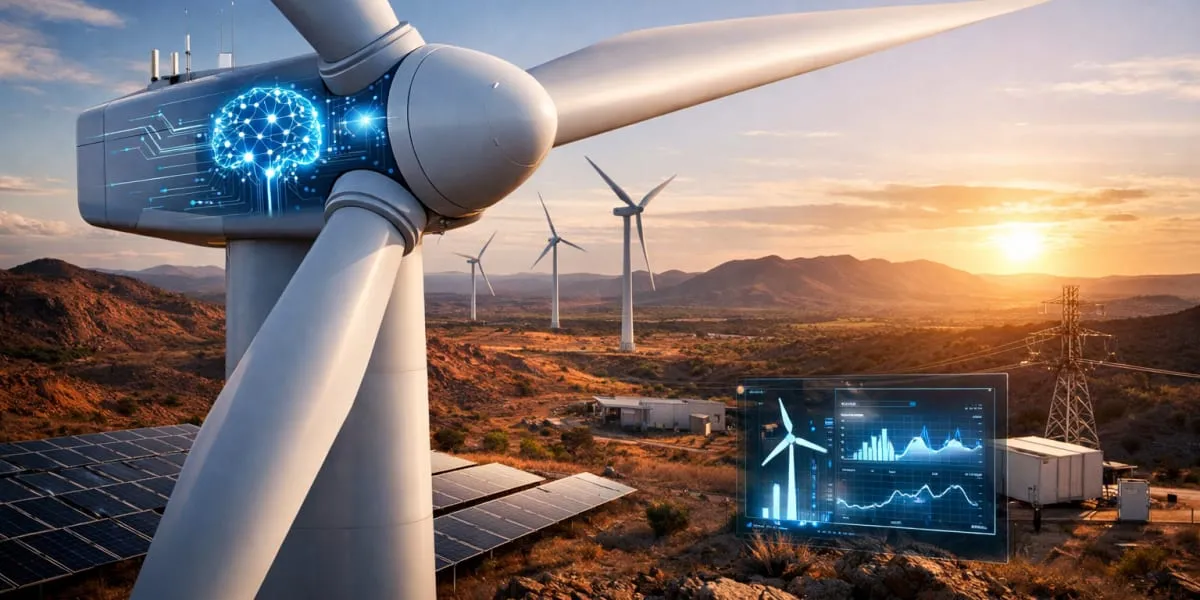
Envision Energy has announced that it has developed its first grid-connected artificial intelligence wind turbine prototype for Fortescue's Nullagine Wind Project in the Pilbara. The prototype supports Fortescue's inaugural operational wind development and marks an expansion of Envision's presence in the Australian renewable energy market through deployment of its Physical AI system for industrial decarbonisation. The company presented the initiative as part of efforts to apply AI to energy systems nationwide.

The project comprises 17 Envision EN182 turbines rated at seven point eight Megawatt (MW) each, engineered for mining and desert environments, local wind regimes and stringent grid requirements. The turbine design integrates Nabrawind's self-erecting tower technology with a hub height of 188 metre, which Envision positioned as a global benchmark for onshore wind and a means to unlock higher energy yield. Local adaptation and robust erection methods were described as central to meeting operational demands in the Pilbara.

At the core of the technology stack is the Dubhe Energy Foundation Model, which Envision described as the world's largest Physical AI system, and which was unveiled by founder and chief executive Lei Zhang at Abu Dhabi Sustainability Week. Dubhe is reported to operate in concert with Envision's Tianji Weather Foundation Model to analyse real-world energy data streams and to orchestrate renewable generation, energy storage, grid operations and electricity demand in real time. Envision asserted that the models enable renewable resources to be harnessed while driving system costs toward near-zero marginal levels.

The company noted that AI adoption across wind operations and maintenance has accelerated, with techniques such as machine learning, deep learning, digital twins and SCADA-based predictive analytics used to reduce unplanned downtime, extend component life and improve energy output. Envision's international product line president characterised the grid connection as validation of the Physical AI approach and a scalable blueprint for industrial decarbonisation. Fortescue's chief executive highlighted that the Nullagine Wind Project will integrate with Pilbara Energy Connect to balance daytime solar with night-time and seasonal wind generation and to displace diesel and gas across haul fleets and processing sites.

Envision Energy has announced that it has developed its first grid-connected artificial intelligence wind turbine prototype for Fortescue's Nullagine Wind Project in the Pilbara. The prototype supports Fortescue's inaugural operational wind development and marks an expansion of Envision's presence in the Australian renewable energy market through deployment of its Physical AI system for industrial decarbonisation. The company presented the initiative as part of efforts to apply AI to energy systems nationwide. The project comprises 17 Envision EN182 turbines rated at seven point eight Megawatt (MW) each, engineered for mining and desert environments, local wind regimes and stringent grid requirements. The turbine design integrates Nabrawind's self-erecting tower technology with a hub height of 188 metre, which Envision positioned as a global benchmark for onshore wind and a means to unlock higher energy yield. Local adaptation and robust erection methods were described as central to meeting operational demands in the Pilbara. At the core of the technology stack is the Dubhe Energy Foundation Model, which Envision described as the world's largest Physical AI system, and which was unveiled by founder and chief executive Lei Zhang at Abu Dhabi Sustainability Week. Dubhe is reported to operate in concert with Envision's Tianji Weather Foundation Model to analyse real-world energy data streams and to orchestrate renewable generation, energy storage, grid operations and electricity demand in real time. Envision asserted that the models enable renewable resources to be harnessed while driving system costs toward near-zero marginal levels. The company noted that AI adoption across wind operations and maintenance has accelerated, with techniques such as machine learning, deep learning, digital twins and SCADA-based predictive analytics used to reduce unplanned downtime, extend component life and improve energy output. Envision's international product line president characterised the grid connection as validation of the Physical AI approach and a scalable blueprint for industrial decarbonisation. Fortescue's chief executive highlighted that the Nullagine Wind Project will integrate with Pilbara Energy Connect to balance daytime solar with night-time and seasonal wind generation and to displace diesel and gas across haul fleets and processing sites.

Related Stories

Gold Stories

Next Story
Resources

Schindler named among Forbes’ World’s Best Employers 2026

Schindler has been named among Forbes’ World’s Best Employers 2026, a global ranking recognising companies for their workplace environments.Compiled by Forbes in partnership with Statista, the ranking is based on independent employee feedback, including whether employees would recommend their organisation to friends and family.The company said the recognition reflected its focus on creating a workplace where employees can develop their expertise and build careers. ..

Next Story
Infrastructure Urban

India needs an export-execution mindset: Vishesh Jain

Interview with Vishesh Jain, Founder & CEO, EximpleWhat gaps in India’s global trade ecosystem led you to build Eximple, and what problem did you see businesses struggling with most?Eximple came out of a problem that all three founders had seen from different choke points in the trade ecosystem. India has millions of MSMEs and manufacturers, and many of them can make products that are genuinely competitive on quality. Yet only a small fraction is able to build meaningful international businesses. In our experience, the gap is usually not manufacturing capability; it is the ability to exe..

Next Story
Building Material

Nuvoco reports 13.5% revenue growth in Q2 FY27

Nuvoco Vistas Corp. Ltd. reported consolidated revenue of Rs 27.9 billion for Q2 FY27, up 13.5% year on year. Cement sales volume rose 9% to 4.7 million tonnes (MMT), while EBITDA increased 11% to Rs 4.11 billion.The company said it began its cement operations in 2014 with a 2.3 MMT per annum (MMTPA) operation at Nimbol. It now aims to reach 35 MMTPA of cement capacity by FY28, nearly 15 times its initial capacity. Its portfolio spans cement, ready-mix concrete and modern building materials.On sustainability and cost efficiency, Nuvoco partnered with CleanMax for a 46.4 MW wind-solar hybrid re..

Advertisement

Subscribe to Our Newsletter

Get daily newsletters around different themes from Construction world.

STAY CONNECTED

Advertisement

SPECIAL OFFER
QR Code