India Accelerates Clean Energy Transition With Indigenous Technologies
POWER & RENEWABLE ENERGY

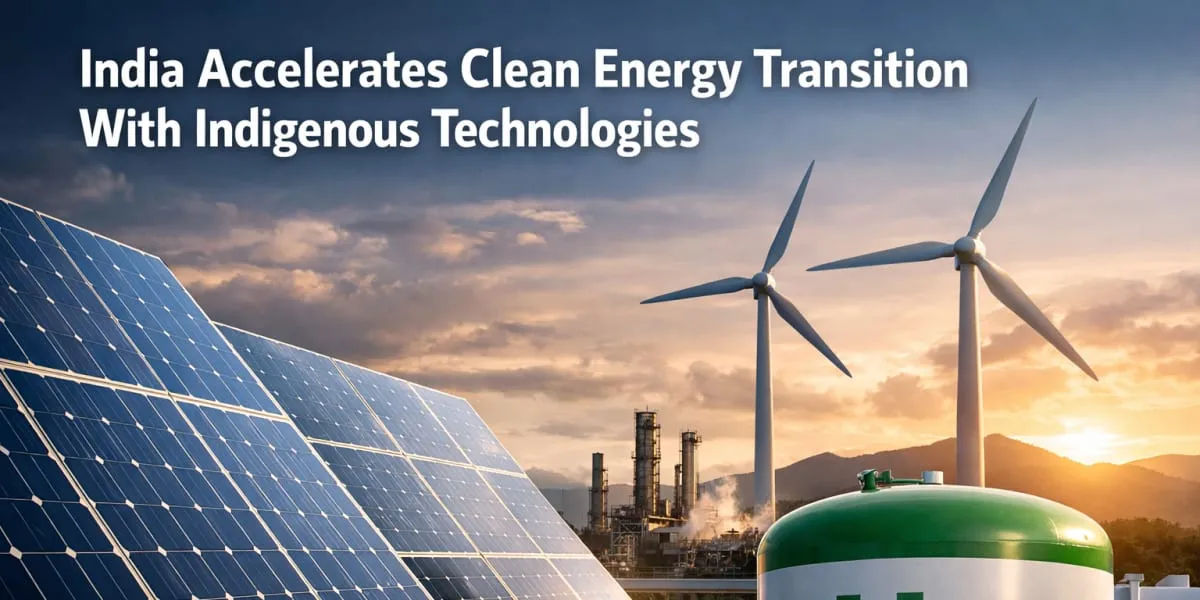
India Accelerates Clean Energy Transition With Indigenous Technologies

At the Planet C3 Summit on Climate, Circularity and Community the minister said India’s clean energy transition is a national strategy to reduce import dependence, strengthen indigenous capacities and position the country to lead the global shift towards a greener future. He outlined an agenda covering resource security, domestic manufacturing and policy reform to accelerate innovation and ensure time-bound delivery. The approach aims to scale existing initiatives while launching new measures to meet rising demand across strategic sectors.

The minister highlighted demand for critical materials such as lithium and rare earth permanent magnets driven by electric mobility, renewable energy, electronics, space and defence. He noted that much of the requirement is met through imports and domestic capacity must be expanded rapidly to avoid shortfalls. He cited the first indigenous permanent magnet plant in Visakhapatnam and a dedicated rare earth magnet policy to strengthen supply chains.

He stressed that energy security is central to technological growth, particularly for sectors enabled by Artificial Intelligence (AI) that require reliable continuous power. The Nuclear Energy Mission was described as a key pillar intended to increase nuclear capacity by 2047 through phased expansion and wider participation from public and private stakeholders. The collaborative model between government and industry was presented as gaining momentum to accelerate progress in critical areas.

The government has adopted a mission-mode framework linking the National Green Hydrogen Mission, India AI Mission, the National Quantum Mission and biotechnology programmes as parts of a broader strategy. This was supported by increased public investment in research, a dedicated corpus and institutional mechanisms such as the National Research Foundation (NRF) to strengthen the research ecosystem. Structured interfaces between industry, academia and government are being promoted to align research with market needs and scale technologies, with startups and women-led enterprises noted as important contributors. The minister emphasised that urgency and coordination are required so self-reliance combined with global engagement advances national priorities and global sustainability goals.

At the Planet C3 Summit on Climate, Circularity and Community the minister said India’s clean energy transition is a national strategy to reduce import dependence, strengthen indigenous capacities and position the country to lead the global shift towards a greener future. He outlined an agenda covering resource security, domestic manufacturing and policy reform to accelerate innovation and ensure time-bound delivery. The approach aims to scale existing initiatives while launching new measures to meet rising demand across strategic sectors. The minister highlighted demand for critical materials such as lithium and rare earth permanent magnets driven by electric mobility, renewable energy, electronics, space and defence. He noted that much of the requirement is met through imports and domestic capacity must be expanded rapidly to avoid shortfalls. He cited the first indigenous permanent magnet plant in Visakhapatnam and a dedicated rare earth magnet policy to strengthen supply chains. He stressed that energy security is central to technological growth, particularly for sectors enabled by Artificial Intelligence (AI) that require reliable continuous power. The Nuclear Energy Mission was described as a key pillar intended to increase nuclear capacity by 2047 through phased expansion and wider participation from public and private stakeholders. The collaborative model between government and industry was presented as gaining momentum to accelerate progress in critical areas. The government has adopted a mission-mode framework linking the National Green Hydrogen Mission, India AI Mission, the National Quantum Mission and biotechnology programmes as parts of a broader strategy. This was supported by increased public investment in research, a dedicated corpus and institutional mechanisms such as the National Research Foundation (NRF) to strengthen the research ecosystem. Structured interfaces between industry, academia and government are being promoted to align research with market needs and scale technologies, with startups and women-led enterprises noted as important contributors. The minister emphasised that urgency and coordination are required so self-reliance combined with global engagement advances national priorities and global sustainability goals.

Next Story
Real Estate

North India Leads Green Building Growth Surge

North India has emerged as a major hub for green building development, with 2,475 projects spanning 2.81 billion sq ft across the National Capital Region (NCR), as highlighted at the IGBC GreenTech Summit 2026 held in New Delhi.Organised by the CII Indian Green Building Council, the summit brought together policymakers, industry leaders and technology experts to accelerate the adoption of climate technologies in the built environment.Uttar Pradesh ranked second nationally with 1,673 IGBC-registered projects covering 1.78 billion sq ft, while Delhi accounted for 794 projects spanning 0.63 billi..

Next Story
Real Estate

Yamuna Expressway Property Prices Jump Sharply in Five Years

The Yamuna Expressway has emerged as one of NCR’s strongest real estate corridors, with sharp price appreciation across both apartments and plots between 2020 and 2025, according to the latest ‘RealX Stats’ report by InvestoXpert Advisors.The report states that average apartment prices along the corridor increased from Rs 3,950 per sq ft in 2020 to Rs 10,200 per sq ft in 2025, reflecting an overall appreciation of 158.2 per cent. In 2025 alone, apartment prices rose 7.37 per cent year on year, indicating sustained end-user demand and continued investor interest.Plots and land parcels rec..

Next Story
Real Estate

Homeland, VRC Acquire Mohali Land for Mixed-Use Projects

Homeland Group, in collaboration with VRC, has acquired two prime mixed land-use parcels in Mohali through a GMADA e-auction, marking some of the highest bids recorded for such developments. A 5.5-acre parcel near the Chandigarh border was acquired at approximately Rs 700 million per acre, generating around Rs 4 billion for the Greater Mohali Area Development Authority. Additionally, a 13-acre site in Sector 62 was secured at about Rs 470 million per acre, with the total deal value exceeding Rs 6 billion. The projects will be developed jointly, featuring premium residential apartments integr..

Advertisement

Subscribe to Our Newsletter

Get daily newsletters around different themes from Construction world.

STAY CONNECTED

Advertisement

Advertisement

Advertisement