IWTMA Flags State Bottlenecks To 10 GW Annual Wind Growth
POWER & RENEWABLE ENERGY

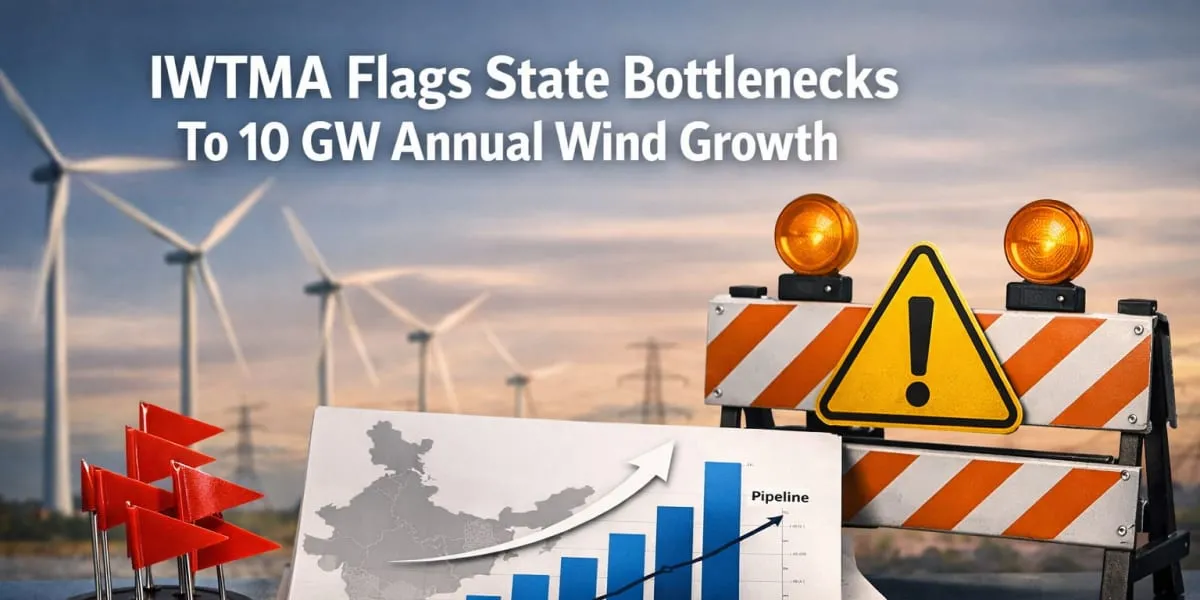
IWTMA Flags State Bottlenecks To 10 GW Annual Wind Growth

The Indian Wind Turbine Manufacturers Association released a report identifying state-level bottlenecks to reaching the country’s 10 gigawatt (GW) annual wind capacity target. The study notes a 43 GW pipeline under construction, 25.8 GW awarded during FY2023-25 and seven point six GW awarded in FY2025-26. It records six point one GW of new capacity in FY2025-26 and places cumulative installed capacity at 55 GW as of March 2026. Meeting the 100 GW objective by 2030 requires sustaining roughly 10 GW of annual installations.

The report singles out transmission readiness and connectivity allocation, land acquisition and Right of Way, regulatory approvals and timely execution of power sale agreements as principal state-level constraints. It says aligning regulations and approval processes can reduce timelines, cut transaction costs and strengthen investor confidence. Recommendations include clearer substation-level evacuation data and five-year rolling transmission plans.

The study evaluates eight major wind-producing and emerging states across nine lifecycle areas under two frameworks: Demand Enablement and Project Execution and Clearance. Demand Enablement covers demand assessment, grid planning, utility allocation and renewable purchase obligation implementation plus commercial and industrial open access. Project Execution and Clearance addresses project registration, land allotment, grid connectivity, Right of Way and commissioning.

Gujarat ranks highest under Demand Enablement while Maharashtra records best-practice performance across 12 parameters under Project Execution and Clearance, with Gujarat next on 11 parameters. The report highlights digital single-window registration, time-bound land-use conversion and online grid-connectivity applications as measures that reduce development friction. It proposes Green Energy Open Access approvals within 15 days and connectivity grants within 30 days where feasible.

The study notes central and state agencies plan more than 152 GW of transmission evacuation infrastructure by 2030 and says coordinated implementation can help convert the project pipeline into commissioned capacity. It presents the findings as a practical reference for policymakers, regulators, state agencies, developers and investors and urges replication of proven state-level practices to establish a predictable framework that can sustain 10 GW of annual wind additions.

The Indian Wind Turbine Manufacturers Association released a report identifying state-level bottlenecks to reaching the country’s 10 gigawatt (GW) annual wind capacity target. The study notes a 43 GW pipeline under construction, 25.8 GW awarded during FY2023-25 and seven point six GW awarded in FY2025-26. It records six point one GW of new capacity in FY2025-26 and places cumulative installed capacity at 55 GW as of March 2026. Meeting the 100 GW objective by 2030 requires sustaining roughly 10 GW of annual installations. The report singles out transmission readiness and connectivity allocation, land acquisition and Right of Way, regulatory approvals and timely execution of power sale agreements as principal state-level constraints. It says aligning regulations and approval processes can reduce timelines, cut transaction costs and strengthen investor confidence. Recommendations include clearer substation-level evacuation data and five-year rolling transmission plans. The study evaluates eight major wind-producing and emerging states across nine lifecycle areas under two frameworks: Demand Enablement and Project Execution and Clearance. Demand Enablement covers demand assessment, grid planning, utility allocation and renewable purchase obligation implementation plus commercial and industrial open access. Project Execution and Clearance addresses project registration, land allotment, grid connectivity, Right of Way and commissioning. Gujarat ranks highest under Demand Enablement while Maharashtra records best-practice performance across 12 parameters under Project Execution and Clearance, with Gujarat next on 11 parameters. The report highlights digital single-window registration, time-bound land-use conversion and online grid-connectivity applications as measures that reduce development friction. It proposes Green Energy Open Access approvals within 15 days and connectivity grants within 30 days where feasible. The study notes central and state agencies plan more than 152 GW of transmission evacuation infrastructure by 2030 and says coordinated implementation can help convert the project pipeline into commissioned capacity. It presents the findings as a practical reference for policymakers, regulators, state agencies, developers and investors and urges replication of proven state-level practices to establish a predictable framework that can sustain 10 GW of annual wind additions.

Related Stories

Gold Stories

Next Story
Infrastructure Urban

Bengaluru Metro Awards Rs 554.8 mn Travellator Contract

Bengaluru Metro Rail Corporation (BMRCL) has awarded a Rs 55.48 crore (Rs 554.8 million (mn)) contract to Milan Road Buildtech LLP for civil and structural works to install a travellator and a connecting walkway at Central Silk Board. The contract covers design, construction and structural interfaces required to link the two adjacent metro stations. BMRCL authorised the award as part of procurement for infrastructure works on the Phase-2A project. The procurement followed BMRCL's standard tendering and evaluation procedures. The project will connect the Yellow Line Central Silk Board station w..

Next Story
Infrastructure Transport

GMRC Floats Tenders For Ahmedabad Metro RRTS Hybrid Corridors

Gujarat Metro Rail Corporation (GMRC) has floated three tenders for design consultancy services for the Ahmedabad Metro Phase three Metro cum Regional Rapid Transit System (RRTS) hybrid corridor. The procurements cover work on an additional network of 48.38 kilometre (km) to be integrated into the existing metro system. GMRC framed the tenders to secure specialised consultancy for alignment design, systems integration and coordination with RRTS planning. The consultancy scope will support detailed design and interface management for the hybrid corridors. The proposed hybrid routes include Vaki..

Next Story
Infrastructure Transport

Pune Metro Groundwork Starts on Swargate Katraj Underground Line

Construction work has begun on Pune Metro’s underground extension from Swargate to Katraj, with excavation starting at the busy Market Yard station. MLA Madhuri Misal inaugurated the excavation and inspected activities along the corridor. Maha Metro has commenced digging shafts to lower Tunnel Boring Machines (TBMs) into the ground and intends to deploy four TBMs gradually over the next few months. Station building and tunnelling will proceed simultaneously to streamline the schedule. Because the entire line is underground, authorities expect traffic disruption to be minimal and road space w..

Advertisement

Subscribe to Our Newsletter

Get daily newsletters around different themes from Construction world.

STAY CONNECTED

Advertisement