JSW Energy Commissions Wind Blade Plant In Gujarat
POWER & RENEWABLE ENERGY

JSW Energy Commissions Wind Blade Plant In Gujarat

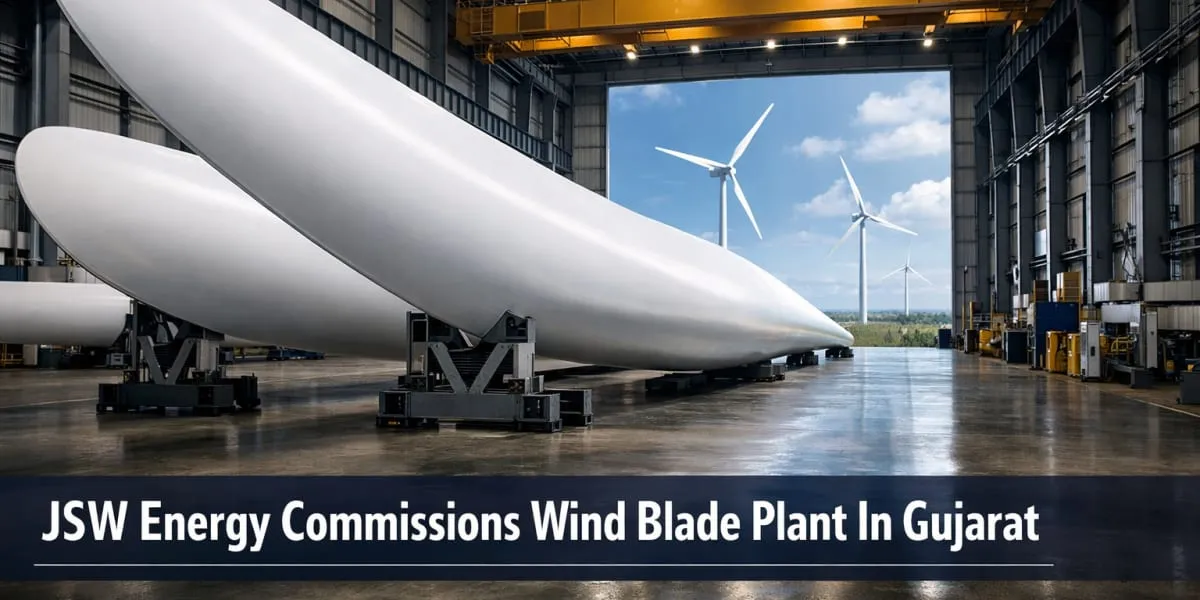
JSW Energy has commissioned a wind blade manufacturing plant in Halol, Gujarat, expanding its presence in wind energy manufacturing and strengthening the domestic supply chain. The facility has the capacity to produce 450 blades annually, sufficient to support around 600 MW of wind power projects each year. The development aligns with the Ministry of New and Renewable Energy drive to boost domestic manufacturing and local content in the renewable sector.

The plant will produce 82-metre-long blades designed for four MW wind turbine generators to meet rising demand for larger, more efficient turbines. JSW Energy is progressing with a second facility at Chitradurga in Karnataka that is in advanced stages of commissioning. Bringing blade manufacturing in-house is expected to reduce transport and procurement costs and to give the company greater control over project execution.

The company indicated the move should lower capital expenditure on future wind projects and reduce exposure to raw material price volatility, thereby improving project returns. The new facility is expected to support an expanding project pipeline and to provide a more reliable supply of turbine blades as execution accelerates. The company currently operates three point nine GW of installed wind capacity and has a pipeline that includes six point five GW of locked-in hybrid projects and two point four GW of standalone wind projects.

Across its portfolio JSW Energy reports a total locked-in generation capacity of 32.1 GW, comprising 13.7 GW of operational assets and 13.8 GW under construction, with a development pipeline of four point six GW. The group has secured 29.6 GWh of energy storage capacity, including 26.4 GWh of pumped hydro storage and three point two GWh of battery energy storage. JSW Energy has set targets of reaching 30 GW of power generation capacity and 40 GWh of energy storage by 2030 and has committed to carbon neutrality by 2050.

JSW Energy has commissioned a wind blade manufacturing plant in Halol, Gujarat, expanding its presence in wind energy manufacturing and strengthening the domestic supply chain. The facility has the capacity to produce 450 blades annually, sufficient to support around 600 MW of wind power projects each year. The development aligns with the Ministry of New and Renewable Energy drive to boost domestic manufacturing and local content in the renewable sector. The plant will produce 82-metre-long blades designed for four MW wind turbine generators to meet rising demand for larger, more efficient turbines. JSW Energy is progressing with a second facility at Chitradurga in Karnataka that is in advanced stages of commissioning. Bringing blade manufacturing in-house is expected to reduce transport and procurement costs and to give the company greater control over project execution. The company indicated the move should lower capital expenditure on future wind projects and reduce exposure to raw material price volatility, thereby improving project returns. The new facility is expected to support an expanding project pipeline and to provide a more reliable supply of turbine blades as execution accelerates. The company currently operates three point nine GW of installed wind capacity and has a pipeline that includes six point five GW of locked-in hybrid projects and two point four GW of standalone wind projects. Across its portfolio JSW Energy reports a total locked-in generation capacity of 32.1 GW, comprising 13.7 GW of operational assets and 13.8 GW under construction, with a development pipeline of four point six GW. The group has secured 29.6 GWh of energy storage capacity, including 26.4 GWh of pumped hydro storage and three point two GWh of battery energy storage. JSW Energy has set targets of reaching 30 GW of power generation capacity and 40 GWh of energy storage by 2030 and has committed to carbon neutrality by 2050.

Related Stories

Gold Stories

Next Story
Resources

Schindler named among Forbes’ World’s Best Employers 2026

Schindler has been named among Forbes’ World’s Best Employers 2026, a global ranking recognising companies for their workplace environments.Compiled by Forbes in partnership with Statista, the ranking is based on independent employee feedback, including whether employees would recommend their organisation to friends and family.The company said the recognition reflected its focus on creating a workplace where employees can develop their expertise and build careers. ..

Next Story
Infrastructure Urban

India needs an export-execution mindset: Vishesh Jain

Interview with Vishesh Jain, Founder & CEO, EximpleWhat gaps in India’s global trade ecosystem led you to build Eximple, and what problem did you see businesses struggling with most?Eximple came out of a problem that all three founders had seen from different choke points in the trade ecosystem. India has millions of MSMEs and manufacturers, and many of them can make products that are genuinely competitive on quality. Yet only a small fraction is able to build meaningful international businesses. In our experience, the gap is usually not manufacturing capability; it is the ability to exe..

Next Story
Building Material

Nuvoco reports 13.5% revenue growth in Q2 FY27

Nuvoco Vistas Corp. Ltd. reported consolidated revenue of Rs 27.9 billion for Q2 FY27, up 13.5% year on year. Cement sales volume rose 9% to 4.7 million tonnes (MMT), while EBITDA increased 11% to Rs 4.11 billion.The company said it began its cement operations in 2014 with a 2.3 MMT per annum (MMTPA) operation at Nimbol. It now aims to reach 35 MMTPA of cement capacity by FY28, nearly 15 times its initial capacity. Its portfolio spans cement, ready-mix concrete and modern building materials.On sustainability and cost efficiency, Nuvoco partnered with CleanMax for a 46.4 MW wind-solar hybrid re..

Advertisement

Subscribe to Our Newsletter

Get daily newsletters around different themes from Construction world.

STAY CONNECTED

Advertisement

SPECIAL OFFER
QR Code