Karnal Plans 20 MW Hybrid Renewable Plant At Indri Drain
POWER & RENEWABLE ENERGY

Karnal Plans 20 MW Hybrid Renewable Plant At Indri Drain

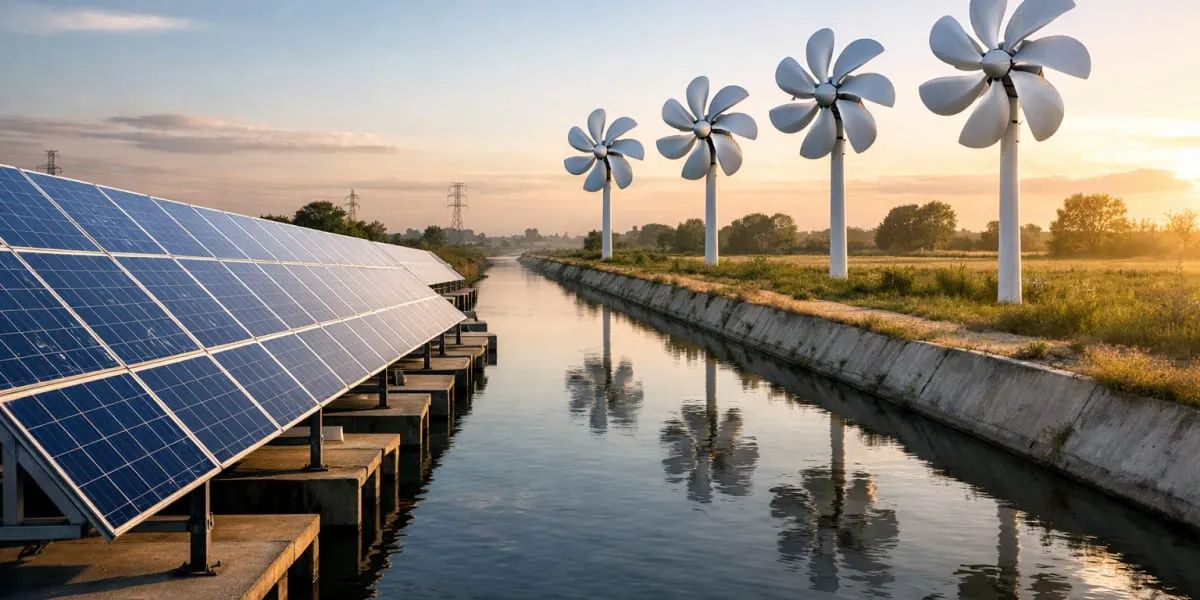
Karnal Municipal Corporation is planning a 20-megawatt (MW) hybrid renewable energy plant along the Indri Escape drain under the Urban Challenge Fund. The system will combine a 15 MW solar facility and five MW flower-shaped wind turbines to create a hybrid supply capable of meeting a substantial share of municipal electricity demand. The commissioner and technical experts visited the site to evaluate feasibility and options for integrating generation with drainage infrastructure.

The scheme is proposed on about 25 acres alongside the drain and will reuse underutilised municipal land while addressing pollution and appearance concerns. The plan envisages channelising the drain to improve water flow, constructing a pillar-based platform to support solar panels without obstructing drainage and landscaping the surrounding area with greenery and open public spaces. Improved access roads are to be provided to enable construction and maintenance. The landscaping is intended to provide pedestrian promenades and informal recreation areas while preserving maintenance clearances.

Electricity produced by the plant is intended to power 182 municipal tubewells, six sewage treatment plants (STPs), boosting centres and disposal pumping stations, reducing dependence on conventional supply. Current annual electricity expenditure is around Rs 20 crore, which converts to Rs 200 million (Rs 200 mn) and the corporation expects the project to substantially cut this outlay. A detailed project report will be prepared and approvals will be sought under the Urban Challenge Fund before execution. Savings on grid purchases are projected to improve budgetary flexibility for other municipal services.

The capital cost is estimated at Rs 110 crore, equivalent to Rs 1.1 billion (Rs 1.1 bn), subject to final DPR figures and sanctioning procedures. Officials emphasise that the initiative aims to transform a neglected stretch into a productive municipal asset while advancing clean energy and self-reliance in power supply. The DPR will assess technical and financial feasibility, operation and maintenance arrangements and projected lifecycle savings. Implementation timelines will depend on funding approvals, technical studies and contractor selection.

Karnal Municipal Corporation is planning a 20-megawatt (MW) hybrid renewable energy plant along the Indri Escape drain under the Urban Challenge Fund. The system will combine a 15 MW solar facility and five MW flower-shaped wind turbines to create a hybrid supply capable of meeting a substantial share of municipal electricity demand. The commissioner and technical experts visited the site to evaluate feasibility and options for integrating generation with drainage infrastructure. The scheme is proposed on about 25 acres alongside the drain and will reuse underutilised municipal land while addressing pollution and appearance concerns. The plan envisages channelising the drain to improve water flow, constructing a pillar-based platform to support solar panels without obstructing drainage and landscaping the surrounding area with greenery and open public spaces. Improved access roads are to be provided to enable construction and maintenance. The landscaping is intended to provide pedestrian promenades and informal recreation areas while preserving maintenance clearances. Electricity produced by the plant is intended to power 182 municipal tubewells, six sewage treatment plants (STPs), boosting centres and disposal pumping stations, reducing dependence on conventional supply. Current annual electricity expenditure is around Rs 20 crore, which converts to Rs 200 million (Rs 200 mn) and the corporation expects the project to substantially cut this outlay. A detailed project report will be prepared and approvals will be sought under the Urban Challenge Fund before execution. Savings on grid purchases are projected to improve budgetary flexibility for other municipal services. The capital cost is estimated at Rs 110 crore, equivalent to Rs 1.1 billion (Rs 1.1 bn), subject to final DPR figures and sanctioning procedures. Officials emphasise that the initiative aims to transform a neglected stretch into a productive municipal asset while advancing clean energy and self-reliance in power supply. The DPR will assess technical and financial feasibility, operation and maintenance arrangements and projected lifecycle savings. Implementation timelines will depend on funding approvals, technical studies and contractor selection.

Next Story
Infrastructure Urban

Centre Clears Power Distribution Upgrade for Uttar Pradesh

The Central Government has approved power distribution projects worth Rs 407.39 billion for Uttar Pradesh under the Revamped Distribution Sector Scheme (RDSS). The investment will be used to modernise the state's electricity distribution infrastructure and strengthen network capacity across urban and rural areas. The package targets one of the country's largest distribution networks as the state experiences rapid urbanisation and rising electricity consumption. Planned interventions include the strengthening of distribution lines, modernisation of substations, replacement of ageing electrical ..

Next Story
Infrastructure Energy

India Data Centres To Consume 191 TWh By 2040 Driving Renewables

A Wood Mackenzie report says India's operational data centre capacity is projected to increase more than fivefold to 12 gigawatt (GW) by 2030 from 2.2 GW in 2025 as artificial intelligence (AI) and cloud computing drive demand. It projects electricity consumption to rise from 10 terawatt-hour (TWh) in 2025 to 191 TWh by 2040. The study forecasts a compound annual growth rate of around 40 per cent and notes AI-dedicated capacity will surge nearly 24-fold from 275 megawatt (MW) in 2025 to 6,546 MW by 2030. The report places India's digital economy at Rs 32 trillion (tn) in 2025 and says it contr..

Next Story
Infrastructure Transport

Hydrogen Train Completes 1,200 Kilometres Of Trials

India's first hydrogen train was flagged off between Jind and Sonipat on July 17 and has travelled over 1,200 kilometres in trials, saving diesel consumption of more than 3,200 litres, a Railway Ministry press release said. The deployment marks the introduction of a zero-emission fuel cell train into route testing and represents a milestone in domestic rail innovation. The train generates electricity onboard through a chemical reaction between hydrogen and oxygen, producing electricity to propel the vehicle while emitting only water vapour as a by-product. There is no smoke and no tailpipe car..

Advertisement

Subscribe to Our Newsletter

Get daily newsletters around different themes from Construction world.

STAY CONNECTED

Advertisement

Advertisement

Advertisement