+
Maharashtra Invites PPP Bids For 200 MW Floating Solar Project
POWER & RENEWABLE ENERGY

Maharashtra Invites PPP Bids For 200 MW Floating Solar Project

The Water Resources Department of the Government of Maharashtra has invited bids under a public–private partnership for two renewable energy and infrastructure projects on the Purna Project reservoir. The tender was issued by the Executive Engineer of the Purna Irrigation Division at Basmathnagar through E?Tender Notice No. 02 for the financial year 2026?27. The document was published on 24 July 2026 and detailed bid papers will be available from 28 July to 11 August 2026.

The first project covers the upgradation, operation, maintenance and management of the existing 22.5 megawatt (22.5 MW) Yeldari Dam Hydroelectric Plant that forms part of the Purna Irrigation Project. The facility will be offered to selected developers under the PPP framework with the stated objective of improving operational efficiency and maximising renewable power generation from the current hydro resource. The department indicated that the arrangement should ensure effective maintenance and longer term asset optimisation practices.

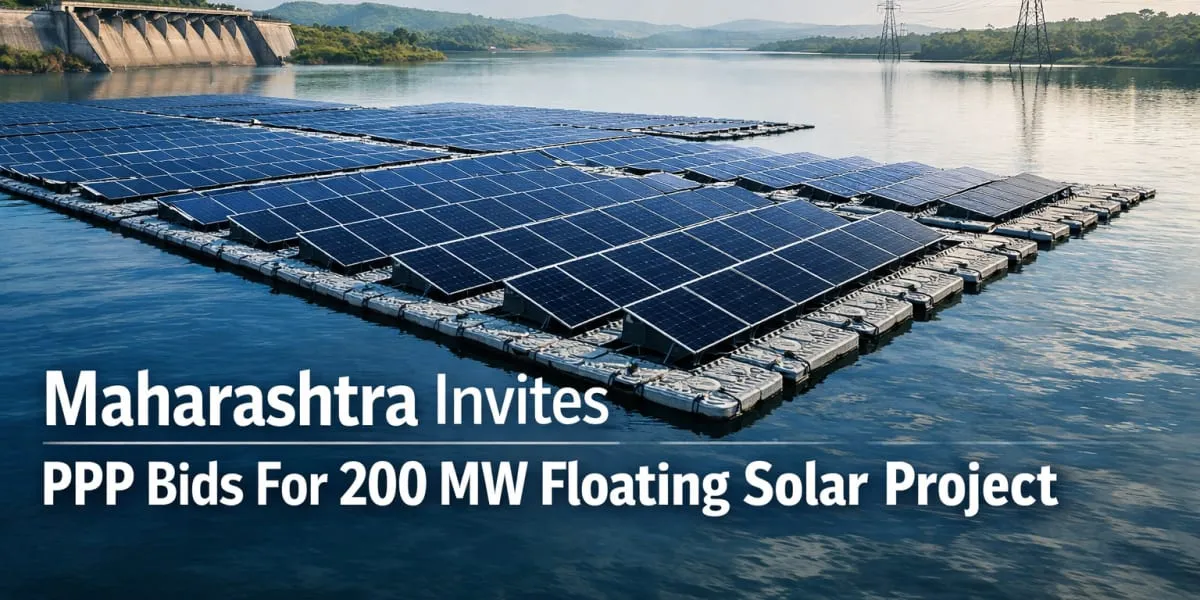
The second project envisages the development of a 200 megawatt (200 MW) Floating Solar Photovoltaic (FSPV) installation integrated with a Battery Energy Storage System (BESS) on the reservoir surface. The initiative aims to utilise available water area for clean energy generation while incorporating storage capability to support grid stability and enhance renewable utilisation. Technical specifications and integration arrangements will be set out in the detailed tender documents and bidders are expected to comply with standards.

The preliminary notice did not include details on earnest money deposit or performance bank guarantee, so bidders must consult tender documents on Maharashtra Government e?tender portal for bid security and requirements. All bidding activity must be completed online and the department advised participants to monitor the portal for corrigendum and modifications; no separate notifications will be issued. The projects form part of the state strategy to expand clean power with hydropower, floating solar and storage.

The Water Resources Department of the Government of Maharashtra has invited bids under a public–private partnership for two renewable energy and infrastructure projects on the Purna Project reservoir. The tender was issued by the Executive Engineer of the Purna Irrigation Division at Basmathnagar through E?Tender Notice No. 02 for the financial year 2026?27. The document was published on 24 July 2026 and detailed bid papers will be available from 28 July to 11 August 2026. The first project covers the upgradation, operation, maintenance and management of the existing 22.5 megawatt (22.5 MW) Yeldari Dam Hydroelectric Plant that forms part of the Purna Irrigation Project. The facility will be offered to selected developers under the PPP framework with the stated objective of improving operational efficiency and maximising renewable power generation from the current hydro resource. The department indicated that the arrangement should ensure effective maintenance and longer term asset optimisation practices. The second project envisages the development of a 200 megawatt (200 MW) Floating Solar Photovoltaic (FSPV) installation integrated with a Battery Energy Storage System (BESS) on the reservoir surface. The initiative aims to utilise available water area for clean energy generation while incorporating storage capability to support grid stability and enhance renewable utilisation. Technical specifications and integration arrangements will be set out in the detailed tender documents and bidders are expected to comply with standards. The preliminary notice did not include details on earnest money deposit or performance bank guarantee, so bidders must consult tender documents on Maharashtra Government e?tender portal for bid security and requirements. All bidding activity must be completed online and the department advised participants to monitor the portal for corrigendum and modifications; no separate notifications will be issued. The projects form part of the state strategy to expand clean power with hydropower, floating solar and storage.

Related Stories

Gold Stories

Next Story
Real Estate

BMC OC Amnesty Scheme Requires Key Approvals from Mumbai Societies

The Brihanmumbai Municipal Corporation (BMC) has clarified that housing societies applying under its Occupation Certificate (OC) amnesty scheme must possess key approvals linked to the original construction. The requirements include a valid Intimation of Disapproval (IOD), an approved building plan and a Commencement Certificate (CC), along with a No Objection Certificate (NOC) from the developer or original construction applicant. The Standard Operating Procedure (SOP) makes clear that the absence of an OC alone will not qualify a building for relief. Societies must establish that their build..

Next Story
Real Estate

Gurugram Emerges as Luxury Senior Living Hub

Gurugram is emerging as a potential hub for luxury senior living, supported by available land, healthcare infrastructure, connectivity and a concentration of affluent professionals, high-net-worth individuals and non-resident Indians. These factors could give the city an advantage over land-constrained metros such as Mumbai. A report by the Association of Senior Living India (ASLI) and JLL estimates that India’s organised senior living market could represent a $10.1 bn opportunity by 2030. The sector had about 25,050 organised units as of June 2026, while penetration stood at only 1.5 per ce..

Next Story
Real Estate

Corrosion Costs India’s Infrastructure Rs. 142 bn Annually

Corrosion costs India an estimated Rs. 1.42 tn annually, equivalent to 4.3 per cent of gross domestic product, according to a report by the Confederation of Indian Industry and the National Research Institute. Infrastructure accounts for Rs. 142 bn of the annual burden, making it the sector with the largest absolute cost among those examined. The report, presented at the CII Annual Infrastructure Summit 2026, said the infrastructure-sector cost equals about 2.9 per cent of the sector’s gross domestic product. It estimated that effective measures could generate maximum savings of Rs. 495.8 bn..

Advertisement

Subscribe to Our Newsletter

Get daily newsletters around different themes from Construction world.

STAY CONNECTED

Advertisement

SPECIAL OFFER
QR Code