ONGC, Reliance Pact Enables Deepwater Resource Sharing
POWER & RENEWABLE ENERGY

ONGC, Reliance Pact Enables Deepwater Resource Sharing

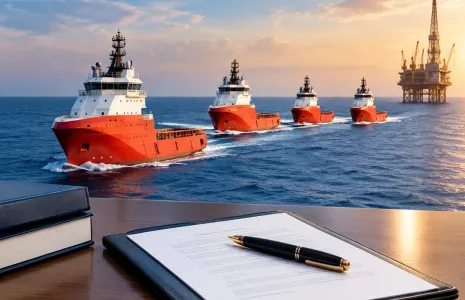
Oil and Natural Gas Corporation Limited and Reliance Industries Limited recently signed a landmark agreement to enable resource sharing for deepwater offshore exploration and production operations along India’s East Coast. The collaboration will primarily cover assets in the Krishna Godavari Basin and the Andaman offshore region, aimed at improving cost efficiency, execution timelines, and utilisation of critical infrastructure in complex deepwater projects.
The agreement aligns with the Oilfields (Regulation and Development) Amendment Act, 2025, facilitated by the Ministry of Petroleum and Natural Gas (MoPNG), which provides a clear regulatory framework for sharing onshore and offshore infrastructure among E&P operators. This policy initiative supports collaborative development of oilfields and optimised hydrocarbon production.
Under the arrangement, the two companies will explore shared use of key offshore resources, including processing facilities, drilling rigs, marine support vessels, power systems, pipelines, and specialised logging and well services.
The structured framework is expected to deliver tangible benefits such as reduced capital and operating costs through shared high-value assets, improved utilisation by minimising duplication, faster mobilisation of limited deepwater services, and enhanced safety through shared emergency response and training capabilities.
The agreement reflects the Government of India’s broader focus on strengthening energy security through increased domestic exploration and production, supported by progressive regulation and industry collaboration.

Oil and Natural Gas Corporation Limited and Reliance Industries Limited recently signed a landmark agreement to enable resource sharing for deepwater offshore exploration and production operations along India’s East Coast. The collaboration will primarily cover assets in the Krishna Godavari Basin and the Andaman offshore region, aimed at improving cost efficiency, execution timelines, and utilisation of critical infrastructure in complex deepwater projects.The agreement aligns with the Oilfields (Regulation and Development) Amendment Act, 2025, facilitated by the Ministry of Petroleum and Natural Gas (MoPNG), which provides a clear regulatory framework for sharing onshore and offshore infrastructure among E&P operators. This policy initiative supports collaborative development of oilfields and optimised hydrocarbon production.Under the arrangement, the two companies will explore shared use of key offshore resources, including processing facilities, drilling rigs, marine support vessels, power systems, pipelines, and specialised logging and well services.The structured framework is expected to deliver tangible benefits such as reduced capital and operating costs through shared high-value assets, improved utilisation by minimising duplication, faster mobilisation of limited deepwater services, and enhanced safety through shared emergency response and training capabilities.The agreement reflects the Government of India’s broader focus on strengthening energy security through increased domestic exploration and production, supported by progressive regulation and industry collaboration.

Related Stories

Gold Stories

Next Story
Resources

Schindler named among Forbes’ World’s Best Employers 2026

Schindler has been named among Forbes’ World’s Best Employers 2026, a global ranking recognising companies for their workplace environments.Compiled by Forbes in partnership with Statista, the ranking is based on independent employee feedback, including whether employees would recommend their organisation to friends and family.The company said the recognition reflected its focus on creating a workplace where employees can develop their expertise and build careers. ..

Next Story
Infrastructure Urban

India needs an export-execution mindset: Vishesh Jain

Interview with Vishesh Jain, Founder & CEO, EximpleWhat gaps in India’s global trade ecosystem led you to build Eximple, and what problem did you see businesses struggling with most?Eximple came out of a problem that all three founders had seen from different choke points in the trade ecosystem. India has millions of MSMEs and manufacturers, and many of them can make products that are genuinely competitive on quality. Yet only a small fraction is able to build meaningful international businesses. In our experience, the gap is usually not manufacturing capability; it is the ability to exe..

Next Story
Building Material

Nuvoco reports 13.5% revenue growth in Q2 FY27

Nuvoco Vistas Corp. Ltd. reported consolidated revenue of Rs 27.9 billion for Q2 FY27, up 13.5% year on year. Cement sales volume rose 9% to 4.7 million tonnes (MMT), while EBITDA increased 11% to Rs 4.11 billion.The company said it began its cement operations in 2014 with a 2.3 MMT per annum (MMTPA) operation at Nimbol. It now aims to reach 35 MMTPA of cement capacity by FY28, nearly 15 times its initial capacity. Its portfolio spans cement, ready-mix concrete and modern building materials.On sustainability and cost efficiency, Nuvoco partnered with CleanMax for a 46.4 MW wind-solar hybrid re..

Advertisement

Subscribe to Our Newsletter

Get daily newsletters around different themes from Construction world.

STAY CONNECTED

Advertisement

SPECIAL OFFER
QR Code