Renewable Energy Sector May Seek Seven Million Sq Ft Warehousing
POWER & RENEWABLE ENERGY

Renewable Energy Sector May Seek Seven Million Sq Ft Warehousing

Colliers India projects the renewable energy sector may lease up to seven million square feet (seven mn sq ft) of warehousing annually by 2030. The estimate reflects a growing need for storage and movement of large components and balance of system items across the supply chain. The firm indicated that such demand could reshape industrial real estate requirements and occupier specifications.

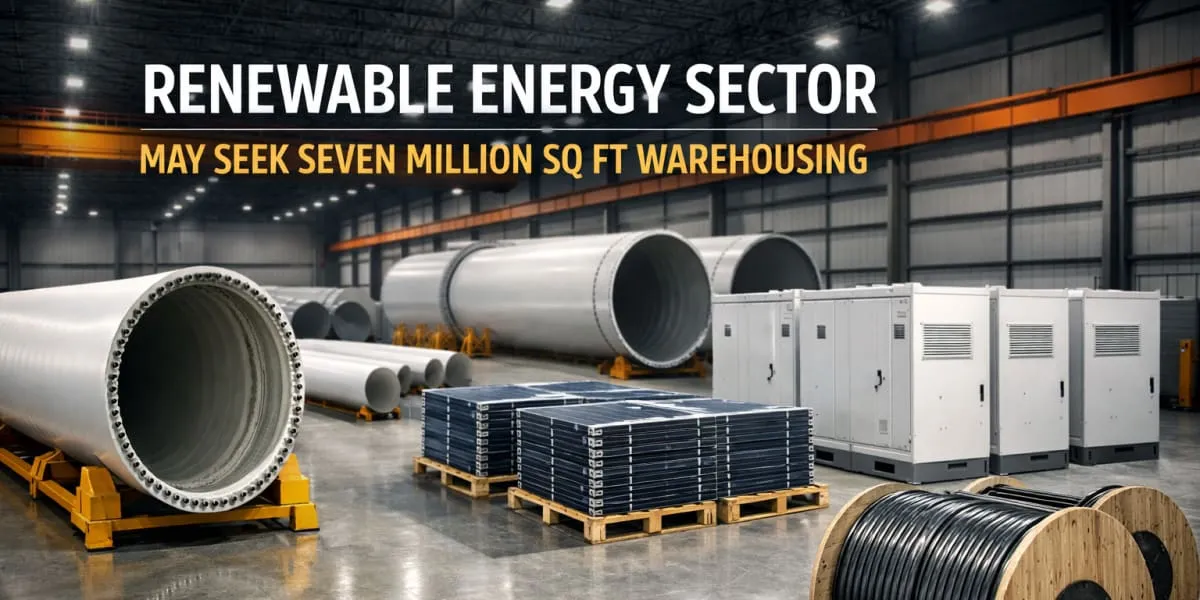
The demand will be driven by expansion in solar and wind deployment, the emergence of battery and electrolysers manufacturing, and the scaling of manufacturing supply chains. Developers and occupiers will require larger clear height, additional yard space and specialised handling capabilities to store blades, modules and battery packs. Location choices are likely to favour proximity to ports and existing manufacturing clusters to reduce transit times.

Colliers indicated the anticipated annual leasing could prompt increased investment in logistics parks and the conversion of existing warehouses to suit heavy and oversized goods. Landlords may look to retrofit space for higher loadings and improved access while institutional investors could view the trend as a long term income opportunity. Rental growth and vacancy dynamics are likely to differ by region and asset quality.

Market participants may respond by planning strategic corridors and last mile distribution nodes to support installation timelines and reduce transit costs. Policymakers and local authorities would need to consider zoning and infrastructure support to facilitate large scale storage and movement of renewable energy components. The projection highlights how the energy transition is interacting with real estate demand patterns.

Supply chain adjustments could include greater warehousing automation, specialised material handling equipment and additional training for the workforce to manage heavy renewable components. Developers may coordinate with original equipment manufacturers and project developers to design fit for purpose facilities that shorten lead times. Such alignment could also influence secondary markets for modular storage solutions and specialised contractors.

Colliers India projects the renewable energy sector may lease up to seven million square feet (seven mn sq ft) of warehousing annually by 2030. The estimate reflects a growing need for storage and movement of large components and balance of system items across the supply chain. The firm indicated that such demand could reshape industrial real estate requirements and occupier specifications. The demand will be driven by expansion in solar and wind deployment, the emergence of battery and electrolysers manufacturing, and the scaling of manufacturing supply chains. Developers and occupiers will require larger clear height, additional yard space and specialised handling capabilities to store blades, modules and battery packs. Location choices are likely to favour proximity to ports and existing manufacturing clusters to reduce transit times. Colliers indicated the anticipated annual leasing could prompt increased investment in logistics parks and the conversion of existing warehouses to suit heavy and oversized goods. Landlords may look to retrofit space for higher loadings and improved access while institutional investors could view the trend as a long term income opportunity. Rental growth and vacancy dynamics are likely to differ by region and asset quality. Market participants may respond by planning strategic corridors and last mile distribution nodes to support installation timelines and reduce transit costs. Policymakers and local authorities would need to consider zoning and infrastructure support to facilitate large scale storage and movement of renewable energy components. The projection highlights how the energy transition is interacting with real estate demand patterns. Supply chain adjustments could include greater warehousing automation, specialised material handling equipment and additional training for the workforce to manage heavy renewable components. Developers may coordinate with original equipment manufacturers and project developers to design fit for purpose facilities that shorten lead times. Such alignment could also influence secondary markets for modular storage solutions and specialised contractors.

Next Story
Infrastructure Energy

NSW Launches 2.5 GW Renewable Tender And 12 GWh Storage

New South Wales has opened a pair of record tenders seeking two point five gigawatts (GW) of new renewable generation and 12 gigawatt?hours (GWh) of long?duration storage to accelerate its clean energy transition. The generation auction, Tender 8, is the largest launched under the NSW Electricity Infrastructure Roadmap and is being managed by independent consumer trustee AusEnergy Services Limited (ASL). The storage contest, Tender 9, seeks up to 12 GWh of additional storage and follows a decision to unlock an extra 50 per cent of capacity above baseline planning targets. Officials indicated t..

Next Story
Infrastructure Energy

Jharkhand Researchers Develop Eco-Friendly Solar Cell

A team from the Department of Energy Engineering at the Central University of Jharkhand (CUJ) has developed an eco-friendly solar cell that uses a plant-based natural dye extracted from the petals of Mirabilis jalapa (commonly known as Gulabbas or Four O'Clock Flower). The researchers described the work as part of ongoing laboratory studies to explore sustainable alternatives to conventional photovoltaics. The device builds on dye-sensitised solar cell concepts adapted for locally available botanical materials. The lead researcher said the developed solar cell had achieved a highest power conv..

Next Story
Infrastructure Energy

Gwalior Floats Rs 99.8 mn Tender For Two MW Solar Plant

The Gwalior Municipal Corporation has issued a Notice Inviting Tender under a Request For Proposal to appoint an agency to develop a grid-connected solar power project at Manpur. The scheme calls for a two Megawatt AC on-grid ground-mounted solar photovoltaic plant, with a 20 per cent DC oversizing that raises the total DC capacity to two point four Megawatt (MW). The selected developer will be responsible for detailed design, construction and all associated infrastructure works required for grid integration. The original tender document was dated eight June 2024 and was digitally updated in M..

Advertisement

Subscribe to Our Newsletter

Get daily newsletters around different themes from Construction world.

STAY CONNECTED

Advertisement

Advertisement

Advertisement

-->