+
Data Centres May Drive 195 Mn Sq Ft Housing Demand by 2030
Real Estate

Data Centres May Drive 195 Mn Sq Ft Housing Demand by 2030

India’s expanding data centre ecosystem could generate demand for nearly 195 million sq ft of residential space by 2030, according to a report by proptech company Square Yards.

The report estimates that the country’s proposed data centre pipeline of approximately 9,030 MW could create nearly 433, 000 jobs across supporting industries and services, strengthening housing demand in surrounding locations.

Unlike conventional commercial developments, data centres attract investments in power infrastructure, fibre connectivity, logistics, commercial facilities and ancillary services. These investments can gradually transform nearby regions into urban and economic growth corridors.

India generates nearly 20 per cent of the world’s digital data but accounts for only around 4 per cent of global data centre capacity, indicating considerable potential for expansion. Rising adoption of artificial intelligence, cloud computing and enterprise digitisation is expected to accelerate investment in the sector.

Vivek Agarwal, Co-Founder and Chief Technology Officer, Square Yards, said data centres could become the next major infrastructure anchors after highways, airports, industrial corridors and information technology parks.

While data centre facilities directly employ a limited workforce, Agarwal said investments in power, connectivity and logistics create confidence among businesses, developers and institutions, encouraging long-term residential and commercial development.

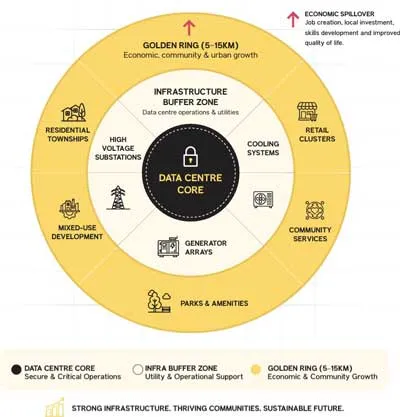
The report identifies a 5-15 km “Golden Ring” around major data centre facilities where residential townships, mixed-use developments, retail centres, transport infrastructure and civic amenities are expected to expand. Housing demand in these areas is likely to be supported by ancillary employment and wider economic activity.

Maharashtra is projected to generate more than 54 million sq ft of residential demand, followed by Karnataka at nearly 28 million sq ft and Andhra Pradesh at over 23 million sq ft.

Uttar Pradesh could record approximately 22.7 million sq ft of demand, followed by Telangana at 21.6 million sq ft and Tamil Nadu at 19.4 million sq ft.

The report also identifies Visakhapatnam, Noida, Gujarat International Finance Tec-City and other infrastructure-rich locations as potential beneficiaries of sustained investment, improved connectivity and economic development.


Sunita Mishra, Vice President – Research and Insights, Square Yards, said housing demand generally follows locations offering strong employment opportunities. She added that the impact of data centre development would extend beyond major metropolitan areas to Tier-II and Tier-III cities.

India’s expanding data centre ecosystem could generate demand for nearly 195 million sq ft of residential space by 2030, according to a report by proptech company Square Yards.The report estimates that the country’s proposed data centre pipeline of approximately 9,030 MW could create nearly 433, 000 jobs across supporting industries and services, strengthening housing demand in surrounding locations.Unlike conventional commercial developments, data centres attract investments in power infrastructure, fibre connectivity, logistics, commercial facilities and ancillary services. These investments can gradually transform nearby regions into urban and economic growth corridors.India generates nearly 20 per cent of the world’s digital data but accounts for only around 4 per cent of global data centre capacity, indicating considerable potential for expansion. Rising adoption of artificial intelligence, cloud computing and enterprise digitisation is expected to accelerate investment in the sector.Vivek Agarwal, Co-Founder and Chief Technology Officer, Square Yards, said data centres could become the next major infrastructure anchors after highways, airports, industrial corridors and information technology parks.While data centre facilities directly employ a limited workforce, Agarwal said investments in power, connectivity and logistics create confidence among businesses, developers and institutions, encouraging long-term residential and commercial development.The report identifies a 5-15 km “Golden Ring” around major data centre facilities where residential townships, mixed-use developments, retail centres, transport infrastructure and civic amenities are expected to expand. Housing demand in these areas is likely to be supported by ancillary employment and wider economic activity.Maharashtra is projected to generate more than 54 million sq ft of residential demand, followed by Karnataka at nearly 28 million sq ft and Andhra Pradesh at over 23 million sq ft.Uttar Pradesh could record approximately 22.7 million sq ft of demand, followed by Telangana at 21.6 million sq ft and Tamil Nadu at 19.4 million sq ft.The report also identifies Visakhapatnam, Noida, Gujarat International Finance Tec-City and other infrastructure-rich locations as potential beneficiaries of sustained investment, improved connectivity and economic development.Sunita Mishra, Vice President – Research and Insights, Square Yards, said housing demand generally follows locations offering strong employment opportunities. She added that the impact of data centre development would extend beyond major metropolitan areas to Tier-II and Tier-III cities.

Related Stories

Gold Stories

Next Story
Building Material

Hard Worker Wins Three Honours at Kyoorius Design Awards

The Ramco Cements Limited’s construction chemicals brand, Hard Worker, has won three honours at the Kyoorius Design Awards 2026, including the Grand Prix – Grey Elephant in the Design in Action category.The brand also secured two Blue Elephant honours, one for Design in Action and another for Packaging, recognising the design approach behind its brand identity and packaging.Launched in 2025, Hard Worker entered the construction chemicals segment with the brand promise, “Hard-working products for hardworking people.” Its visual identity uses animals and birds to represent product benefi..

Next Story
Infrastructure Transport

Kopri-Patni Creek Bridge to Improve Thane-Navi Mumbai Connectivity

Road connectivity between Thane and Navi Mumbai is set to receive a boost with the proposed six-lane Kopri-Patni Creek Bridge, which will provide a new route across Thane Creek. The project is intended to create a direct link between the two urban centres and add capacity to the region’s road network. The bridge will connect Kopri in Thane East with Patni in Navi Mumbai. It will begin at Mith Bandar Road in Kopri, about 750 metres from Thane railway station, cross Thane Creek and land near Airoli Knowledge City Road in Navi Mumbai. The project has advanced with Akshya Infra Projects emerging..

Next Story
Infrastructure Urban

Bengaluru Cuts Unaccounted-for Water to 26.5 Per Cent

The Bengaluru Water Supply and Sewerage Board (BWSSB) has reduced unaccounted-for water from nearly 51 per cent in 2013 to 26.5 per cent in 2025, improving efficiency across a metropolitan region of 14 mn people. The reduction has saved nearly 200 mn litres of water a day without requiring equivalent additional capacity. Bengaluru depends primarily on the Cauvery river system, with water transported over 100 km to the city. BWSSB operates six major treatment plants with combined installed capacity of 2,293 MLD and supplies nearly 150 litres per person per day. The Cauvery Water Supply Scheme S..

Advertisement

Subscribe to Our Newsletter

Get daily newsletters around different themes from Construction world.

STAY CONNECTED

Advertisement

SPECIAL OFFER
QR Code