Solar Rooftops Slash Household Power Bills To Zero In Kerala And Rajasthan
POWER & RENEWABLE ENERGY

Solar Rooftops Slash Household Power Bills To Zero In Kerala And Rajasthan

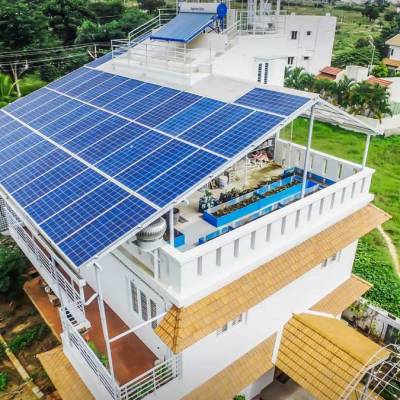
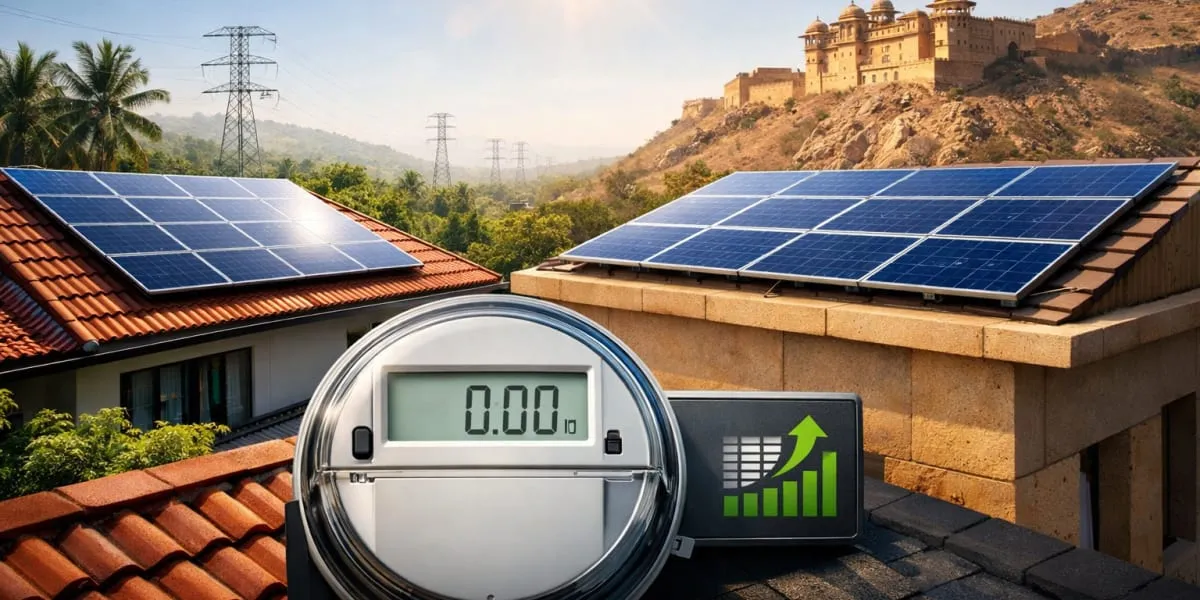
Household adoption of rooftop solar panels in Kerala and Rajasthan has reduced many electricity bills to zero as systems meet daytime consumption and feed surplus into the grid under net metering arrangements. State initiatives and local installers have promoted small to medium rooftop systems for residential use, supported by subsidies and simplified approval processes. The shift is driven by rising retail tariffs, improved panel efficiency and finance options that spread upfront costs over time.

Installations now serve tens of thousands of homes across cities and rural towns, with community programmes enabling collective procurement to lower unit costs. Typical residential systems range from three to 10 kilowatt-peak (kW) capacity and are sized to match household demand profiles and roof availability. Consumers report substantial monthly savings and managers of distribution companies note reduced load during peak sunshine hours.

Distribution companies have adjusted billing and grid management to integrate behind the meter generation and net metering declarations, while regulators refine tariff and export credit rules to balance utility revenue needs. The increased local generation eases pressure on centralised plants and reduces transmission losses, contributing to lower system costs and improved reliability. Analysts say the movement supports national clean energy targets and helps reduce carbon emissions from household consumption.

Financing schemes and vendor warranties have matured, making rooftop solar a viable option for a broader income range, and governments plan further incentives to scale installations. Industry stakeholders expect uptake to continue as technology costs decline and consumer awareness rises, prompting new business models in operations and maintenance. The transition is portrayed as a practical step towards energy affordability and sustainability for households in both states.

"Join industry leaders at RAHSTA Expo, India's premier platform for roads, highways and traffic infrastructure. Register now to explore innovations, network with experts and shape the future of mobility."

Household adoption of rooftop solar panels in Kerala and Rajasthan has reduced many electricity bills to zero as systems meet daytime consumption and feed surplus into the grid under net metering arrangements. State initiatives and local installers have promoted small to medium rooftop systems for residential use, supported by subsidies and simplified approval processes. The shift is driven by rising retail tariffs, improved panel efficiency and finance options that spread upfront costs over time. Installations now serve tens of thousands of homes across cities and rural towns, with community programmes enabling collective procurement to lower unit costs. Typical residential systems range from three to 10 kilowatt-peak (kW) capacity and are sized to match household demand profiles and roof availability. Consumers report substantial monthly savings and managers of distribution companies note reduced load during peak sunshine hours. Distribution companies have adjusted billing and grid management to integrate behind the meter generation and net metering declarations, while regulators refine tariff and export credit rules to balance utility revenue needs. The increased local generation eases pressure on centralised plants and reduces transmission losses, contributing to lower system costs and improved reliability. Analysts say the movement supports national clean energy targets and helps reduce carbon emissions from household consumption. Financing schemes and vendor warranties have matured, making rooftop solar a viable option for a broader income range, and governments plan further incentives to scale installations. Industry stakeholders expect uptake to continue as technology costs decline and consumer awareness rises, prompting new business models in operations and maintenance. The transition is portrayed as a practical step towards energy affordability and sustainability for households in both states.

Next Story
Real Estate

NICMAR’s campus is a live lesson in construction methodology

At NICMAR University, architecture becomes a live lesson in construction innovation. Pankaj Nande, Principal Architect, TDC Architecture and Design, explains how Alumil’s fenestration systems helped turn a precast campus vision into a functional, durable and future-facing learning environment for the next generation of builders.Please take us through your journey as an architect and some of the projects you have worked on.I am the founder of TDC- Architecture & Design, Pune. Our journey started with the thought of doing justice not only to design, but also to construction methodology, te..

Next Story
Infrastructure Urban

India needs to build a building health operating system

Cyond is bringing engineering-led diagnostics, AI-assisted data and standardised repair systems to building preservation, after screening nearly 1.5 lakh buildings and finding water-related deterioration in 67 per cent. In this interaction with Construction World, Sunil Gorle, Founder, Cyond, discusses how building health insights can make maintenance more predictive.What business opportunity did Cyond identify in structural diagnostics and waterproofing?India has invested trillions of rupees in creating its built environment. Yet, many assets expected to last 70-100 years begin showing deteri..

Next Story
Infrastructure Urban

Waterproofing Blueprint

Waterproofing buildings used to be an annual pre-monsoon affair but the evolution of real-estate development has changed that approach. In new developments, developers are weaving waterproofing solutions into both the design and construction phases, an approach that Nikhil Madan, Managing Director, Mahima Group, says, “is all about ensuring lasting durability [of the building] and keeping lifecycle risks including water seepage and extensive maintenance to a minimum.”Watertight by designAluminium formwork systems aren’t commonly thought of as a waterproofing tool but at the Mahima Group,..

Advertisement

Subscribe to Our Newsletter

Get daily newsletters around different themes from Construction world.

STAY CONNECTED

Advertisement

Advertisement

Advertisement