Tripura Expands Solar Footprint With 15 kW Rooftop Plant
POWER & RENEWABLE ENERGY

Tripura Expands Solar Footprint With 15 kW Rooftop Plant

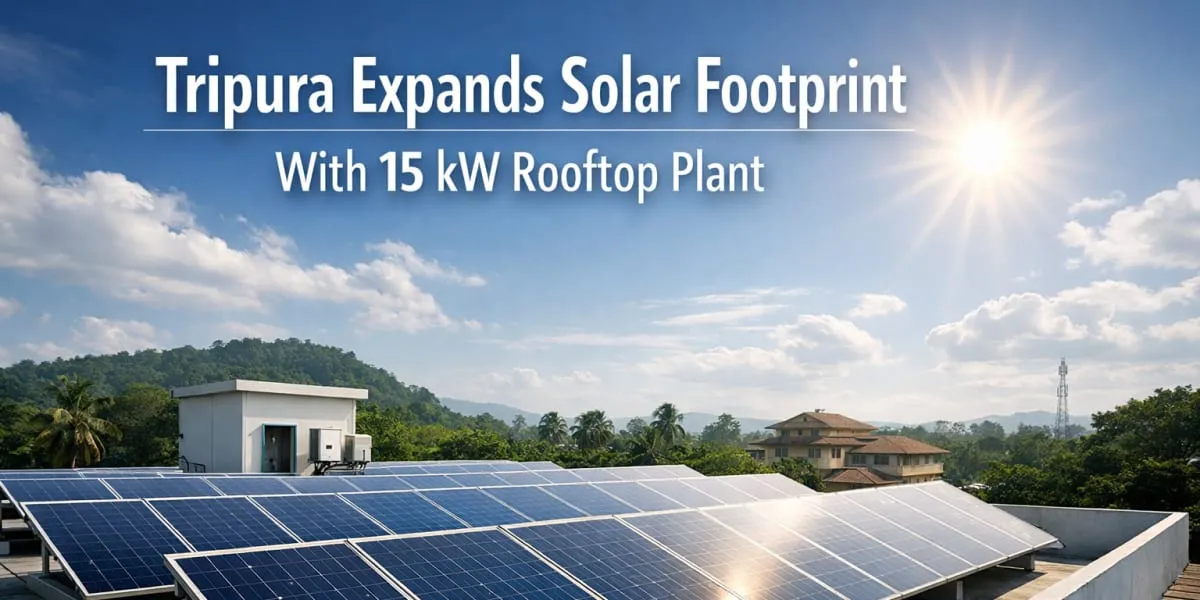
The Tripura government has expanded its solar footprint by commissioning a 15 kilowatt (kW) rooftop solar plant at a government office in Gomati under the Solar Sankalp initiative. The installation forms part of a broader push to deploy renewable energy across state government buildings and to reduce dependency on conventional grid supply. Officials said the plant will serve as a demonstration model for other offices and institutions across the state. The move aligns with state efforts to integrate decentralised clean energy solutions.

The 15 kW system comprises photovoltaic panels mounted on the rooftop and associated inverters and monitoring equipment to manage generation and consumption. The facility is expected to supply a portion of the office electrical load and to lower electricity expenditure, while also reducing greenhouse gas emissions associated with fossil fuel based power. Technical teams from the state electricity utility oversaw commissioning and will be responsible for operations and maintenance. The project reflects coordination between government departments and energy agencies to expedite rooftop adoption.

The state plans to replicate similar installations across administrative centres to scale the benefits of distributed generation and to enhance energy resilience at local level. Training and capacity building for facility managers have been scheduled to ensure effective operation and to encourage timely maintenance. The initiative is intended to create awareness among officials and the public about the viability of rooftop solar for institutional buildings. Early demonstrations are expected to inform future procurement and deployment strategies.

Tripura authorities view the Gomati rooftop plant as a step towards meeting broader sustainability objectives and strengthening the role of renewables in the state energy mix. Continued emphasis on project implementation and monitoring is anticipated to support informed expansion of rooftop systems. The government indicated that similar projects will be evaluated and prioritised based on performance data and operational learnings. The rollout is positioned as part of ongoing efforts to mainstream clean energy.

The Tripura government has expanded its solar footprint by commissioning a 15 kilowatt (kW) rooftop solar plant at a government office in Gomati under the Solar Sankalp initiative. The installation forms part of a broader push to deploy renewable energy across state government buildings and to reduce dependency on conventional grid supply. Officials said the plant will serve as a demonstration model for other offices and institutions across the state. The move aligns with state efforts to integrate decentralised clean energy solutions. The 15 kW system comprises photovoltaic panels mounted on the rooftop and associated inverters and monitoring equipment to manage generation and consumption. The facility is expected to supply a portion of the office electrical load and to lower electricity expenditure, while also reducing greenhouse gas emissions associated with fossil fuel based power. Technical teams from the state electricity utility oversaw commissioning and will be responsible for operations and maintenance. The project reflects coordination between government departments and energy agencies to expedite rooftop adoption. The state plans to replicate similar installations across administrative centres to scale the benefits of distributed generation and to enhance energy resilience at local level. Training and capacity building for facility managers have been scheduled to ensure effective operation and to encourage timely maintenance. The initiative is intended to create awareness among officials and the public about the viability of rooftop solar for institutional buildings. Early demonstrations are expected to inform future procurement and deployment strategies. Tripura authorities view the Gomati rooftop plant as a step towards meeting broader sustainability objectives and strengthening the role of renewables in the state energy mix. Continued emphasis on project implementation and monitoring is anticipated to support informed expansion of rooftop systems. The government indicated that similar projects will be evaluated and prioritised based on performance data and operational learnings. The rollout is positioned as part of ongoing efforts to mainstream clean energy.

Next Story
Real Estate

Housing Sales Dip 7 per cent QoQ Across Top Cities

India’s housing market saw a 7 per cent quarter-on-quarter decline in sales across the top seven cities in Q1 2026, with approximately 1,01,675 units sold compared to 1,08,970 units in Q4 2025, according to ANAROCK Group. However, on a yearly basis, sales rose 9 per cent, indicating continued underlying demand.The total sales value stood at around Rs 1.51 trillion, reflecting a 5 per cent quarterly drop but a 6 per cent annual increase. Mumbai Metropolitan Region and Bengaluru together accounted for nearly 48 per cent of total sales, while Chennai recorded the highest quarterly decline at 18..

Next Story
Real Estate

Birla Estates Enters Mumbai Redevelopment

Birla Estates has announced its entry into Mumbai’s redevelopment segment with a luxury residential project in Khar West, developed in partnership with Parinee Real Estate Builders. The project will redevelop Anmol Co-operative Housing Society and Bhartiya Bhavan Co-operative Housing Society, marking the company’s first redevelopment initiative in the Mumbai Metropolitan Region.Spread across 1.3 acres, the development will offer a saleable area of 2.9 lakh sq ft with an estimated revenue potential of Rs 17 billion. Positioned in one of Mumbai’s prime residential micro-markets, the projec..

Next Story
Infrastructure Urban

Hitachi, MUFG Expand EV Financing Model

Hitachi and MUFG Bank have expanded their NextGen business co-creation model to accelerate decarbonised mobility by financing electric vehicles and charging infrastructure. The renewed collaboration aims to address key barriers to electrification, including limited access to capital and the need for integrated energy solutions.Building on earlier partnerships, the expanded model extends beyond battery-focused solutions to include electric mobility assets, charging systems and energy management infrastructure across global markets. The initiative will leverage structured financing through speci..

Advertisement

Subscribe to Our Newsletter

Get daily newsletters around different themes from Construction world.

STAY CONNECTED

Advertisement

Advertisement

Advertisement