Vijayawada Division Expands Solar Capacity, Saves Rs 18.554 mn
POWER & RENEWABLE ENERGY

Vijayawada Division Expands Solar Capacity, Saves Rs 18.554 mn

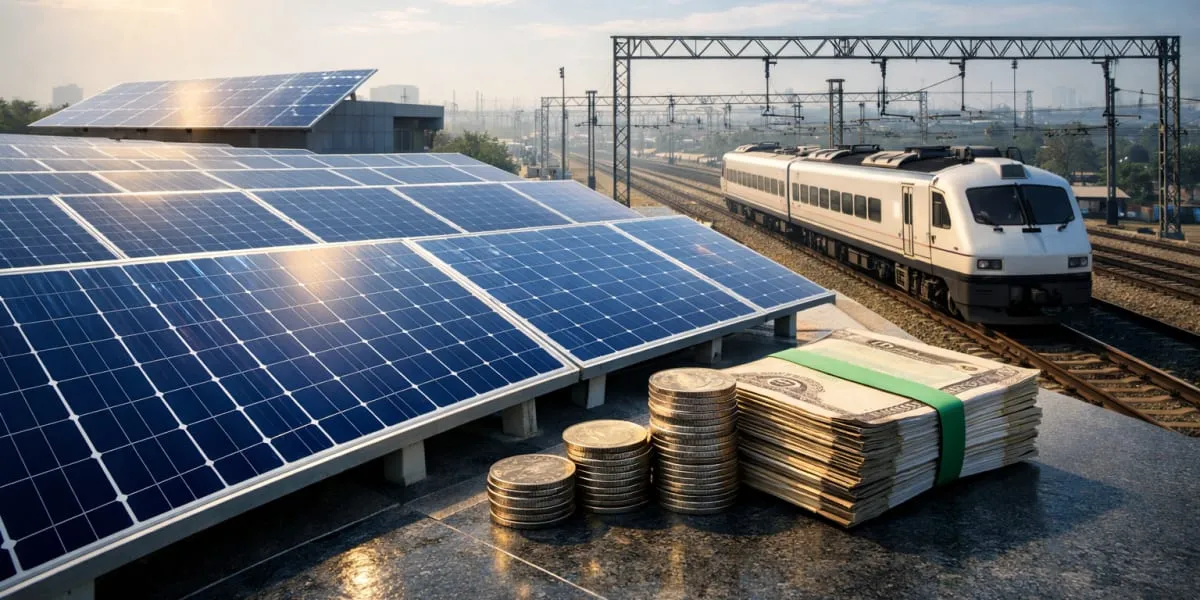
The Vijayawada Division of South Coast Railway scaled up green energy, marking National Renewable Energy Day by reporting that in the first four months of the 2026–27 financial year it generated more than 1.99 mn solar units and saved Rs 18.554 mn in operational costs. The division's total installed solar capacity reached 4,864 kilowatt-peak (kWp) across 265 installations. This footprint includes 2,978 kWp deployed at railway stations, 1,476 kWp at administrative offices and service buildings, 120 kWp at staff quarters and 290 kWp across 70 level-crossing gates to maintain signalling and power in rural, outage-prone stretches.

The expansion builds on a strong 2025–26 fiscal performance when installations produced 4.406 mn solar units, delivered operational savings of Rs 46.14 mn and offset 3,525.52 tonnes of carbon dioxide (t). Between April and July 2026 the division prevented a further 1,592.59 t of carbon dioxide emissions. The release said the substitution of diesel and grid power has contributed to measurable reductions in fuel costs and emissions across passenger and freight operations.

Beyond photovoltaic capacity, the division has transitioned completely to 100 per cent LED lighting across all interior and exterior facilities and installed solar water heating systems with a combined daily capacity of 56,700 litres for running rooms, rest houses and hospitals. Ten stations within the division, including Kadiyam, Dwarapudi, Madhuranagar, Sarpavaram, Uppaluru, Ulavapadu, Kavutaram, Nidamanuru, Moturu and Pedana, achieved Shunya Plus net-zero status by producing surplus solar power.

Vijayawada Railway Station holds an Indian Green Building Council Platinum certification for sustainable design supported by 610 kWp of Building-Integrated Photovoltaic (BIPV) panels installed across its platforms. The division said ongoing investments and distributed generation aim to improve energy resilience and reduce operating costs while contributing to broader climate goals.

The Vijayawada Division of South Coast Railway scaled up green energy, marking National Renewable Energy Day by reporting that in the first four months of the 2026–27 financial year it generated more than 1.99 mn solar units and saved Rs 18.554 mn in operational costs. The division's total installed solar capacity reached 4,864 kilowatt-peak (kWp) across 265 installations. This footprint includes 2,978 kWp deployed at railway stations, 1,476 kWp at administrative offices and service buildings, 120 kWp at staff quarters and 290 kWp across 70 level-crossing gates to maintain signalling and power in rural, outage-prone stretches. The expansion builds on a strong 2025–26 fiscal performance when installations produced 4.406 mn solar units, delivered operational savings of Rs 46.14 mn and offset 3,525.52 tonnes of carbon dioxide (t). Between April and July 2026 the division prevented a further 1,592.59 t of carbon dioxide emissions. The release said the substitution of diesel and grid power has contributed to measurable reductions in fuel costs and emissions across passenger and freight operations. Beyond photovoltaic capacity, the division has transitioned completely to 100 per cent LED lighting across all interior and exterior facilities and installed solar water heating systems with a combined daily capacity of 56,700 litres for running rooms, rest houses and hospitals. Ten stations within the division, including Kadiyam, Dwarapudi, Madhuranagar, Sarpavaram, Uppaluru, Ulavapadu, Kavutaram, Nidamanuru, Moturu and Pedana, achieved Shunya Plus net-zero status by producing surplus solar power. Vijayawada Railway Station holds an Indian Green Building Council Platinum certification for sustainable design supported by 610 kWp of Building-Integrated Photovoltaic (BIPV) panels installed across its platforms. The division said ongoing investments and distributed generation aim to improve energy resilience and reduce operating costs while contributing to broader climate goals.

Related Stories

Gold Stories

Next Story
Infrastructure Urban

Bengaluru Metro Awards Rs 554.8 mn Travellator Contract

Bengaluru Metro Rail Corporation (BMRCL) has awarded a Rs 55.48 crore (Rs 554.8 million (mn)) contract to Milan Road Buildtech LLP for civil and structural works to install a travellator and a connecting walkway at Central Silk Board. The contract covers design, construction and structural interfaces required to link the two adjacent metro stations. BMRCL authorised the award as part of procurement for infrastructure works on the Phase-2A project. The procurement followed BMRCL's standard tendering and evaluation procedures. The project will connect the Yellow Line Central Silk Board station w..

Next Story
Infrastructure Transport

GMRC Floats Tenders For Ahmedabad Metro RRTS Hybrid Corridors

Gujarat Metro Rail Corporation (GMRC) has floated three tenders for design consultancy services for the Ahmedabad Metro Phase three Metro cum Regional Rapid Transit System (RRTS) hybrid corridor. The procurements cover work on an additional network of 48.38 kilometre (km) to be integrated into the existing metro system. GMRC framed the tenders to secure specialised consultancy for alignment design, systems integration and coordination with RRTS planning. The consultancy scope will support detailed design and interface management for the hybrid corridors. The proposed hybrid routes include Vaki..

Next Story
Infrastructure Transport

Pune Metro Groundwork Starts on Swargate Katraj Underground Line

Construction work has begun on Pune Metro’s underground extension from Swargate to Katraj, with excavation starting at the busy Market Yard station. MLA Madhuri Misal inaugurated the excavation and inspected activities along the corridor. Maha Metro has commenced digging shafts to lower Tunnel Boring Machines (TBMs) into the ground and intends to deploy four TBMs gradually over the next few months. Station building and tunnelling will proceed simultaneously to streamline the schedule. Because the entire line is underground, authorities expect traffic disruption to be minimal and road space w..

Advertisement

Subscribe to Our Newsletter

Get daily newsletters around different themes from Construction world.

STAY CONNECTED

Advertisement