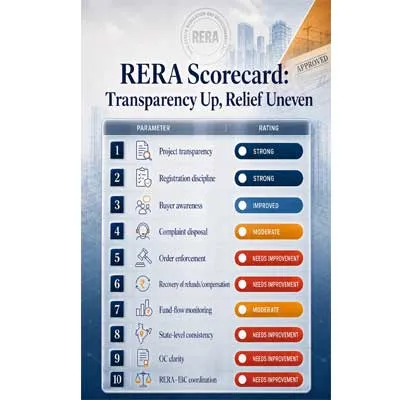
RERA promised timely possession, financial discipline, transparency and faster redress. A decade later, it has changed how Indian real estate operates—projects are registered, disclosures are public, and developers work under greater scrutiny.But visibility is not the same as relief. RERA’s real test now lies in execution: whether orders are enforced, funds remain protected, projects are completed, and buyers receive justice without another long fight.One law, many state realitiesIndia has one central RERA Act, but its implementation depends heavily on state machinery. MoHUA’s September 2025 update recorded 35 Real Estate Regulatory Authorities, 29 Appellate Tribunals, 1,51,113 registered projects, 1,06,545 registered agents and 1,47,383 complaints disposed of nationally. These numbers show scale, but not uniformity of performance. That unevenness is central to the RERA story. Suneet Maheshwari, Founder & Managing Partner, Udvik Infra Advisors, notes that RERA has introduced strict timelines, standardised area calculations, defect liability periods and enhanced disclosures, but adds that implementation “depends on each state, and it is not uniform across India.” He points out that stronger states have delivered better buyer protection, while several regions continue to operate with limited institutional depth and enforcement capacity. The Supreme Court’s decision striking down West Bengal’s separate housing law, WB-HIRA, reinforced the primacy of the central RERA framework. But legal uniformity has not automatically produced administrative uniformity. That is RERA’s first structural problem: the promise is national, but the quality of redress remains local.Visibility is not the same as governanceRERA has succeeded in addressing one of the sector’s deepest historical weaknesses: information asymmetry. Gautam Chatterjee, Former Chairman, MahaRERA, says the The pre-RERA problem was that buyers often did not know whether their money was being used for the same project, whether construction was progressing or whether the promised timeline was credible. He credits RERA portals with making project information more accessible and improving buyer awareness. This is a real achievement. It has helped credible developers, improved disclosure standards and supported market discipline.But disclosure alone cannot become the endpoint of regulation. A registration number does not guarantee delivery. A quarterly update does not prove financial health. A disposed complaint does not necessarily mean the grievance has been resolved.RERA’s next test is therefore not whether data exists. It is whether that data helps regulators detect risk early and intervene before projects become distressed.Enforcement remains the weak linkRERA created a specialised forum, but its real value depends on whether orders translate into relief. Chatterjee identifies execution as a key miss: “Orders have been passed by various RERA authorities, but execution of those orders has been a problem. The authority itself does not execute the order. It is dependent on the collectorate machinery to get the orders executed.”That dependence affects trust. A refund, interest or compensation order does not end the dispute if the buyer must pursue recovery through another arm of government.Heena Chheda, Partner, Economic Laws Practice, puts it sharply: “In many cases, homebuyers are able to obtain orders for refund, interest or possession, but face serious difficulty in getting those orders executed… the RERA order may become only a paper decree.”Concerns over uneven implementation are not merely industry observations; they are reflected in the repeated policy focus on enforcement, stalled projects and non-compliance of RERA orders at the Central Advisory Council level. The message is clear: RERA has not failed as a concept, but its enforcement architecture remains incomplete.The financial firewall needs sharper monitoringRERA’s 70 per cent separate account rule has improved financial discipline, but it is not a complete safeguard. Binitha Dalal, Founder and Managing Director, Mt. K Kapital, says the framework has “materially improved financial discipline”, while cautioning that implementation quality still varies across markets and developers.Chheda adds the legal limitation: “It is not a complete escrow mechanism,” since only 70 per cent of amounts realised from allottees must be kept in the separate account, and its effectiveness depends on audits, certification, withdrawal monitoring and enforcement.That is the next frontier. Regulators must be able to track fund flows, test certifications, and detect stress before projects become financially vulnerable. UP-RERA’s move to allow grievances where promoters receive money in non-project accounts shows that fund diversion remains a live regulatory concern even after the separate account rule.The Amitabh Kant Committee’s finding that lack of financial viability is a key reason stalled projects remain unresolved reinforces the point: RERA must move from disclosure-based monitoring to risk-based supervision.When RERA meets insolvencyRERA can regulate a project, but it cannot by itself rescue a collapsed balance sheet. That is where its limits meet the Insolvency and Bankruptcy Code.This overlap became critical after homebuyers were recognised as financial creditors under the IBC, giving them a place in insolvency proceedings. But it also changed the battle: once a developer enters insolvency, a RERA order for refund, interest, or possession may still be shaped by creditor claims, project viability and the approved resolution plan.The Amrapali case showed the risk clearly—when fund diversion, stalled construction and financial distress converge, ordinary regulatory orders are not enough. The Amitabh Kant Committee later identified the lack of financial viability as a key reason legacy stalled projects remain unresolved.The OC grey zoneThe Occupation Certificate (OC) is another area where legal clarity and buyer experience do not always align. Technically, an OC is issued by the competent municipal or planning authority. RERA does not issue it. As Chatterjee explains, when another competent authority grants an OC, RERA generally has to accept that certificate; if the certificate is wrongly issued, the buyer may need to raise that issue in another forum. This creates a practical grey zone. A project may have technical occupation approval, while buyers may still dispute amenities, common areas, access roads, utilities, water, sewage or other contractual commitments.Santhosh Kumar, Vice Chairman, ANAROCK Group, says: “Many developers do see the OC as the legal ‘finish line’ even if the project is incomplete in terms of water, sewage and road connections. This can land buyers in a grey zone where they can move in but will have a rough time with overall liveability.” Preksha Singh, CEO, Agrasheel Infratech, makes a balanced point: RERA has improved disclosure and execution discipline, but procedural interpretations around OCs are sometimes treated more as legal closure points than as indicators of complete liveability on the ground. An OC should not erase contractual accountability. The next phase of RERA must distinguish clearly between technical occupation, contractual completion and buyer possession experience.The reform agendaRERA 2.0 should not be framed as a developer-versus-buyer debate. It should be framed as a market credibility agenda.Dr Niranjan Hiranandani, Chairman, NAREDCO, says RERA has been a transformative reform that brought transparency and accountability, but calls for greater digitisation, uniform enforcement across states and faster, developer-friendly dispute resolution mechanisms. He also cautions that delays are often implementation challenges, not a failure of RERA itself. That distinction is important. A stronger RERA should not slow housing supply. It should improve predictability.The next decade needs time-bound enforcement of orders, public dashboards showing order compliance and recovery status, stronger recovery powers, better-staffed regulators and tribunals, real-time escrow and fund-flow monitoring, accountability for false certification, uniform national performance standards for state RERAs, clearer OC-linked rules, and stronger coordination with NCLT, consumer courts and district recovery machinery.RERA publishes registrations and disposals. It does not publish, with equal force, how many buyers actually received possession, refund or compensation. That is the implementation gap that the next decade must answer.Key takeawaysRERA improved transparency, not reliefState-level execution remains unevenDisposal does not mean justiceFund discipline still needs proofOC is an approval and not a closureInsolvency can dilute RERA reliefBuyers still carry the burdenTrust depends on enforceability-PRANJAL PATIL