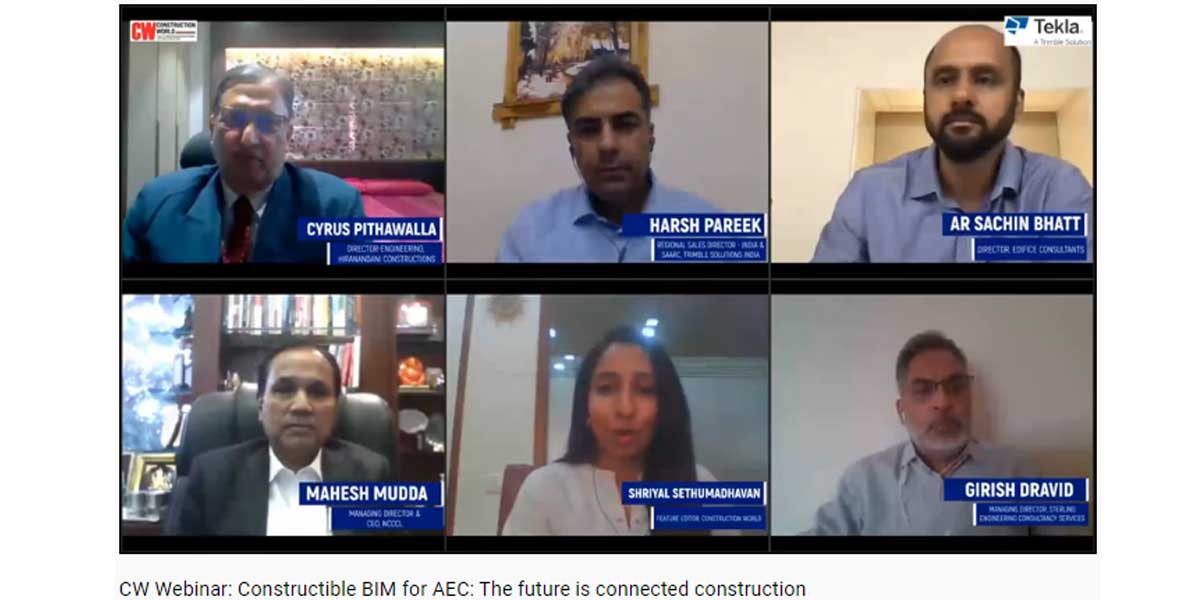
Several real estate projects suffer due to lack of collaboration among stakeholder groups. The reason lies in lack of constructible data that is up-to-date and is connected across stakeholders, beyond the design office. The major challenge is that everybody works in silos – different stakeholders use different platforms and this leads to challenges in project management and collaboration. There is lack of data to interoperate.
In such a scenario, can constructible Building Information Modelling (BIM) be the ideal solution?
Challenges in adoption
In the Indian real estate scenario, there have been key apprehensions and challenges about BIM that have been coming in the way of its adoption.
Cyrus Pithawalla, Director-Engineering, Hiranandani Constructions, points outs to “training” as a major requirement for adoption of BIM. He also mentions the need for architects and RCC consultants to come forward and extend a stronger support. He says, “In several instances, even if we want to adopt BIM, most architects or RCC consultants refuse saying that they are not used to it.” Pithawalla also mentions the challenge of cost and the need to deter this to the minimum. Considering that software may have its own limitations, he questions, “We normally tend to speak of commercial buildings where there is a lot of MEP works. Can BIM offer solutions for residential buildings as well? Also, can the finishing items such as tiling, plastering, and flooring, too be covered by BIM?”
“Everything is absolutely possible with BIM,” responds Harsh Pareek, Regional Sales Director-India & SAARC, Trimble Solutions India. He says, “A lot of times, we restrict ourselves from doing something because we always struggle to find the content availability. We at Trimble are working hard to make available as much content as possible without the need for any customisation.” Commenting on the availability of training to encourage the usage of BIM, Pareek adds that Trimble offers very basic software oriented training to the project specific and project oriented training.
BIM: Expenditure or an investment?
Cost is often stated as one of the key challenges to adopt BIM in projects. So if the real estate sector stakeholders have to consider the application and benefits of BIM, should it be looked at as an expenditure or investment?
In all spontaneity, Mahesh Mudda, Managing Director & CEO, New Consolidated Construction Company (NCCCL), responds, “I certainly consider the adoption of BIM as an investment.” He says, “Change is the name of the game and we have to adapt to developments that are happening world over. Adoption of BIM will only offer returns on investment.” Mudda further elaborates on the need to understand the dynamics of BIM and why the tool is required. While it will certainly not add to the project expenditure, it will reduce the execution time and eradicate all kinds of coordination issues. Even before the start of the project, there could be considerable reductions in steel and concrete consumption, as well as in wastages.
Today, in real estate, there are several large scale projects that are complex in nature and where each square feet and each rupee matters. However, the time duration to execute these projects is less. Hence, Mudda says, “BIM is the way forward.”
BIM for the structural engineer
As a structural engineer, does BIM improve outcomes required of the task of assuring the sturdiness of the structure?
Urging structural engineers to opt for this technology, Girish Dravid, Managing Director, Sterling Engineering Consultancy Services, says, “For the structural engineer and fellow engineering consultants such as MEP, façade and all other engineers, coordination and collaboration is extremely important with the architectural theme.” Having information, which is already partly coordinated or fully coordinated, only makes it easy for the structural engineer to evolve a suitable and most appropriate structural system.
Speaking from his experience, Dravid also mentions how BIM helps him save on manpower cost as well. Sharing an instance, he says, “If I am making a model in BIM, my quantity surveyor (QS) manpower reduces to 30 per cent because I am no more making errors and redoing jobs, and everything is available at a click. So, I can use my QS team’s time more efficiently in conducting checks and doing various alterations in terms of optimisation by using different specifications and seeing the cost on the same BIM tool. They are working on the same model that has come from the architect and other MEP consultants. So there are no discrepancies in whatever we are doing.”
Adding to the benefits, Dravid shares, “Clients are in a hurry to start foundation works even before the design. They constantly keep changing the designs. In a construction period of three years, the average changes that happen in a building are more than 12 in my experience. So we are actually designing 12 buildings in three years, and ultimately only one gets built.” But he now mentions that doing all the required changes is easy on BIM because one can instantly know the effects, the structural engineer can communicate with the client about the implications of changes that the client wants to make.
The architectural perspective of BIM
How can an architect use BIM in interactions with clients and other collaborators?
BIM has a completely different purpose. Ar Sachin Bhatt, Director, Edifice Consultants, shares, “A lot of clients insist for the designs and deliberations to be on BIM. However, a lot of them still perceive it just as a tool to avoid clashes and get a slightly smoother work at site.” He adds, “There is another set of clients as well who have been using this more effectively, taking it to another level where they use the model post occupation for modelling, maintenance, and facility management.”
Ar Bhatt goes on to add that with using BIM, there is a lot of save. “In today’s competitive market, where the costs are going up but the fees are going down, you don’t have a choice but to get into ways of automating things.”
BIM initiates effective communication. “When you are interacting with the clients,” says Ar Bhatt, “there used to be a time when they would use SketchUp to show a design to the client at the conceptual stage. Today, we are using the BIM models to discuss the designs at a later date with the clients as well. The result: We have been able to conclude an issue in few minutes, which would have otherwise taken a physical meeting at site.”
Where is the gap in adopting BIM?
Builders and contractors do face the challenge of wastages on site, which they want to eradicate. And while structural engineers are doing engineering analysis and design, there is much more that BIM can help them achieve.
Yet, where does the gap lie to adopt it 100 per cent?
Pareek is prompt at saying “the mind-set.” Adapting to change is often difficult. He says, “At the project level, if the guidelines for BIM and constructability are clearly defined, everybody will be able to implement it. The problem is when it becomes a question of choice.” It is important to have the clarity and understanding about what is BIM and at which level what needs to be delivered. Once the awareness grows in everybody’s mind, they will also know the kind of training that is required.
On his part, Dravid shares: “On an average, we handle over 200 projects across three offices at any given point in time. But the number of projects on which BIM is being used is not even 10 per cent.” He clearly states that the reason need not be lack of training, but is certainly due to lack of demand. “So unless the client imposes that there has to be BIM on this project, we will not adopt the technology.”
Highlighting the gap he sees in the adoption of BIM, Ar Bhatt says, “The biggest resistance comes from us at the senior level. We find it difficult to accept, learn or adopt a new tool and a new way of working.” He adds, “What happens more often than not is that you get a call from the client who wants to see the set of drawings in the next two to fifteen days, and the first thing we do is to drop the idea of BIM, and get the work done in the language that we know best. This needs to change. If we are aware of what should be the right answer, we will be able to respond to the client a little better. This is where training comes in and the need to know the nuances of what BIM actually involves.”
Further pointing out to the distribution of cost in a project, Pareek adds, “Look at the different activities – design and detailing is one aspect; and construction, fabrication, procurement and logistics is almost 90 per cent of the cost of the project. If the gain is huge at the design and detailing stage, and if it can be implemented with patience and with the right methods in the construction stage, how much wastage and how much efficiency can be gained with.” He is certain that it is not only about architects and engineers, but the value chain needs to be understood well by the developers and contractors on precisely why it is needed.
A practice by need, and not by choice!|
The past pandemic months have been crucial for India to realise the power of digitalisation. Pithawalla says, “As our prime minister has already said, we need to become Atmanirbhar. The real estate sector has to use BIM, and use it effectively. BIM is the future.” On his part, Mudda concludes, “BIM is the need of the hour. We need to convince ourselves to adopt it. We have to come and work together and see how we can use BIM effectively.”
With metro-rail and expressway projects already adopting BIM during its tender process, the day may not be far when for the real estate sector too, BIM will become a practice by need and not by choice.
- SHRIYAL SETHUMADHAVAN
(Collated from views shared in a recent CW online panel discussion on ‘Constructible BIM for AEC: The Future is Connected Construction’.)