+
Sinoboom launches collision avoidance system for scissor lifts
Equipment

Sinoboom launches collision avoidance system for scissor lifts

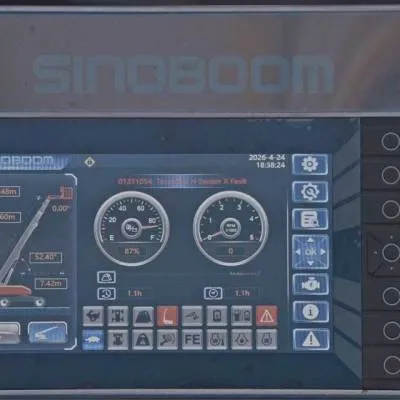
Sinoboom has launched its Collision Avoidance Radar System (CARS) for scissor lifts and mast lifts, designed to address limitations associated with conventional single-sensor systems, including detection blind spots, false alarms and limited adaptability across operating conditions.

The system uses multiple sensors mounted on the platform rail within a compact casing and connected to the control unit. It detects overhead obstacles and activates alerts in two stages, with lift movement automatically restricted during the second stage to help protect operators from impact.

CARS is compatible with both older and newer Sinoboom scissor lift control systems, allowing it to be deployed across existing fleets. While the operating experience differs slightly between the two systems, both provide dynamic hazard detection and operator protection.

The first alarm stage is activated when an obstacle is detected between one and two metres overhead. The CARS unit displays a flashing indicator and sounds a buzzer, while the scissor lift’s integrated alarm is also activated. On newer control systems, lifting and driving speeds are automatically reduced at this stage.

When an obstacle is detected less than one metre overhead, the second alarm stage is activated. Lifting and driving movements are automatically restricted, while audible and visual alarms continue to alert the operator.

The system also allows the obstacle detection distance to be adjusted according to the operator’s height, providing additional flexibility for operations involving multiple users or shift-based working.

Sinoboom said CARS combines an ultrasonic sensor offering ±20-degree coverage with a LiDAR sensor capable of detection across a range of zero to three metres. The dual-sensor configuration is designed to reduce short-range measurement errors by 50 per cent.

The primary alarm distance can be calibrated between 0.6 metres and 2.5 metres, while the secondary alarm maintains a one-metre buffer zone. An emergency override button also allows temporary continuation of operations, with the protection system restored when the button is released.

The system follows Sinoboom’s launch of CARS for boom lifts in 2025.

Sinoboom has launched its Collision Avoidance Radar System (CARS) for scissor lifts and mast lifts, designed to address limitations associated with conventional single-sensor systems, including detection blind spots, false alarms and limited adaptability across operating conditions.The system uses multiple sensors mounted on the platform rail within a compact casing and connected to the control unit. It detects overhead obstacles and activates alerts in two stages, with lift movement automatically restricted during the second stage to help protect operators from impact.CARS is compatible with both older and newer Sinoboom scissor lift control systems, allowing it to be deployed across existing fleets. While the operating experience differs slightly between the two systems, both provide dynamic hazard detection and operator protection.The first alarm stage is activated when an obstacle is detected between one and two metres overhead. The CARS unit displays a flashing indicator and sounds a buzzer, while the scissor lift’s integrated alarm is also activated. On newer control systems, lifting and driving speeds are automatically reduced at this stage.When an obstacle is detected less than one metre overhead, the second alarm stage is activated. Lifting and driving movements are automatically restricted, while audible and visual alarms continue to alert the operator.The system also allows the obstacle detection distance to be adjusted according to the operator’s height, providing additional flexibility for operations involving multiple users or shift-based working.Sinoboom said CARS combines an ultrasonic sensor offering ±20-degree coverage with a LiDAR sensor capable of detection across a range of zero to three metres. The dual-sensor configuration is designed to reduce short-range measurement errors by 50 per cent.The primary alarm distance can be calibrated between 0.6 metres and 2.5 metres, while the secondary alarm maintains a one-metre buffer zone. An emergency override button also allows temporary continuation of operations, with the protection system restored when the button is released.The system follows Sinoboom’s launch of CARS for boom lifts in 2025.

Related Stories

Gold Stories

Next Story
Technology

Procol to unveil AI procurement command centre at DPW Amsterdam

Procol is set to unveil a role-based AI command centre at DPW Amsterdam 2026, designed to help procurement teams execute multi-step workflows across existing enterprise systems through plain-language requests.Powered by Clara, Procol’s AI orchestration layer, the platform can run sourcing, budget checks and approvals across systems including SAP Ariba, Coupa and Oracle without requiring data migration.According to Procol, early enterprise deployments have shown up to a 15 per cent reduction in operational processing costs, an 80 per cent reduction in end-to-end procurement cycle times and a ..

Next Story
Equipment

Bridgestone India launches ‘Tyres Carry Life’ digital film

Bridgestone India has launched a new digital film, ‘Tyres Carry Life’, as the company marks 30 years of operations in India. The campaign focuses on the responsibility associated with tyres as products that support people’s everyday journeys, mobility and safety.The film highlights Bridgestone’s approach to quality across design, engineering, testing and manufacturing, while linking it to the company’s responsibility towards customers and road users. It draws on founder Shojiro Ishibashi’s philosophy of “Serving Society with Superior Quality.”According to the company, the respo..

Next Story
Resources

EQT launches Middle East platform with Abu Dhabi office

Global private markets firm EQT has recently launched its Middle East platform and opened an office at Abu Dhabi Global Market (ADGM), establishing an on-the-ground presence in the Gulf Cooperation Council (GCC) region.The Abu Dhabi office will serve as a strategic base as EQT expands its presence across GCC markets. The platform is intended to strengthen support for existing portfolio companies, deepen institutional relationships and pursue new investment opportunities linked to the region’s economic transformation.EQT said GCC economies are playing an increasing role in global capital flow..

Advertisement

Subscribe to Our Newsletter

Get daily newsletters around different themes from Construction world.

STAY CONNECTED

Advertisement

SPECIAL OFFER
QR Code