Delhi Micro-Markets Drive Up Housing Prices: Grihum Study
Real Estate

Delhi Micro-Markets Drive Up Housing Prices: Grihum Study

A new study by Grihum Housing Finance reveals that the rise of micro-markets across Delhi-NCR is fuelling real estate price appreciation, especially in the affordable housing segment. Key drivers include renewed post-pandemic interest, migration trends, and government schemes like PMAY.

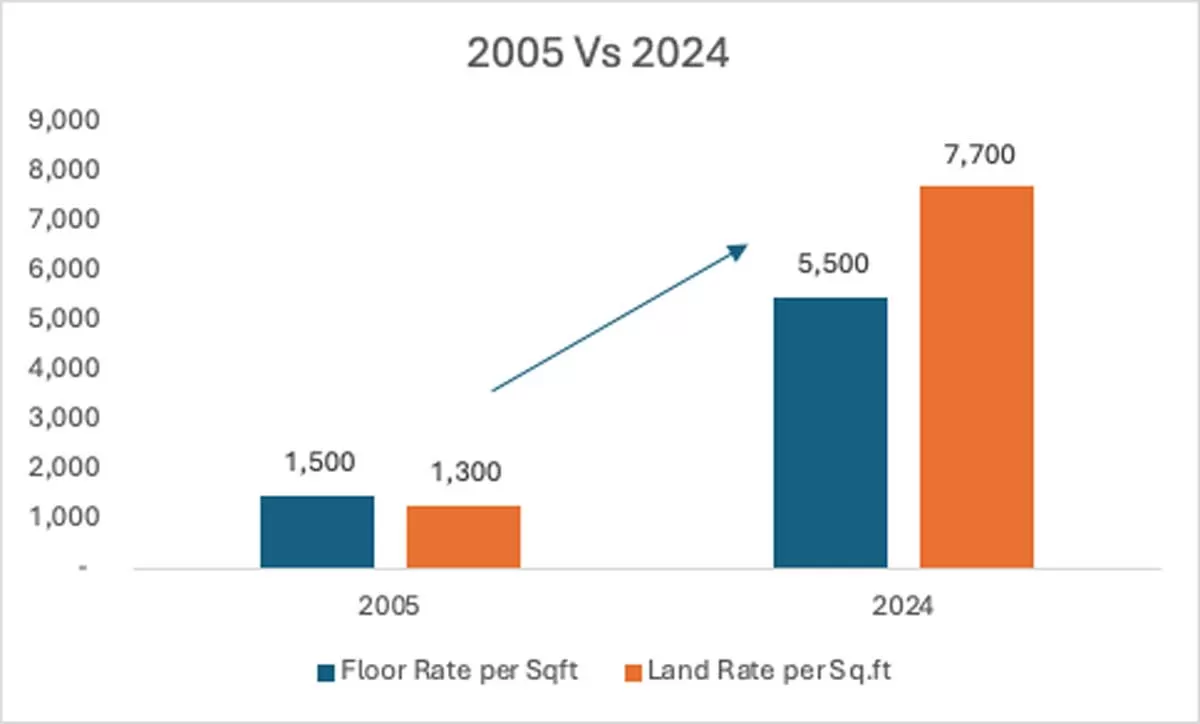
According to the study, over the past two decades, floor rates have risen 267 per cent, from Rs 1,500 per sq ft in 2005 to Rs 5,500 in 2024. In the same period, land rates surged 492 per cent, from Rs 1,300 to Rs 7,700 per sq ft. The sharp increase highlights strong capital appreciation in Delhi’s emerging locations.

Backed by banks and housing finance companies (HFCs), the region has expanded its housing supply to support the “Housing for All” mission. Emerging zones include Kakrola, Rajapuri, Mahavir Enclave, Chander Vihar, Palam, Amberhai Village, and Bamnoli, among others.

""At a time when India’s affordable housing sector is gaining structural momentum—driven by rurbanisation, income shifts, and PMAY—the ‘Grihum Guide to Affordable Housing: Delhi-NCR Edition’ arrives as a timely and field-rooted resource,"" said Manish Jaiswal, MD & CEO, Grihum. ""It uniquely evaluates the asset itself—not just the borrower—bringing sharper visibility on Net Credit Loss drivers.

The handbook includes affordability benchmarks, suggesting EMI brackets and recommended localities based on income levels. For instance:
  • For income up to Rs 5 lakh p.a., EMI ~Rs 20,800: Areas like Rohini, Sangam Vihar, Deoli, Madangir.
  • For income up to Rs 10 lakh p.a., EMI ~Rs 45,600: Locations include Kakrola, Qutub Enclave, Shyam Vihar.
The report also flags infrastructural challenges in Delhi-NCR—transport, healthcare, and sanitation—and proposes solutions through policy reforms and fast-track mechanisms.
With a footprint spanning Delhi and parts of Haryana, UP, and Rajasthan, the Grihum Guide serves as a critical tool for stakeholders in the affordable housing ecosystem.

A new study by Grihum Housing Finance reveals that the rise of micro-markets across Delhi-NCR is fuelling real estate price appreciation, especially in the affordable housing segment. Key drivers include renewed post-pandemic interest, migration trends, and government schemes like PMAY.According to the study, over the past two decades, floor rates have risen 267 per cent, from Rs 1,500 per sq ft in 2005 to Rs 5,500 in 2024. In the same period, land rates surged 492 per cent, from Rs 1,300 to Rs 7,700 per sq ft. The sharp increase highlights strong capital appreciation in Delhi’s emerging locations.Backed by banks and housing finance companies (HFCs), the region has expanded its housing supply to support the “Housing for All” mission. Emerging zones include Kakrola, Rajapuri, Mahavir Enclave, Chander Vihar, Palam, Amberhai Village, and Bamnoli, among others.At a time when India’s affordable housing sector is gaining structural momentum—driven by rurbanisation, income shifts, and PMAY—the ‘Grihum Guide to Affordable Housing: Delhi-NCR Edition’ arrives as a timely and field-rooted resource, said Manish Jaiswal, MD & CEO, Grihum. It uniquely evaluates the asset itself—not just the borrower—bringing sharper visibility on Net Credit Loss drivers.The handbook includes affordability benchmarks, suggesting EMI brackets and recommended localities based on income levels. For instance:For income up to Rs 5 lakh p.a., EMI ~Rs 20,800: Areas like Rohini, Sangam Vihar, Deoli, Madangir.For income up to Rs 10 lakh p.a., EMI ~Rs 45,600: Locations include Kakrola, Qutub Enclave, Shyam Vihar.The report also flags infrastructural challenges in Delhi-NCR—transport, healthcare, and sanitation—and proposes solutions through policy reforms and fast-track mechanisms.With a footprint spanning Delhi and parts of Haryana, UP, and Rajasthan, the Grihum Guide serves as a critical tool for stakeholders in the affordable housing ecosystem.

Next Story
Real Estate

RBI Rate Cut Boosts Confidence Across Housing Market

Industry Context and Market DynamicsThe real estate industry has welcomed the RBI’s rate cut as a timely boost to affordability and demand. With home prices having risen steadily across major markets, even a marginal reduction in interest rates meaningfully strengthens purchasing power, especially for first-time and mid-income buyers.Ashish Jerath, President – Sales & Marketing, Smartworld Developers, observes:“The RBI’s 25-basis-point cut, bringing the repo rate down to 5.25%, is a timely boost for the real estate sector. Lower interest rates reduce borrowing costs, enabling homeb..

Next Story
Infrastructure Transport

BMC Resumes Rs 170 Billion Road Works, Targets 80 per cent By Jan 2026

Following the withdrawal of the southwest monsoon in October, the Brihanmumbai Municipal Corporation (BMC) has restarted work on 645 roads—covering 297.49 kilometres—under its large-scale concretisation programme. Data shows that more than 60 per cent of the resumed works are located in the western suburbs. Officials said the civic body aims to complete concretisation on 80 per cent of the roads where fresh work has begun by January 2026. Launched in 2022, the Rs 170 billion project seeks to concretise 700 kilometres of roads across Mumbai. All civil works were halted during the monsoon ..

Next Story
Infrastructure Urban

India Pushes Digital Shift In Urban Land Mapping

The Department of Land Resources (DoLR) under the Ministry of Rural Development has convened a National Symposium on NAKSHA – the National Geospatial Knowledge-based Land Survey of Urban Habitations – to advance India’s transition to modern, technology-driven land mapping. Speaking at the inaugural session, Secretary Manoj Joshi underscored the urgent need to move revenue departments away from outdated, tape-based methods and rough hand-drawn sketches. He stressed that adopting latitude–longitude-based digital mapping and GIS-linked registration systems is essential for economic stabi..

Advertisement

Subscribe to Our Newsletter

Get daily newsletters around different themes from Construction world.

STAY CONNECTED

Advertisement

Advertisement

Advertisement

Advertisement

Open In App