AI Innovations Take Centre Stage At India AI Impact Summit
Technology

AI Innovations Take Centre Stage At India AI Impact Summit

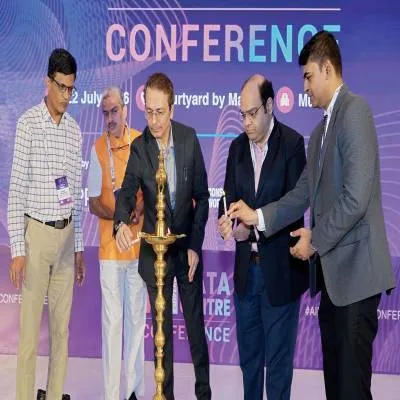
On the third day of the India AI Impact Summit 2026 Expo spread across 10 pavilions, attendees included industry leaders, start-ups, academic institutions, government representatives and citizens. A large number of young people and students attended despite inclement weather to witness live demonstrations of cutting-edge Artificial Intelligence (AI) tools and technologies. The exhibition continued to attract strong participation across sectors, reflecting heightened interest in emerging digital capabilities. The showcase offered hands-on sessions and technical briefings for learners and practitioners.

A key focus at the Expo was AI-driven cybersecurity, with exhibitors demonstrating Managed Detection and Response (MDR) platforms and AI-powered threat intelligence systems that emphasised prevention and rapid incident handling. Presentations highlighted multilevel prevention-first security frameworks and secure end-to-end AI transactions designed for the next phase of digital commerce. Delegates were given insight into how AI combined with human expertise can detect anomalies, prevent cyber-attacks and reduce risks to critical digital assets. Demonstrations included live scenario simulations and vendor briefings to illustrate deployment pathways.

Experts indicated that predictive analytics, real-time monitoring and AI-enabled response systems can strengthen cyber security across businesses, government departments and public institutions. The exhibition also showcased AI applications in governance, enterprise systems integration, smart urban platforms and digital infrastructure management to support scalable and efficient systems. Visitors engaged with exhibitors to explore practical deployment models, data security standards and compliance mechanisms, and student interest suggested growing career aspirations in AI.

The Expo served as a platform for collaboration between academia, industry and government and the strong footfall underlined the relevance of AI-driven solutions for science, innovation and resilience. Organisers described the event as reinforcing efforts to democratise access to advanced technologies and to support sustainable growth. The Summit underscored India's commitment to building secure, inclusive and future-ready AI ecosystems. Stakeholders voiced support for continued engagement and follow-up initiatives.

On the third day of the India AI Impact Summit 2026 Expo spread across 10 pavilions, attendees included industry leaders, start-ups, academic institutions, government representatives and citizens. A large number of young people and students attended despite inclement weather to witness live demonstrations of cutting-edge Artificial Intelligence (AI) tools and technologies. The exhibition continued to attract strong participation across sectors, reflecting heightened interest in emerging digital capabilities. The showcase offered hands-on sessions and technical briefings for learners and practitioners. A key focus at the Expo was AI-driven cybersecurity, with exhibitors demonstrating Managed Detection and Response (MDR) platforms and AI-powered threat intelligence systems that emphasised prevention and rapid incident handling. Presentations highlighted multilevel prevention-first security frameworks and secure end-to-end AI transactions designed for the next phase of digital commerce. Delegates were given insight into how AI combined with human expertise can detect anomalies, prevent cyber-attacks and reduce risks to critical digital assets. Demonstrations included live scenario simulations and vendor briefings to illustrate deployment pathways. Experts indicated that predictive analytics, real-time monitoring and AI-enabled response systems can strengthen cyber security across businesses, government departments and public institutions. The exhibition also showcased AI applications in governance, enterprise systems integration, smart urban platforms and digital infrastructure management to support scalable and efficient systems. Visitors engaged with exhibitors to explore practical deployment models, data security standards and compliance mechanisms, and student interest suggested growing career aspirations in AI. The Expo served as a platform for collaboration between academia, industry and government and the strong footfall underlined the relevance of AI-driven solutions for science, innovation and resilience. Organisers described the event as reinforcing efforts to democratise access to advanced technologies and to support sustainable growth. The Summit underscored India's commitment to building secure, inclusive and future-ready AI ecosystems. Stakeholders voiced support for continued engagement and follow-up initiatives.

Related Stories

Gold Stories

Next Story
Infrastructure Urban

KONE Opens India's First Digital Experience Centre in Pune

KONE, a global elevator and escalator manufacturer, has inaugurated its first Digital Experience Centre (DEC) in India, located in Pune. The facility aims to showcase how artificial intelligence (AI), connectivity and data-driven technologies can enhance customer experiences and improve building operations.The centre was inaugurated by Jussi Herlin, Executive Vice Chair, KONE Corporation; Philippe Delorme, President and CEO, KONE; and Nandan Nilekani, Co-founder and Chairman of the Board, Infosys.Designed as an interactive customer environment, the facility demonstrates digital solutions cover..

Next Story
Infrastructure Urban

CII GreenCo Launches Circularity Guidelines for Indian Industry

The Confederation of Indian Industry (CII) GreenCo Council has launched the CII GreenCo Circularity Guidelines – Pilot Version at the 17th CII GreenCo Waste & Resource Management Summit 2026 in Chennai. The initiative aims to strengthen resource efficiency, waste reduction and circular economy practices across Indian manufacturing and process industries.The guidelines introduce a structured framework with circularity indices covering raw materials, consumables, packaging and other resource inputs. These indicators will help industries assess existing practices, identify opportunities to ..

Next Story
Infrastructure Energy

Global Electronics Association Launches IPC-1783-CO2E Standard

The Global Electronics Association has introduced IPC-1783-CO2E, a new international standard aimed at improving consistency, transparency and comparability in product carbon footprint reporting across the electronics manufacturing industry.The standard, titled International Standard for Data Collection and Reporting of CO2 Equivalent (CO2e) Emissions for the Electronics Manufacturing Supply Chain, provides industry-specific guidance for collecting, estimating and reporting carbon emissions data.With increasing regulatory requirements and customer expectations, electronics manufacturers face c..

Advertisement

Subscribe to Our Newsletter

Get daily newsletters around different themes from Construction world.

STAY CONNECTED

Advertisement

SPECIAL OFFER
QR Code