Govt Unveils AI Integration Plan for Education and Skilling
Technology

Govt Unveils AI Integration Plan for Education and Skilling

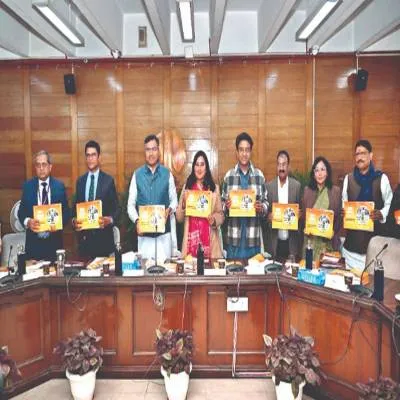
Union Minister of State (Independent Charge) for Skill Development and Entrepreneurship and Minister of State for Education, Jayant Chaudhary, recently outlined the Government’s vision for integrating artificial intelligence across India’s education and skilling ecosystems at Google’s AI for Learning Forum in New Delhi.
The Minister announced a landmark collaboration between the Ministry of Skill Development and Entrepreneurship, Google Cloud, and Chaudhary Charan Singh University, positioning CCSU as India’s first AI-enabled state university pilot. The initiative is aligned with the Prime Minister’s vision of a technology-driven Viksit Bharat 2047.
Prior to the formal session, the Minister interacted with CCSU students and faculty, discussing how AI can broaden learning pathways, improve employability, and create opportunities for youth from Tier-2 and Tier-3 cities. During a fireside chat, he emphasised breaking silos between education and skilling, noting that AI can bridge classroom learning with industry requirements.
Under the pilot, CCSU will serve as a national living laboratory for AI-first education, deploying personalised AI tutors, AI-driven skill-gap analysis, and intelligent document processing to improve academic and administrative outcomes. Learnings from the initiative are intended to be scaled across India’s higher education ecosystem, including over 45,000 colleges and 1,200 universities.
The Minister also highlighted alignment with the Rs 600 billion Model ITI Scheme, enabling vocational institutions to integrate AI-enabled curricula alongside upgraded infrastructure. Google announced additional commitments, including an Rs 850 million Google.org grant to Wadhwani AI to support AI integration into national platforms such as SWAYAM and Poshan Tracker, with outreach to nearly 75 million learners.
Reiterating India’s global role, the Minister noted that AI solutions developed for India’s linguistic and geographic diversity could serve as models for the Global South, reinforcing the country’s commitment to inclusive and scalable digital public infrastructure.

Union Minister of State (Independent Charge) for Skill Development and Entrepreneurship and Minister of State for Education, Jayant Chaudhary, recently outlined the Government’s vision for integrating artificial intelligence across India’s education and skilling ecosystems at Google’s AI for Learning Forum in New Delhi.The Minister announced a landmark collaboration between the Ministry of Skill Development and Entrepreneurship, Google Cloud, and Chaudhary Charan Singh University, positioning CCSU as India’s first AI-enabled state university pilot. The initiative is aligned with the Prime Minister’s vision of a technology-driven Viksit Bharat 2047.Prior to the formal session, the Minister interacted with CCSU students and faculty, discussing how AI can broaden learning pathways, improve employability, and create opportunities for youth from Tier-2 and Tier-3 cities. During a fireside chat, he emphasised breaking silos between education and skilling, noting that AI can bridge classroom learning with industry requirements.Under the pilot, CCSU will serve as a national living laboratory for AI-first education, deploying personalised AI tutors, AI-driven skill-gap analysis, and intelligent document processing to improve academic and administrative outcomes. Learnings from the initiative are intended to be scaled across India’s higher education ecosystem, including over 45,000 colleges and 1,200 universities.The Minister also highlighted alignment with the Rs 600 billion Model ITI Scheme, enabling vocational institutions to integrate AI-enabled curricula alongside upgraded infrastructure. Google announced additional commitments, including an Rs 850 million Google.org grant to Wadhwani AI to support AI integration into national platforms such as SWAYAM and Poshan Tracker, with outreach to nearly 75 million learners.Reiterating India’s global role, the Minister noted that AI solutions developed for India’s linguistic and geographic diversity could serve as models for the Global South, reinforcing the country’s commitment to inclusive and scalable digital public infrastructure.

Next Story
Real Estate

Union Budge: Infra-Led Urban Shift

The Union Budget FY27 reinforces infrastructure-led urbanisation as the backbone of India’s real estate and housing growth. Higher public capital expenditure, City Economic Regions, risk-mitigation mechanisms and REIT-led asset monetisation are being widely viewed as long-term enablers, even as the industry continues to seek sharper supply-side reforms and affordability-focused measures. Here are a few industry insights:Dr Niranjan Hiranandani, Chairman, NAREDCO & Hiranandani Group“The Union Budget 2026-27 is growth-oriented and stability-focused, supporting consumption and aiming to s..

Next Story
Infrastructure Urban

Budget 2026 Charts Path for Infrastructure-Led, Tech-Driven Growth

The Union Budget 2026–27 signals strong continuity in India’s macroeconomic strategy, anchored in elevated public capital expenditure, fiscal discipline, and a sharper focus on manufacturing, infrastructure, and regional development. With capital outlay pegged at ₹12.2 lakh crore and a fiscal deficit target of around 4.3 per cent, the Budget balances growth ambition with stability, offering long-term visibility to investors and project developers.A dominant theme is the centrality of infrastructure as a multiplier for economic expansion. Public capex now accounts for over 3.3 per cent of..

Next Story
Infrastructure Energy

Tata Power Arm Crosses 10 GW EPC Milestone

Tata Power Renewable Energy Ltd (TPREL) has achieved a major milestone by executing 10 gigawatts of engineering, procurement and construction (EPC) renewable energy projects to date, reinforcing its position in India’s clean energy infrastructure sector. According to the company, the executed portfolio comprises 4.2 gigawatts of in-house projects and 5.8 gigawatts of third-party projects. Of the total 10 gigawatts commissioned so far, 9.7 gigawatts are solar projects and 290 megawatts are wind projects. In the first nine months of FY26, TPREL commissioned 1.88 gigawatts of EPC renewable en..

Advertisement

Subscribe to Our Newsletter

Get daily newsletters around different themes from Construction world.

STAY CONNECTED

Advertisement

Advertisement

Advertisement

Advertisement

Open In App