India Among First AI Nations, Focused on Diffusion and ROI
Technology

India Among First AI Nations, Focused on Diffusion and ROI

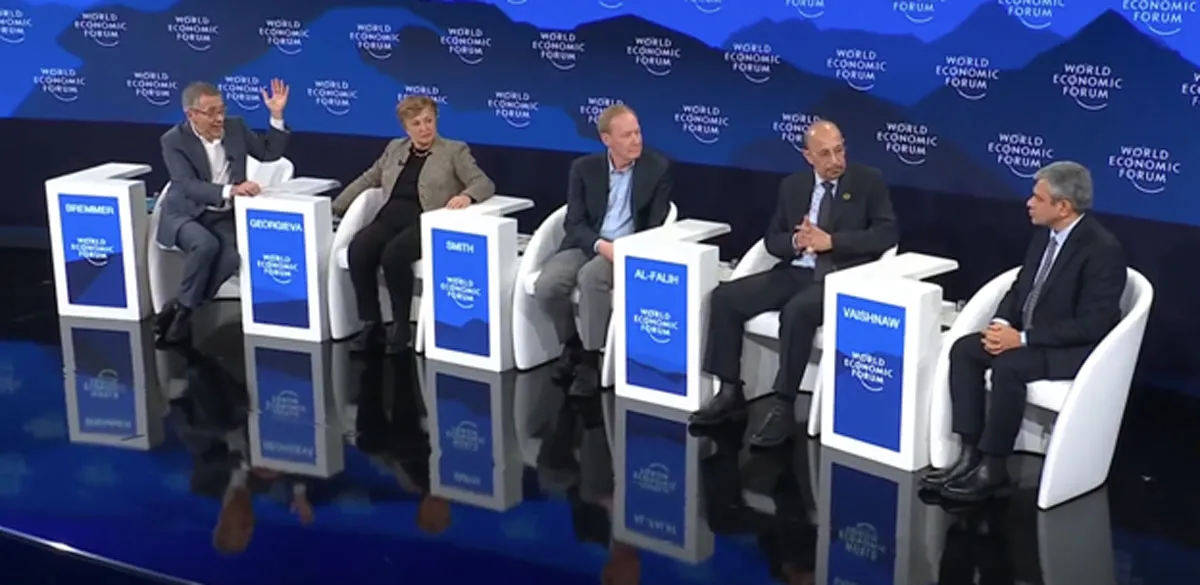
Union Minister for Electronics and Information Technology Ashwini Vaishnaw recently outlined India’s artificial intelligence strategy at a panel discussion titled ‘AI Power Play, No Referees’ during the World Economic Forum in Davos. The Minister emphasised that India is firmly positioned among the first bouquet of AI nations, driven by large-scale diffusion, economic viability and techno-legal governance.

Addressing global AI alignments and geopolitics, Shri Vaishnaw said India is working across the entire AI stack, spanning applications, models, chips, infrastructure and energy. He noted that the real return on investment in AI comes from enterprise deployment and productivity gains rather than the pursuit of extremely large models. According to him, nearly 95 per cent of AI use cases can be addressed using models in the 20–50 billion parameter range, many of which India is already deploying across sectors.

The Minister cautioned against equating geopolitical influence with ownership of very large AI models, observing that such models can be switched off and may create economic stress for developers. He stressed that AI power in the next industrial phase will be driven by low-cost solutions delivering high returns, supported increasingly by CPUs, smaller models and custom silicon.

Highlighting India’s approach to AI diffusion, Shri Vaishnaw said the government has enabled affordable AI compute by empanelling around 38,000 GPUs through a public–private partnership model. The subsidised national compute facility provides access to students, researchers, startups and innovators at nearly one-third of global costs.

On governance, the Minister outlined India’s techno-legal approach to AI regulation, combining legal frameworks with technical tools. He noted that India is developing systems to detect deepfakes, mitigate bias and ensure proper unlearning of AI models, with an emphasis on evidentiary robustness suitable for judicial scrutiny.

The panel was moderated by Ian Bremmer of Eurasia Group and included global leaders from industry, finance and policymaking, reflecting the growing international focus on responsible, economically grounded AI deployment.

Union Minister for Electronics and Information Technology Ashwini Vaishnaw recently outlined India’s artificial intelligence strategy at a panel discussion titled ‘AI Power Play, No Referees’ during the World Economic Forum in Davos. The Minister emphasised that India is firmly positioned among the first bouquet of AI nations, driven by large-scale diffusion, economic viability and techno-legal governance. Addressing global AI alignments and geopolitics, Shri Vaishnaw said India is working across the entire AI stack, spanning applications, models, chips, infrastructure and energy. He noted that the real return on investment in AI comes from enterprise deployment and productivity gains rather than the pursuit of extremely large models. According to him, nearly 95 per cent of AI use cases can be addressed using models in the 20–50 billion parameter range, many of which India is already deploying across sectors. The Minister cautioned against equating geopolitical influence with ownership of very large AI models, observing that such models can be switched off and may create economic stress for developers. He stressed that AI power in the next industrial phase will be driven by low-cost solutions delivering high returns, supported increasingly by CPUs, smaller models and custom silicon. Highlighting India’s approach to AI diffusion, Shri Vaishnaw said the government has enabled affordable AI compute by empanelling around 38,000 GPUs through a public–private partnership model. The subsidised national compute facility provides access to students, researchers, startups and innovators at nearly one-third of global costs. On governance, the Minister outlined India’s techno-legal approach to AI regulation, combining legal frameworks with technical tools. He noted that India is developing systems to detect deepfakes, mitigate bias and ensure proper unlearning of AI models, with an emphasis on evidentiary robustness suitable for judicial scrutiny. The panel was moderated by Ian Bremmer of Eurasia Group and included global leaders from industry, finance and policymaking, reflecting the growing international focus on responsible, economically grounded AI deployment.

Next Story
Infrastructure Urban

9th India–Myanmar Joint Trade Committee Meeting Held in Nay Pyi Taw

The ninth meeting of the India–Myanmar Joint Trade Committee (JTC) was held in Nay Pyi Taw, Myanmar, with a focus on strengthening bilateral trade and deepening economic cooperation. The meeting was co-chaired by U Minn Minn, Deputy Minister, Ministry of Commerce of the Republic of the Union of Myanmar, and Nitin Kumar Yadav, Additional Secretary, Department of Commerce, Ministry of Commerce and Industry, Government of India.Representatives from relevant ministries and stakeholder departments from both countries participated in the discussions. The meeting covered a broad range of issues aim..

Next Story
Infrastructure Urban

DGCA Launches Digital Pilot Licence Services for ATPL

The Directorate General of Civil Aviation (DGCA) has launched Electronic Personnel Licence (EPL) services for the Airline Transport Pilot Licence (ATPL), marking a significant step in the regulator’s ongoing digital transformation of aviation licensing in India. The service was inaugurated at an event held at the DGCA headquarters.Inaugurating the EPL ATPL service, Director General of Civil Aviation Faiz Ahmed Kidwai said the initiative represents a major advancement in strengthening India’s civil aviation regulatory framework through secure, modern and future-ready digital systems. He con..

Next Story
Infrastructure Urban

Cabinet Extends Atal Pension Yojana and Support Till 2030–31

The Union Cabinet, chaired by Prime Minister Narendra Modi, has approved the continuation of the Atal Pension Yojana (APY) up to the financial year 2030–31, along with the extension of government funding support for promotional and developmental activities and gap funding to ensure the scheme’s long-term sustainability.Under the approved framework, APY will continue to receive government support aimed at expanding its reach among unorganised and low-income workers. This includes funding for awareness campaigns, capacity-building initiatives and other developmental activities to strengthen ..

Advertisement

Subscribe to Our Newsletter

Get daily newsletters around different themes from Construction world.

STAY CONNECTED

Advertisement

Advertisement

Advertisement

Advertisement

Open In App