Centre Removes Early Completion Bonus For Hill Highways
ECONOMY & POLICY

Centre Removes Early Completion Bonus For Hill Highways

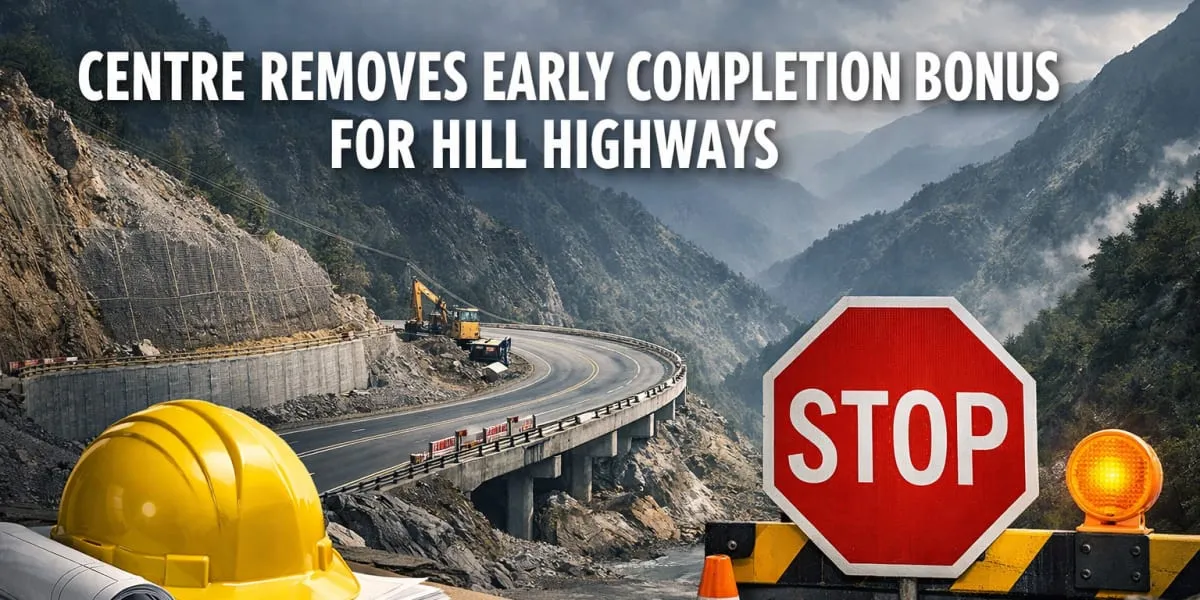
The Union Ministry of Road Transport and Highways (MoRTH) has revised norms for National Highway projects in hilly regions, removing incentives for early completion and introducing stricter measures to improve slope stability and safety. The amendments to model engineering, procurement and construction contract documents and consultancy frameworks for detailed project reports will apply to future National Highway and centrally sponsored projects in mountainous areas. The ministry said rapid expansion of highways through mechanical slope cutting had led to destabilisation and erosion in several locations.

One major change removes the early completion bonus, which under the existing EPC framework gave contractors a bonus of zero point zero three per cent of the contract value for every day a project was finished ahead of schedule. The provision has been scrapped for hilly projects and payment milestones are now tied to slope protection measures such as sealing tension cracks, soil nails, rock bolts, ground anchors and drainage systems to prevent water induced slope failures.

The revised framework mandates a phased construction approach under which contractors may initially undertake only formation cutting and slope profiling, with pavement construction and permanent structures permitted only after newly cut slopes have remained stable for at least one monsoon season. Geological investigation and monitoring requirements have been tightened and detailed surveys must now use Light Detection and Ranging (LiDAR) based mapping and drone surveys across a 300-metre-wide corridor, alongside deployment of Interferometric Synthetic Aperture Radar (InSAR) to detect minute ground movements.

Permanent observation pedestals will be installed on vulnerable slopes during construction and, for deep cut sections exceeding six metres, borehole investigations must extend at least five metres into competent bedrock before designs are finalised. Any proposal to modify approved slope protection measures will require scrutiny by independent bodies such as the Geological Survey of India or Tehri Hydro Development Corporation Limited. The ministry has directed the National Highways Authority of India (NHAI), National Highways and Infrastructure Development Corporation Limited (NHIDCL) and the Border Roads Organisation (BRO) to incorporate the provisions into future tender documents.

"Join industry leaders at RAHSTA Expo, India's premier platform for roads, highways and traffic infrastructure. Register now to explore innovations, network with experts and shape the future of mobility."

The Union Ministry of Road Transport and Highways (MoRTH) has revised norms for National Highway projects in hilly regions, removing incentives for early completion and introducing stricter measures to improve slope stability and safety. The amendments to model engineering, procurement and construction contract documents and consultancy frameworks for detailed project reports will apply to future National Highway and centrally sponsored projects in mountainous areas. The ministry said rapid expansion of highways through mechanical slope cutting had led to destabilisation and erosion in several locations. One major change removes the early completion bonus, which under the existing EPC framework gave contractors a bonus of zero point zero three per cent of the contract value for every day a project was finished ahead of schedule. The provision has been scrapped for hilly projects and payment milestones are now tied to slope protection measures such as sealing tension cracks, soil nails, rock bolts, ground anchors and drainage systems to prevent water induced slope failures. The revised framework mandates a phased construction approach under which contractors may initially undertake only formation cutting and slope profiling, with pavement construction and permanent structures permitted only after newly cut slopes have remained stable for at least one monsoon season. Geological investigation and monitoring requirements have been tightened and detailed surveys must now use Light Detection and Ranging (LiDAR) based mapping and drone surveys across a 300-metre-wide corridor, alongside deployment of Interferometric Synthetic Aperture Radar (InSAR) to detect minute ground movements. Permanent observation pedestals will be installed on vulnerable slopes during construction and, for deep cut sections exceeding six metres, borehole investigations must extend at least five metres into competent bedrock before designs are finalised. Any proposal to modify approved slope protection measures will require scrutiny by independent bodies such as the Geological Survey of India or Tehri Hydro Development Corporation Limited. The ministry has directed the National Highways Authority of India (NHAI), National Highways and Infrastructure Development Corporation Limited (NHIDCL) and the Border Roads Organisation (BRO) to incorporate the provisions into future tender documents.

Next Story
Real Estate

NICMAR’s campus is a live lesson in construction methodology

At NICMAR University, architecture becomes a live lesson in construction innovation. Pankaj Nande, Principal Architect, TDC Architecture and Design, explains how Alumil’s fenestration systems helped turn a precast campus vision into a functional, durable and future-facing learning environment for the next generation of builders.Please take us through your journey as an architect and some of the projects you have worked on.I am the founder of TDC- Architecture & Design, Pune. Our journey started with the thought of doing justice not only to design, but also to construction methodology, te..

Next Story
Infrastructure Urban

India needs to build a building health operating system

Cyond is bringing engineering-led diagnostics, AI-assisted data and standardised repair systems to building preservation, after screening nearly 1.5 lakh buildings and finding water-related deterioration in 67 per cent. In this interaction with Construction World, Sunil Gorle, Founder, Cyond, discusses how building health insights can make maintenance more predictive.What business opportunity did Cyond identify in structural diagnostics and waterproofing?India has invested trillions of rupees in creating its built environment. Yet, many assets expected to last 70-100 years begin showing deteri..

Next Story
Infrastructure Urban

Waterproofing Blueprint

Waterproofing buildings used to be an annual pre-monsoon affair but the evolution of real-estate development has changed that approach. In new developments, developers are weaving waterproofing solutions into both the design and construction phases, an approach that Nikhil Madan, Managing Director, Mahima Group, says, “is all about ensuring lasting durability [of the building] and keeping lifecycle risks including water seepage and extensive maintenance to a minimum.”Watertight by designAluminium formwork systems aren’t commonly thought of as a waterproofing tool but at the Mahima Group,..

Advertisement

Subscribe to Our Newsletter

Get daily newsletters around different themes from Construction world.

STAY CONNECTED

Advertisement

Advertisement

Advertisement