Climate awareness high, action gap persists in India
ECONOMY & POLICY

Climate awareness high, action gap persists in India

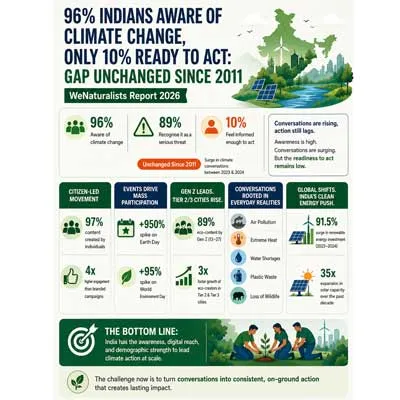
WeNaturalists reported that while 96 per cent of Indians are aware of climate change, only 10 per cent feel informed enough to act, a gap unchanged since 2011. The findings highlight a persistent disconnect between awareness and action despite rising climate concerns.

The report noted a 34 per cent increase in climate conversations between 2023 and 2024, with citizen-led content accounting for 97 per cent of engagement and delivering up to four times higher interaction than branded campaigns. Participation spikes of up to 950 per cent during events such as Earth Day underline the impact of collective climate moments.

Gen Z is driving the shift, contributing 89 per cent of eco-content, while Tier 2 and Tier 3 cities are emerging as key growth hubs with creator bases expanding three times faster than metros. Smaller cities now account for 35 per cent of participation, signalling a broader geographic spread of climate engagement.

The report also linked global energy vulnerabilities to India’s climate urgency, noting strong growth in renewable energy investments and solar capacity. It concluded that while awareness and digital engagement are high, the focus must now shift to translating intent into measurable on-ground climate action.

WeNaturalists reported that while 96 per cent of Indians are aware of climate change, only 10 per cent feel informed enough to act, a gap unchanged since 2011. The findings highlight a persistent disconnect between awareness and action despite rising climate concerns.The report noted a 34 per cent increase in climate conversations between 2023 and 2024, with citizen-led content accounting for 97 per cent of engagement and delivering up to four times higher interaction than branded campaigns. Participation spikes of up to 950 per cent during events such as Earth Day underline the impact of collective climate moments.Gen Z is driving the shift, contributing 89 per cent of eco-content, while Tier 2 and Tier 3 cities are emerging as key growth hubs with creator bases expanding three times faster than metros. Smaller cities now account for 35 per cent of participation, signalling a broader geographic spread of climate engagement.The report also linked global energy vulnerabilities to India’s climate urgency, noting strong growth in renewable energy investments and solar capacity. It concluded that while awareness and digital engagement are high, the focus must now shift to translating intent into measurable on-ground climate action.

Next Story
Infrastructure Urban

PM inaugurates Rs 40 Billion projects in Sikkim

Narendra Modi inaugurated and laid foundation stones for development projects worth Rs 40 billion in Sikkim during the state’s 50th year of statehood celebrations in Gangtok. The projects aim to enhance connectivity, infrastructure and overall socio-economic development in the region.Addressing the event at Paljor Stadium, the Prime Minister highlighted Sikkim’s tourism potential and its success in organic farming, describing it as a model for the country. He reaffirmed the government’s focus on improving infrastructure and providing affordable healthcare through initiatives such as Ayus..

Next Story
Technology

Adani commits $100 billion for AI infrastructure in India

Adani Group has committed $100 billion to develop a large-scale AI infrastructure platform in India, focusing on integrated energy, digital networks and data centres to support the country’s growing artificial intelligence ecosystem.The announcement was made during an event in Visakhapatnam for the foundation of a major AI data centre project involving Google, which plans to invest $15 billion in the facility. The campus, being developed with partners including Adani ConneX, is expected to be among the largest AI data centre developments globally.The platform will be powered by clean energy ..

Next Story
Infrastructure Transport

MMRDA completes key Line 2B harbour crossing

As per an update shared on its official X (formerly Twitter) handle, the Mumbai Metropolitan Region Development Authority (MMRDA) has successfully executed a critical infrastructure milestone on Metro Line 2B, with the installation of a 42-metre, 178-tonne steel span across the Central Railway Harbour Line corridor between Kurla and Tilak Nagar.The complex overnight operation involved lifting two composite steel girders using twin 500-tonne cranes. Executed within the limited block window provided by railway authorities, the activity adhered to stringent safety and quality protocols. The exerc..

Advertisement

Subscribe to Our Newsletter

Get daily newsletters around different themes from Construction world.

STAY CONNECTED

Advertisement

Advertisement

Advertisement