CSIR-CRRI And BPCL Recognised For Plastic Waste Roadblock
ECONOMY & POLICY

CSIR-CRRI And BPCL Recognised For Plastic Waste Roadblock

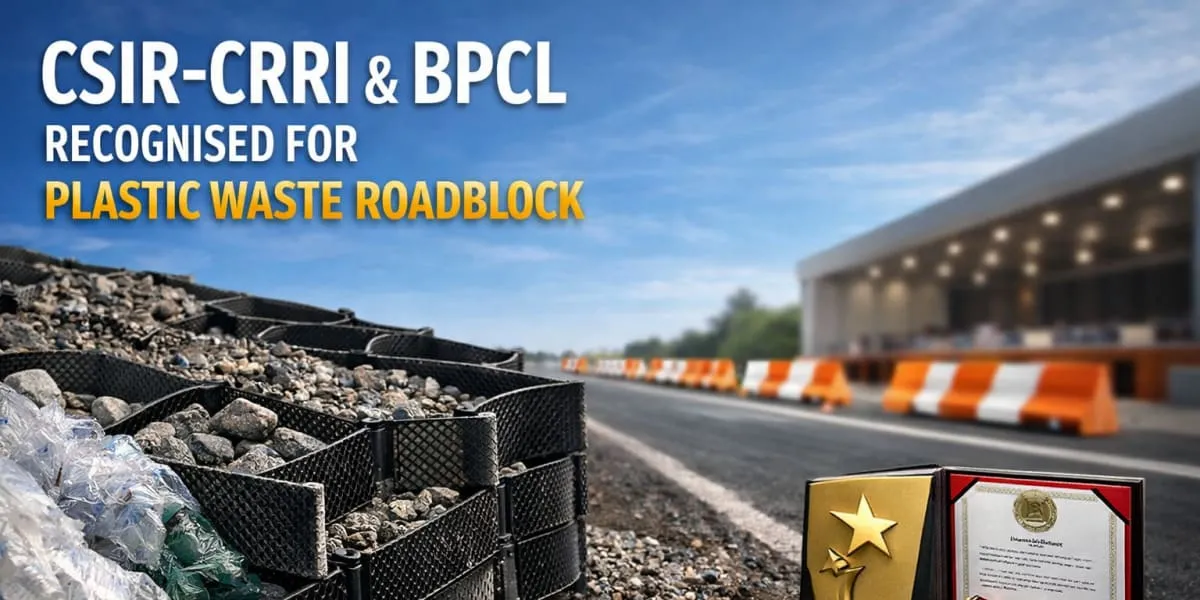
CSIR-Central Road Research Institute (CSIR-CRRI) and Bharat Petroleum Corporation Limited (BPCL) have been recognised by the India Book of Records and the Asia Book of Records for developing a roadblock section using technical textile geocells produced from processed end-of-life plastic. The record citation identified the demonstration as the first roadblock section constructed using a technical textile geocell made from end-of-life plastic, awarded during a ceremony at the CSIR-CRRI auditorium in New Delhi in the presence of senior officials.

The technology converts difficult-to-manage plastic waste into technical textile geocells that are incorporated into road infrastructure to enhance durability and support resilient construction. Developers carried out extensive material characterisation and performance evaluation to ensure that the geocell system met engineering requirements for structural integrity and field applicability. The work formed part of collaborative research between the institute and the oil company and was framed as addressing circular economy objectives while reducing environmental burden.

Officials described the initiative as addressing two national priorities, sustainable waste management and resilient road construction, and said the technique offers a scalable pathway for converting end-of-life plastic into value-added infrastructure materials. Industry representatives noted that the project aligned with existing refinery sustainability mandates and supported corporate sustainability goals. Laboratory and field validation studies were cited as key elements in demonstrating the suitability of the developed geocell solution for road applications.

The recognition by national and regional record authorities was presented as an important milestone in demonstrating practical utilisation of plastic waste in civil engineering. Organisers emphasised the role of industry-academia partnerships in translating research into field-ready technologies and noted that the achievement reinforces commitments to resource efficiency and environmental stewardship. A vote of thanks concluded the event and the partners signalled intentions to pursue further validation and potential scale-up of the technology.

CSIR-Central Road Research Institute (CSIR-CRRI) and Bharat Petroleum Corporation Limited (BPCL) have been recognised by the India Book of Records and the Asia Book of Records for developing a roadblock section using technical textile geocells produced from processed end-of-life plastic. The record citation identified the demonstration as the first roadblock section constructed using a technical textile geocell made from end-of-life plastic, awarded during a ceremony at the CSIR-CRRI auditorium in New Delhi in the presence of senior officials. The technology converts difficult-to-manage plastic waste into technical textile geocells that are incorporated into road infrastructure to enhance durability and support resilient construction. Developers carried out extensive material characterisation and performance evaluation to ensure that the geocell system met engineering requirements for structural integrity and field applicability. The work formed part of collaborative research between the institute and the oil company and was framed as addressing circular economy objectives while reducing environmental burden. Officials described the initiative as addressing two national priorities, sustainable waste management and resilient road construction, and said the technique offers a scalable pathway for converting end-of-life plastic into value-added infrastructure materials. Industry representatives noted that the project aligned with existing refinery sustainability mandates and supported corporate sustainability goals. Laboratory and field validation studies were cited as key elements in demonstrating the suitability of the developed geocell solution for road applications. The recognition by national and regional record authorities was presented as an important milestone in demonstrating practical utilisation of plastic waste in civil engineering. Organisers emphasised the role of industry-academia partnerships in translating research into field-ready technologies and noted that the achievement reinforces commitments to resource efficiency and environmental stewardship. A vote of thanks concluded the event and the partners signalled intentions to pursue further validation and potential scale-up of the technology.

Next Story
Infrastructure Urban

Centre Clears Power Distribution Upgrade for Uttar Pradesh

The Central Government has approved power distribution projects worth Rs 407.39 billion for Uttar Pradesh under the Revamped Distribution Sector Scheme (RDSS). The investment will be used to modernise the state's electricity distribution infrastructure and strengthen network capacity across urban and rural areas. The package targets one of the country's largest distribution networks as the state experiences rapid urbanisation and rising electricity consumption. Planned interventions include the strengthening of distribution lines, modernisation of substations, replacement of ageing electrical ..

Next Story
Infrastructure Energy

India Data Centres To Consume 191 TWh By 2040 Driving Renewables

A Wood Mackenzie report says India's operational data centre capacity is projected to increase more than fivefold to 12 gigawatt (GW) by 2030 from 2.2 GW in 2025 as artificial intelligence (AI) and cloud computing drive demand. It projects electricity consumption to rise from 10 terawatt-hour (TWh) in 2025 to 191 TWh by 2040. The study forecasts a compound annual growth rate of around 40 per cent and notes AI-dedicated capacity will surge nearly 24-fold from 275 megawatt (MW) in 2025 to 6,546 MW by 2030. The report places India's digital economy at Rs 32 trillion (tn) in 2025 and says it contr..

Next Story
Infrastructure Transport

Hydrogen Train Completes 1,200 Kilometres Of Trials

India's first hydrogen train was flagged off between Jind and Sonipat on July 17 and has travelled over 1,200 kilometres in trials, saving diesel consumption of more than 3,200 litres, a Railway Ministry press release said. The deployment marks the introduction of a zero-emission fuel cell train into route testing and represents a milestone in domestic rail innovation. The train generates electricity onboard through a chemical reaction between hydrogen and oxygen, producing electricity to propel the vehicle while emitting only water vapour as a by-product. There is no smoke and no tailpipe car..

Advertisement

Subscribe to Our Newsletter

Get daily newsletters around different themes from Construction world.

STAY CONNECTED

Advertisement

Advertisement

Advertisement