




Curtain Raiser For India-Africa Business Dialogue
ECONOMY & POLICY

Curtain Raiser For India-Africa Business Dialogue

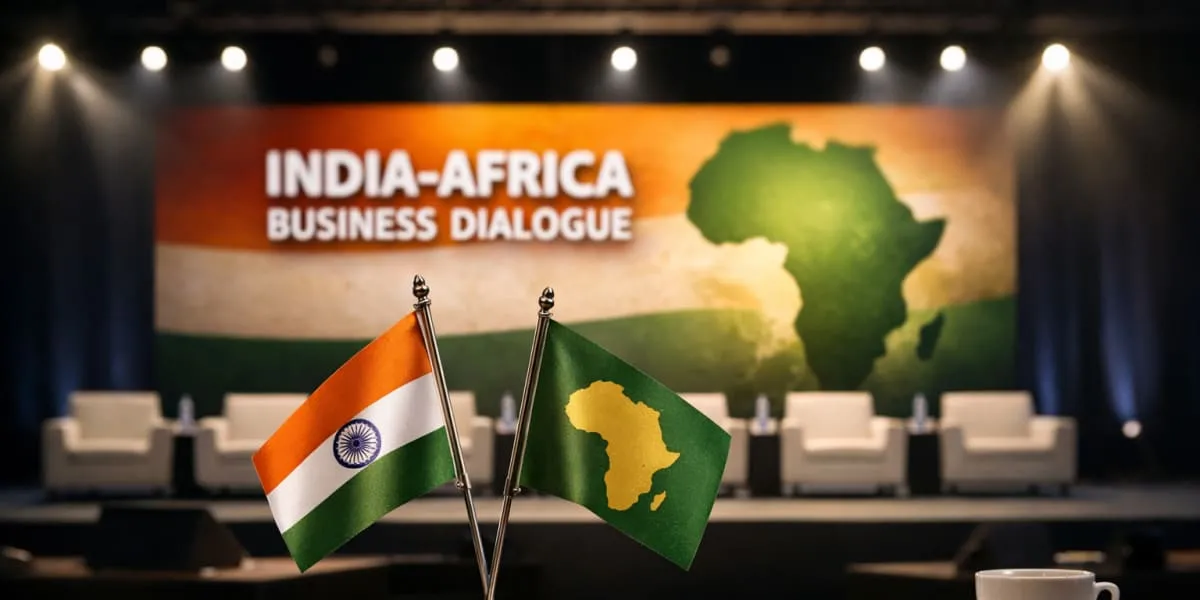
A curtain raiser for the India-Africa Business Dialogue and Exhibition took place on 13 May 2026 at Bharat Mandapam in New Delhi under the chairmanship of the Union Minister of Commerce and Industry, Piyush Goyal. The gathering included resident ambassadors and high commissioners from African countries, senior Indian officials, representatives of industry chambers, export promotion councils and business leaders. The event was held as a preparatory platform ahead of the fourth India-Africa Forum Summit.

The dialogue is intended to deepen economic and strategic engagement through trade, investment, technology partnerships and people-to-people links. Bilateral trade measured in United States dollars (USD) reached USD 93.69 bn in 2025–26, up 14.39 per cent year on year, with India’s exports to Africa at USD 45.42 bn and imports at USD 48.27 bn. The minister noted that AfCFTA, at nearly USD 3.4 trillion, alongside India’s USD 4 trillion economy, creates opportunities to diversify supply chains and raise the value of exports.

He emphasised technology transfer and youth-driven growth and identified renewable energy, green hydrogen, green ammonia, electric mobility, digitalisation and telecommunications as priority areas. With nearly two-thirds of the combined population below 35, the minister urged focus on skilling, startups, innovation ecosystems and talent development to ready workforces for future industries. He argued for moving beyond raw material trade towards local manufacturing, integrated value chains and higher-value products.

The commerce secretary outlined thematic priorities for the dialogue, including climate action and sustainability, infrastructure and connectivity, digital innovation and artificial intelligence, manufacturing and micro, small and medium enterprise partnerships, healthcare and human capital development, financial services, logistics and critical minerals. The programme will include plenary sessions, policy dialogues, sectoral roundtables, business-to-business and business-to-government meetings, networking engagements and an exhibition of technologies and best practices. The secretary cited recent India-Kenya and India-Tanzania joint trade committee meetings and reaffirmed commitment to institutional measures such as the Duty-Free Tariff Preference Scheme for least developed countries and to efforts aimed at doubling bilateral trade by 2030.

A curtain raiser for the India-Africa Business Dialogue and Exhibition took place on 13 May 2026 at Bharat Mandapam in New Delhi under the chairmanship of the Union Minister of Commerce and Industry, Piyush Goyal. The gathering included resident ambassadors and high commissioners from African countries, senior Indian officials, representatives of industry chambers, export promotion councils and business leaders. The event was held as a preparatory platform ahead of the fourth India-Africa Forum Summit. The dialogue is intended to deepen economic and strategic engagement through trade, investment, technology partnerships and people-to-people links. Bilateral trade measured in United States dollars (USD) reached USD 93.69 bn in 2025–26, up 14.39 per cent year on year, with India’s exports to Africa at USD 45.42 bn and imports at USD 48.27 bn. The minister noted that AfCFTA, at nearly USD 3.4 trillion, alongside India’s USD 4 trillion economy, creates opportunities to diversify supply chains and raise the value of exports. He emphasised technology transfer and youth-driven growth and identified renewable energy, green hydrogen, green ammonia, electric mobility, digitalisation and telecommunications as priority areas. With nearly two-thirds of the combined population below 35, the minister urged focus on skilling, startups, innovation ecosystems and talent development to ready workforces for future industries. He argued for moving beyond raw material trade towards local manufacturing, integrated value chains and higher-value products. The commerce secretary outlined thematic priorities for the dialogue, including climate action and sustainability, infrastructure and connectivity, digital innovation and artificial intelligence, manufacturing and micro, small and medium enterprise partnerships, healthcare and human capital development, financial services, logistics and critical minerals. The programme will include plenary sessions, policy dialogues, sectoral roundtables, business-to-business and business-to-government meetings, networking engagements and an exhibition of technologies and best practices. The secretary cited recent India-Kenya and India-Tanzania joint trade committee meetings and reaffirmed commitment to institutional measures such as the Duty-Free Tariff Preference Scheme for least developed countries and to efforts aimed at doubling bilateral trade by 2030.

Next Story
Infrastructure Urban

GBA To Issue Occupancy Certificates For Up To 15 Per Cent Deviation

The Greater Bengaluru Authority (GBA) will begin issuing occupancy certificates for buildings that deviate from sanctioned plans by up to 15 per cent, the deputy chief minister said. The relaxation, previously restricted to five per cent, is intended to assist properties that have been unable to secure water and electricity connections following a Supreme Court order. Officials framed the change as an administrative response to widespread deviations arising from high demand for land in the city. The deputy chief minister indicated that the authority is not acting outside the law and that the m..

Next Story
Infrastructure Urban

TRAI Revises Rating of Properties for Digital Connectivity

The Telecom Regulatory Authority of India (TRAI) issued the Rating of Properties for Digital Connectivity (Amendment) Regulations, 2026 on 13 May 2026 after a consultation that began on 27 February 2026. It incorporated feedback from property managers, Digital Connectivity Rating Agencies (DCRAs), service providers and other stakeholders drawn from implementation experience and capacity building. The amendments and a revised Rating Manual are published on TRAI's website and take effect from 13 May 2026. Key changes include additional half-star levels, expanding the scale from five to nine to a..

Next Story
Building Material

JSW Steel Board Approves Rs 140 bn Raise and BMM Ispat Merger

JSW Steel Limited said its board has approved a plan to raise Rs 14,000 crore and to amalgamate BMM Ispat. The capital amount converts to Rs 140 billion. The board approval covers the principal terms of the fund raise and the proposed merger of the two entities under the JSW Steel group. The decision forms part of a strategic initiative to consolidate operations and shore up financial capacity. The company indicated the proceeds will be allocated to support growth initiatives, strengthen the balance sheet and to facilitate integrated operations following the amalgamation. Management will asses..

Advertisement

Subscribe to Our Newsletter

Get daily newsletters around different themes from Construction world.

STAY CONNECTED

Advertisement

Advertisement

Advertisement

-->














