





Curtain Raiser For India-Africa Business Dialogue
ECONOMY & POLICY

Curtain Raiser For India-Africa Business Dialogue

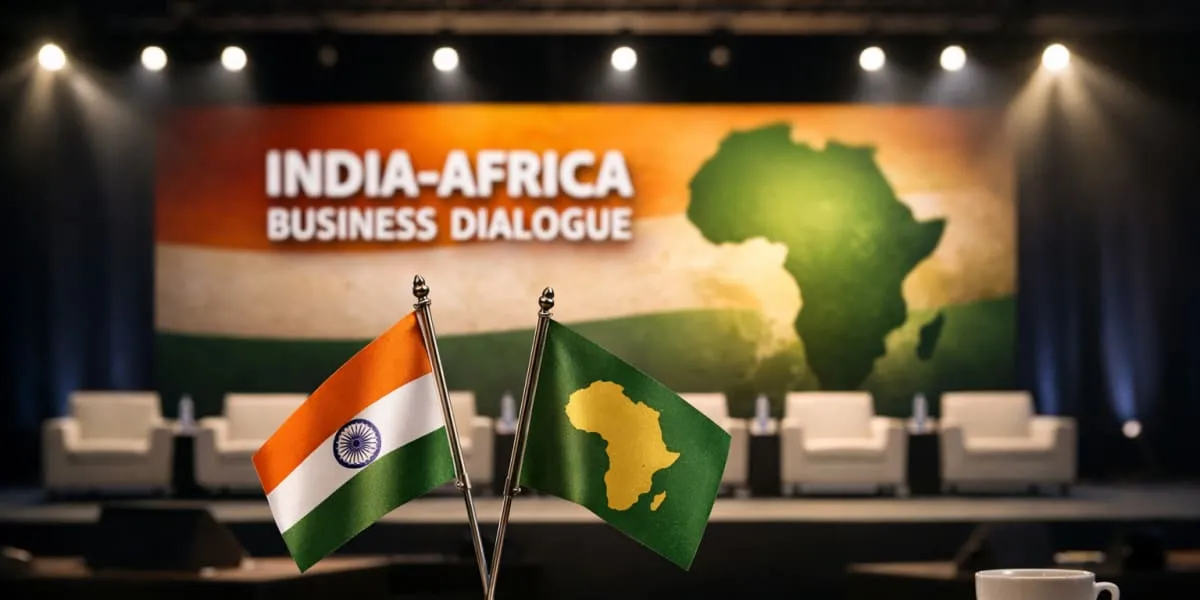
A curtain raiser for the India-Africa Business Dialogue and Exhibition took place on 13 May 2026 at Bharat Mandapam in New Delhi under the chairmanship of the Union Minister of Commerce and Industry, Piyush Goyal. The gathering included resident ambassadors and high commissioners from African countries, senior Indian officials, representatives of industry chambers, export promotion councils and business leaders. The event was held as a preparatory platform ahead of the fourth India-Africa Forum Summit.

The dialogue is intended to deepen economic and strategic engagement through trade, investment, technology partnerships and people-to-people links. Bilateral trade measured in United States dollars (USD) reached USD 93.69 bn in 2025–26, up 14.39 per cent year on year, with India’s exports to Africa at USD 45.42 bn and imports at USD 48.27 bn. The minister noted that AfCFTA, at nearly USD 3.4 trillion, alongside India’s USD 4 trillion economy, creates opportunities to diversify supply chains and raise the value of exports.

He emphasised technology transfer and youth-driven growth and identified renewable energy, green hydrogen, green ammonia, electric mobility, digitalisation and telecommunications as priority areas. With nearly two-thirds of the combined population below 35, the minister urged focus on skilling, startups, innovation ecosystems and talent development to ready workforces for future industries. He argued for moving beyond raw material trade towards local manufacturing, integrated value chains and higher-value products.

The commerce secretary outlined thematic priorities for the dialogue, including climate action and sustainability, infrastructure and connectivity, digital innovation and artificial intelligence, manufacturing and micro, small and medium enterprise partnerships, healthcare and human capital development, financial services, logistics and critical minerals. The programme will include plenary sessions, policy dialogues, sectoral roundtables, business-to-business and business-to-government meetings, networking engagements and an exhibition of technologies and best practices. The secretary cited recent India-Kenya and India-Tanzania joint trade committee meetings and reaffirmed commitment to institutional measures such as the Duty-Free Tariff Preference Scheme for least developed countries and to efforts aimed at doubling bilateral trade by 2030.

A curtain raiser for the India-Africa Business Dialogue and Exhibition took place on 13 May 2026 at Bharat Mandapam in New Delhi under the chairmanship of the Union Minister of Commerce and Industry, Piyush Goyal. The gathering included resident ambassadors and high commissioners from African countries, senior Indian officials, representatives of industry chambers, export promotion councils and business leaders. The event was held as a preparatory platform ahead of the fourth India-Africa Forum Summit. The dialogue is intended to deepen economic and strategic engagement through trade, investment, technology partnerships and people-to-people links. Bilateral trade measured in United States dollars (USD) reached USD 93.69 bn in 2025–26, up 14.39 per cent year on year, with India’s exports to Africa at USD 45.42 bn and imports at USD 48.27 bn. The minister noted that AfCFTA, at nearly USD 3.4 trillion, alongside India’s USD 4 trillion economy, creates opportunities to diversify supply chains and raise the value of exports. He emphasised technology transfer and youth-driven growth and identified renewable energy, green hydrogen, green ammonia, electric mobility, digitalisation and telecommunications as priority areas. With nearly two-thirds of the combined population below 35, the minister urged focus on skilling, startups, innovation ecosystems and talent development to ready workforces for future industries. He argued for moving beyond raw material trade towards local manufacturing, integrated value chains and higher-value products. The commerce secretary outlined thematic priorities for the dialogue, including climate action and sustainability, infrastructure and connectivity, digital innovation and artificial intelligence, manufacturing and micro, small and medium enterprise partnerships, healthcare and human capital development, financial services, logistics and critical minerals. The programme will include plenary sessions, policy dialogues, sectoral roundtables, business-to-business and business-to-government meetings, networking engagements and an exhibition of technologies and best practices. The secretary cited recent India-Kenya and India-Tanzania joint trade committee meetings and reaffirmed commitment to institutional measures such as the Duty-Free Tariff Preference Scheme for least developed countries and to efforts aimed at doubling bilateral trade by 2030.

Next Story
Technology

AI-Enabled Workflows Lift Profitability and Productivity

Organisations modernising frontline workflows with artificial intelligence, automation and real-time data are reporting stronger financial performance, higher productivity and improved employee engagement, according to a global study by Zebra Technologies and Oxford Economics.The research covered 1,000 senior leaders across retail, manufacturing, transportation and logistics in the US, Mexico, the UK, Germany, India, Japan, Australia and New Zealand.In transportation and logistics, 54 per cent of companies that improved picking and packing operations reported faster operational performance, wh..

Next Story
Real Estate

India Leads Global AI Readiness but Implementation Lags

Indian companies lead global averages across all eight artificial intelligence readiness indicators tracked by JLL, but only 19 per cent have started making changes to their workplaces, according to the JLL 2026 Future of Work Survey.The study found that 77 per cent of Indian business leaders expect AI to change their office requirements, creating a 58-percentage-point gap between awareness and implementation. The survey covered more than 2,200 CEOs, CFOs and real estate leaders across 21 countries during the first quarter of 2026.Despite concerns over automation, 58 per cent of Indian leaders..

Next Story
Equipment

Three WOLFF Cranes Build Riyadh Cable-Stayed Bridges

Three WOLFF 180 B luffing jib cranes are supporting the construction of two cable-stayed bridges alongside the existing Wadi Laban Bridge in Riyadh, Saudi Arabia. The project is being developed for the Royal Commission for Riyadh City and executed by the ICRC joint venture comprising IC Ictas and Al Rashid Trading & Contracting Company.The cranes are handling lifting operations including formwork, reinforcement, concrete placement, work platforms, surveying equipment and other construction materials. Each crane is fitted with a 40 m jib, reaches a hook height of 157 m and offers a maximum ..

Advertisement

Subscribe to Our Newsletter

Get daily newsletters around different themes from Construction world.

STAY CONNECTED

Advertisement

Advertisement

Advertisement














