Delhi Approves Multi-Utility Duct Pilot In Chandni Chowk
ECONOMY & POLICY

Delhi Approves Multi-Utility Duct Pilot In Chandni Chowk

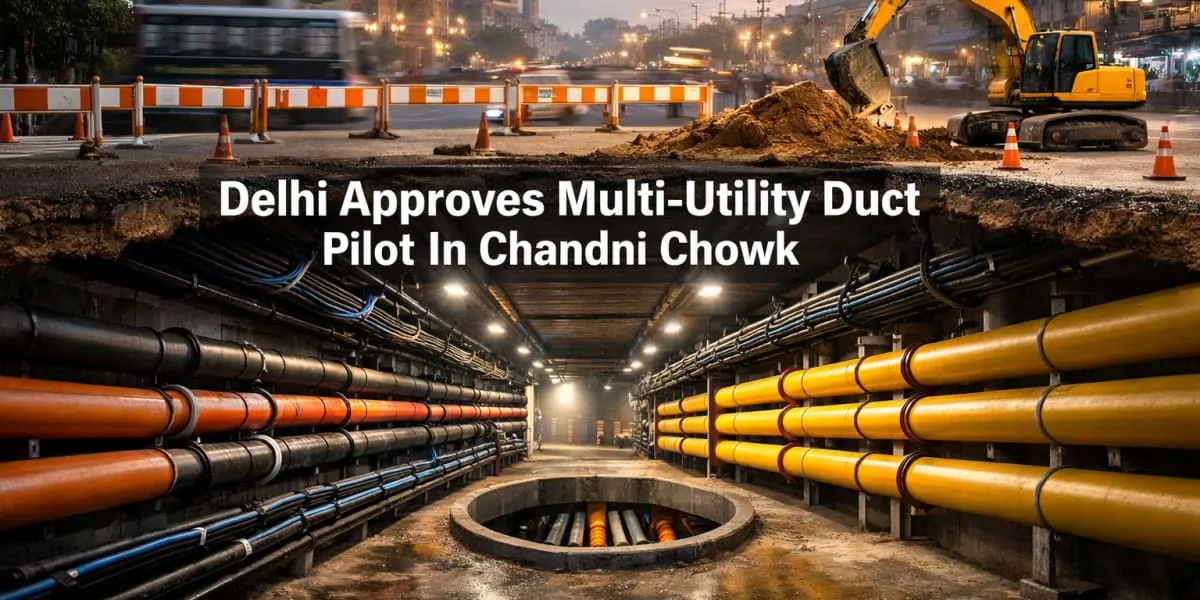
The Delhi government has approved a plan to develop multi-utility ducts comprising shared underground corridors to reduce traffic disruption caused by scattered road digging. The cabinet has cleared the proposal and a pilot project will be launched in the Chandni Chowk area, the chief minister Rekha Gupta said. The initiative forms part of a broader effort to create infrastructure that is safe, well organised and sustainable while catering to future needs. Officials indicated the approach aims to centralise utility placement beneath roads to limit repeated excavation.

At technically suitable locations the ducts will accommodate underground electricity cables, water and gas pipelines, fire-hydrant networks and other essential utility services. The system is intended to enable better coordination among different agencies and to provide an organised framework for developing and expanding underground utility networks across the capital. Technical design of the multi-utility ducts will include provisions for ventilation, fire safety and easy access for maintenance and emergency response. An expert technical committee will be constituted to oversee design and implementation.

The committee will include officials from power distribution companies, the Delhi Jal Board, the Public Works Department and other relevant departments and will supervise construction and expansion based on its recommendations. Authorities expect that shared corridors will make maintenance faster, allow smoother future expansion and reduce the risk of accidental damage to buried utility lines during excavation. Improved coordination among civic and utility agencies is cited as an additional benefit that should reduce the cumulative disruption from uncoordinated work.

For the pilot in Chandni Chowk two stretches have been proposed, measuring 310 metres on Esplanade Road and 560 metres on Mor Sarai Road. Based on the experience gained from these corridors, similar multi-utility ducts would be constructed in other parts of Delhi. The chief minister described the initiative as an important shift towards coordinated urban utility planning and said work will proceed under committee supervision.

The Delhi government has approved a plan to develop multi-utility ducts comprising shared underground corridors to reduce traffic disruption caused by scattered road digging. The cabinet has cleared the proposal and a pilot project will be launched in the Chandni Chowk area, the chief minister Rekha Gupta said. The initiative forms part of a broader effort to create infrastructure that is safe, well organised and sustainable while catering to future needs. Officials indicated the approach aims to centralise utility placement beneath roads to limit repeated excavation. At technically suitable locations the ducts will accommodate underground electricity cables, water and gas pipelines, fire-hydrant networks and other essential utility services. The system is intended to enable better coordination among different agencies and to provide an organised framework for developing and expanding underground utility networks across the capital. Technical design of the multi-utility ducts will include provisions for ventilation, fire safety and easy access for maintenance and emergency response. An expert technical committee will be constituted to oversee design and implementation. The committee will include officials from power distribution companies, the Delhi Jal Board, the Public Works Department and other relevant departments and will supervise construction and expansion based on its recommendations. Authorities expect that shared corridors will make maintenance faster, allow smoother future expansion and reduce the risk of accidental damage to buried utility lines during excavation. Improved coordination among civic and utility agencies is cited as an additional benefit that should reduce the cumulative disruption from uncoordinated work. For the pilot in Chandni Chowk two stretches have been proposed, measuring 310 metres on Esplanade Road and 560 metres on Mor Sarai Road. Based on the experience gained from these corridors, similar multi-utility ducts would be constructed in other parts of Delhi. The chief minister described the initiative as an important shift towards coordinated urban utility planning and said work will proceed under committee supervision.

Related Stories

Gold Stories
Next Story
Resources

Kalpataru Projects International elevates Amit Uplenchwar as Joint MD and CEO

Kalpataru Projects International (KPIL) has elevated Amit Uplenchwar as Joint Managing Director and CEO (designate), following approval by its board on 5 November 2026. He will take charge as Additional Director, Joint Managing Director and CEO from 1 January 2027 for a five-year term ending 31 December 2031, subject to shareholders' approval.Uplenchwar brings over three decades of experience in corporate strategy, business operations, business development, mergers and acquisitions, and international business management. His experience spans transportation, power, water, oil and gas, aerospace..

Next Story
Resources

HCC appoints Vivek Singhal as CEO

Hindustan Construction Company (HCC) has appointed Vivek Singhal as Chief Executive Officer, effective 5 November 2026. He brings over four decades of experience in infrastructure and engineering, procurement and construction (EPC), covering project execution, business leadership, business development and profit and loss management.Singhal has spent 16 years in international markets, delivering projects and managing assets worth approximately Rs 285 billion across five countries. His experience spans airports, metro rail, urban transport, hydropower, bridges and other infrastructure sectors.He..

Next Story
Infrastructure Energy

Essar Signs PPA for 300 MW Hybrid Renewable Energy Project

Essar Renewables, the renewable energy arm of Essar Power, has signed a Power Purchase Agreement (PPA) with NHPC for a 300 MW renewable energy project in Andhra Pradesh. The agreement follows the company’s successful bid for the project two years ago. Essar Power will invest approximately Rs. 45 bn in the development. The project will combine solar and wind generation with Battery Energy Storage Systems (BESS), enabling the supply of reliable and dispatchable renewable power. It forms part of Essar Power’s plan to build a diversified energy portfolio of approximately 5 GW across renewable,..

Advertisement

Subscribe to Our Newsletter

Get daily newsletters around different themes from Construction world.

STAY CONNECTED

Advertisement

SPECIAL OFFER
QR Code