Government Launches BHAVYA Portal To Develop 100 Industrial Parks
ECONOMY & POLICY

Government Launches BHAVYA Portal To Develop 100 Industrial Parks

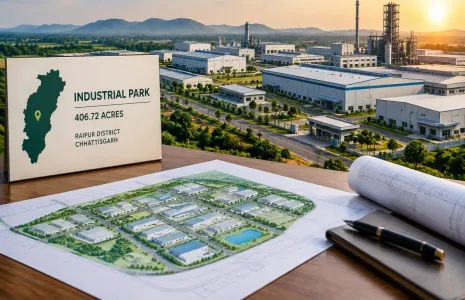
The Union Minister of Commerce and Industry launched the BHAVYA portal in New Delhi as the digital interface for the Bharat Audyogik Vikas Yojana and set out a competitive model under which States will submit detailed project proposals showcasing industrial strengths, land availability, investor interest and sectoral potential. The portal is intended to enable investors to access comprehensive information on parks, including land, connectivity and surrounding infrastructure, and to facilitate challenge-based selection of proposals by States, Union Territories and implementing agencies. The initiative was presented as focused on designing parks to meet sector-specific needs so as to attract domestic and global investment.

The Minister underlined that a decade of investments in roads, railways, ports, power, and digital connectivity alongside reforms such as the Goods and Services Tax, the Insolvency and Bankruptcy Code and labour reforms have created an enabling environment for economic development. Attention was drawn to promotion of startups, expansion of 5G connectivity and free trade agreements as complementary measures to support trade, technology transfer and investment. The scheme is framed to accelerate operationalisation by reducing delays in land acquisition and approvals through digital single window systems and transparent information.

BHAVYA aims to develop 100 industrial parks across the country with park sizes varying from 25 acres in hilly and smaller regions to between 100 and 500 acres in mid sized States and up to 1000 acres near cities, with land to be provided by State Governments and infrastructure supported by the National Industrial Corridor Development Corporation (NICDC) under a 51:49 model. The parks are planned as plug and play facilities offering assured water and power supply, road and rail connectivity, clear land titles and support for investor specific infrastructure. The design includes earmarked areas for startups, deep tech, technology oriented businesses and research and development activities.

The programme proposes modern testing facilities in partnership with the Bureau of Indian Standards (BIS), the Export Inspection Agency (EIA) and the Food Safety and Standards Authority of India (FSSAI) so that advanced testing infrastructure is available within parks. Environmental clearances and industry specific requirements are to be planned in consultation with relevant authorities based on location suitability. The Government signalled openness to dedicated areas for Global Capability Centres, worker housing, social infrastructure and possible international enclaves in partnership with partner countries.

The Minister indicated that Rs 340 billion (Rs 340 bn) has been earmarked by the Central Government to catalyse investments and generate employment through the development of the parks, and noted that the Union Cabinet approved an outlay of Rs 336.6 billion (Rs 336.6 bn) for the scheme. The NICDC was identified as the project management agency responsible for implementation and monitoring and has developed the portal to support DPR submission, appraisal, real time monitoring and coordination among stakeholders. Application windows were set out for phased selection so that initial rounds inform subsequent phases and enable learning based roll out.

Senior officials from the Department for Promotion of Industry and Internal Trade and NICDC stressed that robust digital systems are essential for effective programme management at scale and that the portal will strengthen transparency, accountability and faster operationalisation of industrial parks across the country. The programme was presented as contributing to broad based industrial growth, strengthened Centre State partnership and the vision of Viksit Bharat 2047 by promoting investment, manufacturing capability and employment generation.

The Union Minister of Commerce and Industry launched the BHAVYA portal in New Delhi as the digital interface for the Bharat Audyogik Vikas Yojana and set out a competitive model under which States will submit detailed project proposals showcasing industrial strengths, land availability, investor interest and sectoral potential. The portal is intended to enable investors to access comprehensive information on parks, including land, connectivity and surrounding infrastructure, and to facilitate challenge-based selection of proposals by States, Union Territories and implementing agencies. The initiative was presented as focused on designing parks to meet sector-specific needs so as to attract domestic and global investment. The Minister underlined that a decade of investments in roads, railways, ports, power, and digital connectivity alongside reforms such as the Goods and Services Tax, the Insolvency and Bankruptcy Code and labour reforms have created an enabling environment for economic development. Attention was drawn to promotion of startups, expansion of 5G connectivity and free trade agreements as complementary measures to support trade, technology transfer and investment. The scheme is framed to accelerate operationalisation by reducing delays in land acquisition and approvals through digital single window systems and transparent information. BHAVYA aims to develop 100 industrial parks across the country with park sizes varying from 25 acres in hilly and smaller regions to between 100 and 500 acres in mid sized States and up to 1000 acres near cities, with land to be provided by State Governments and infrastructure supported by the National Industrial Corridor Development Corporation (NICDC) under a 51:49 model. The parks are planned as plug and play facilities offering assured water and power supply, road and rail connectivity, clear land titles and support for investor specific infrastructure. The design includes earmarked areas for startups, deep tech, technology oriented businesses and research and development activities. The programme proposes modern testing facilities in partnership with the Bureau of Indian Standards (BIS), the Export Inspection Agency (EIA) and the Food Safety and Standards Authority of India (FSSAI) so that advanced testing infrastructure is available within parks. Environmental clearances and industry specific requirements are to be planned in consultation with relevant authorities based on location suitability. The Government signalled openness to dedicated areas for Global Capability Centres, worker housing, social infrastructure and possible international enclaves in partnership with partner countries. The Minister indicated that Rs 340 billion (Rs 340 bn) has been earmarked by the Central Government to catalyse investments and generate employment through the development of the parks, and noted that the Union Cabinet approved an outlay of Rs 336.6 billion (Rs 336.6 bn) for the scheme. The NICDC was identified as the project management agency responsible for implementation and monitoring and has developed the portal to support DPR submission, appraisal, real time monitoring and coordination among stakeholders. Application windows were set out for phased selection so that initial rounds inform subsequent phases and enable learning based roll out. Senior officials from the Department for Promotion of Industry and Internal Trade and NICDC stressed that robust digital systems are essential for effective programme management at scale and that the portal will strengthen transparency, accountability and faster operationalisation of industrial parks across the country. The programme was presented as contributing to broad based industrial growth, strengthened Centre State partnership and the vision of Viksit Bharat 2047 by promoting investment, manufacturing capability and employment generation.

Next Story
Infrastructure Transport

Rajasthan Allocates Rs680 Million For Rural Roads

The Rajasthan government has allocated Rs680 million (mn) to strengthen rural road networks, the Deputy Chief Minister and Public Works Department minister Diya Kumari announced. The sanction covers 79 rural road construction projects with a combined length of 151.75 kilometres. The total estimated cost of the approved projects is Rs. 683 million (mn), reflecting the implementation of the state budget for 2026-27. Under the PWD approvals, construction works will be carried out across five legislative assembly constituencies. In Jhalrapatan in Jhalawar district, 21 roads totalling 51.05 kilomet..

Next Story
Infrastructure Transport

Telangana Gets 191-km Four-Lane Highway Boost

The Cabinet Committee on Economic Affairs, chaired by the Prime Minister, approved the widening of the Armoor?Jagtial?Mancherial section of National Highway?63 and the Jagtial?Karimnagar section of National Highway?563 to four?lane standards. The combined capital cost was sanctioned at Rs 75.97 billion (bn), covering a total project length of 190.76 km. The sanction was cleared to be implemented in three separate packages. The Armoor?Jagtial stretch of 63.6 km and the Jagtial?Mancherial stretch of 68.295 km on NH?63 will be developed under the Hybrid Annuity Model, while the 58.866 km Jagtial?..

Next Story
Infrastructure Transport

CCEA Approves Four National Highway Projects Across Four States

The Cabinet Committee on Economic Affairs, chaired by the Prime Minister, approved four national highway projects worth more than Rs 242 billion (bn) across Odisha, Telangana, Bihar and Madhya Pradesh to improve connectivity and ease congestion. The Information and Broadcasting Minister said the projects align with the PM GatiShakti National Master Plan and aim to boost economic activity and freight movement. A coastal highway between Rameshwar and Paradip in Odisha was approved at about Rs 83.01 bn for the 160.18 km corridor under the Hybrid Annuity Model. The route will include a four-lane s..

Advertisement

Subscribe to Our Newsletter

Get daily newsletters around different themes from Construction world.

STAY CONNECTED

Advertisement

Advertisement

Advertisement