Government Mandates 100% Domestic Content for EV Components Under PM E-Drive
PORTS & SHIPPING

Government Mandates 100% Domestic Content for EV Components Under PM E-Drive

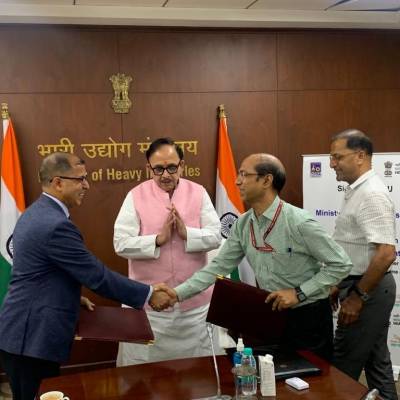
The Ministry of Heavy Industries (MHI) has enforced a 100% domestic content requirement (DCR) for 18 key electric vehicle (EV) components across the two-wheeler, three-wheeler, and e-bus segments to qualify for subsidies under the PM E-Drive program.

MHI has amended eligibility criteria for the Phased Manufacturing Program (PMP) under PM E-Drive, an initiative launched under the Faster Adoption & Manufacturing of Electric Vehicles in India-II (FAME-II) program. The move aims to boost local manufacturing of critical EV components by original equipment manufacturers (OEMs).

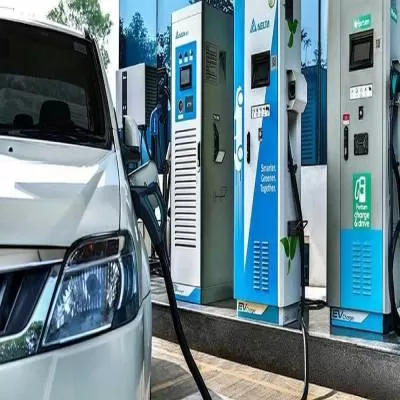
To qualify for subsidies, all 18 listed EV components must be produced domestically. The PM E-Drive was introduced with an outlay of Rs 109 billion (~$1.29 billion) to provide demand incentives, deploy EVs, and develop charging infrastructure for wider EV adoption.

Stricter Compliance Measures and Testing Guidelines Testing agencies will issue separate guidelines to assess domestic manufacturing compliance. Importing battery modules, PMP components, and other EV parts in complete knockdown (CKD) form from a single supplier is prohibited. In integrated units, PMP verification will be conducted individually for each PMP component.

DCR Implementation Timeline for Two & Three-Wheelers MHI has extended the mandatory DCR deadline for several two-wheeler and three-wheeler EV components to May 1, 2025. The required domestically manufactured components include:

? Traction battery pack ? Battery management system (BMS) ? DC-DC converter ? Vehicle control unit ? Onboard charger / External portable charger ? Traction motor ? Traction motor controller (including inverter) ? Instrument cluster

Additionally, the cost of the external charger must now be included in the vehicle’s ex-factory price.

Revised Compliance Timeline for E-Buses The compliance deadline for e-buses has been revised to six months from the amendment issue date for several PMP components, including: ? Heating, ventilation, and air conditioning (HVAC) system ? Electric compressor for brake system ? Charging inlet CCS2 (Combined Charging System for AC & DC charging) ? Traction battery pack ? DC-DC converter ? Vehicle control unit ? Traction motor ? Instrument cluster

The domestic manufacturing requirement for the traction motor controller (including inverter) now mandates an assembled printed circuit board (PCB) integration.

For battery management systems (BMS) and traction motor controllers, the compliance deadline has been extended to 12 months from the amendment date. This also applies to the inverter, which must be assembled with electronic components, semiconductors, and connectors on the PCB.

India’s EV Market Growth in 2024 India’s EV sales hit a record 1.95 million units in 2024, marking a 27% year-over-year (YoY) growth from the 1.53 million units sold in 2023. The government’s push for localisation under PM E-Drive is expected to further accelerate domestic EV production and strengthen India’s position in the global EV market.

The Ministry of Heavy Industries (MHI) has enforced a 100% domestic content requirement (DCR) for 18 key electric vehicle (EV) components across the two-wheeler, three-wheeler, and e-bus segments to qualify for subsidies under the PM E-Drive program. MHI has amended eligibility criteria for the Phased Manufacturing Program (PMP) under PM E-Drive, an initiative launched under the Faster Adoption & Manufacturing of Electric Vehicles in India-II (FAME-II) program. The move aims to boost local manufacturing of critical EV components by original equipment manufacturers (OEMs). To qualify for subsidies, all 18 listed EV components must be produced domestically. The PM E-Drive was introduced with an outlay of Rs 109 billion (~$1.29 billion) to provide demand incentives, deploy EVs, and develop charging infrastructure for wider EV adoption. Stricter Compliance Measures and Testing Guidelines Testing agencies will issue separate guidelines to assess domestic manufacturing compliance. Importing battery modules, PMP components, and other EV parts in complete knockdown (CKD) form from a single supplier is prohibited. In integrated units, PMP verification will be conducted individually for each PMP component. DCR Implementation Timeline for Two & Three-Wheelers MHI has extended the mandatory DCR deadline for several two-wheeler and three-wheeler EV components to May 1, 2025. The required domestically manufactured components include: ? Traction battery pack ? Battery management system (BMS) ? DC-DC converter ? Vehicle control unit ? Onboard charger / External portable charger ? Traction motor ? Traction motor controller (including inverter) ? Instrument cluster Additionally, the cost of the external charger must now be included in the vehicle’s ex-factory price. Revised Compliance Timeline for E-Buses The compliance deadline for e-buses has been revised to six months from the amendment issue date for several PMP components, including: ? Heating, ventilation, and air conditioning (HVAC) system ? Electric compressor for brake system ? Charging inlet CCS2 (Combined Charging System for AC & DC charging) ? Traction battery pack ? DC-DC converter ? Vehicle control unit ? Traction motor ? Instrument cluster The domestic manufacturing requirement for the traction motor controller (including inverter) now mandates an assembled printed circuit board (PCB) integration. For battery management systems (BMS) and traction motor controllers, the compliance deadline has been extended to 12 months from the amendment date. This also applies to the inverter, which must be assembled with electronic components, semiconductors, and connectors on the PCB. India’s EV Market Growth in 2024 India’s EV sales hit a record 1.95 million units in 2024, marking a 27% year-over-year (YoY) growth from the 1.53 million units sold in 2023. The government’s push for localisation under PM E-Drive is expected to further accelerate domestic EV production and strengthen India’s position in the global EV market.

Next Story
Infrastructure Urban

Centre Clears Power Distribution Upgrade for Uttar Pradesh

The Central Government has approved power distribution projects worth Rs 407.39 billion for Uttar Pradesh under the Revamped Distribution Sector Scheme (RDSS). The investment will be used to modernise the state's electricity distribution infrastructure and strengthen network capacity across urban and rural areas. The package targets one of the country's largest distribution networks as the state experiences rapid urbanisation and rising electricity consumption. Planned interventions include the strengthening of distribution lines, modernisation of substations, replacement of ageing electrical ..

Next Story
Infrastructure Energy

India Data Centres To Consume 191 TWh By 2040 Driving Renewables

A Wood Mackenzie report says India's operational data centre capacity is projected to increase more than fivefold to 12 gigawatt (GW) by 2030 from 2.2 GW in 2025 as artificial intelligence (AI) and cloud computing drive demand. It projects electricity consumption to rise from 10 terawatt-hour (TWh) in 2025 to 191 TWh by 2040. The study forecasts a compound annual growth rate of around 40 per cent and notes AI-dedicated capacity will surge nearly 24-fold from 275 megawatt (MW) in 2025 to 6,546 MW by 2030. The report places India's digital economy at Rs 32 trillion (tn) in 2025 and says it contr..

Next Story
Infrastructure Transport

Hydrogen Train Completes 1,200 Kilometres Of Trials

India's first hydrogen train was flagged off between Jind and Sonipat on July 17 and has travelled over 1,200 kilometres in trials, saving diesel consumption of more than 3,200 litres, a Railway Ministry press release said. The deployment marks the introduction of a zero-emission fuel cell train into route testing and represents a milestone in domestic rail innovation. The train generates electricity onboard through a chemical reaction between hydrogen and oxygen, producing electricity to propel the vehicle while emitting only water vapour as a by-product. There is no smoke and no tailpipe car..

Advertisement

Subscribe to Our Newsletter

Get daily newsletters around different themes from Construction world.

STAY CONNECTED

Advertisement

Advertisement

Advertisement