Gujarat Leaders Flag Off 182 Buses for Every Assembly Seat
ECONOMY & POLICY

Gujarat Leaders Flag Off 182 Buses for Every Assembly Seat

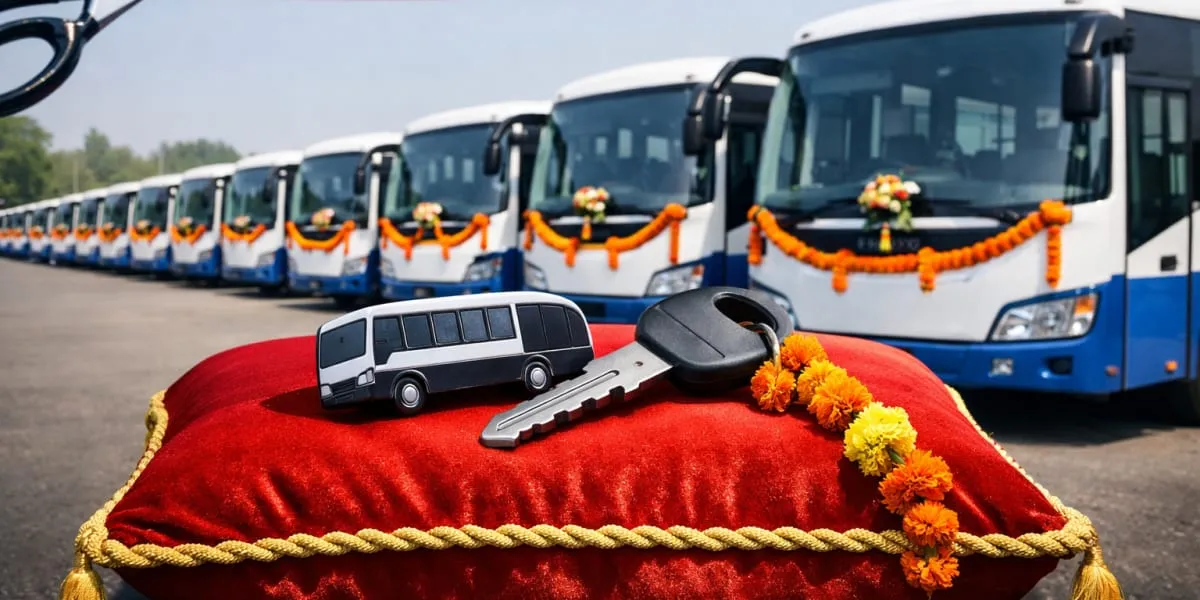
Gujarat State Road Transport Corporation (GSRTC) expanded its fleet with the inauguration of 182 new buses, one for each of the state's 182 Assembly constituencies, in an event in Gandhinagar led by Chief Minister Bhupendra Patel and Deputy Chief Minister Harsh Sanghavi. The ceremony included the Minister of State for Transport Pravin Mali and attendance by State Cabinet ministers, members of the legislative assembly and senior GSRTC officials. The leaders symbolically handed over keys to the drivers of the new buses and conveyed their wishes to the people.

GSRTC operates a daily fleet of over 8,000 buses, covering approximately 3.3 mn kilometres and providing safe and timely services to more than 2.7 mn passengers each day. The corporation increases services during festivals and religious fairs to facilitate travel and enable communities to celebrate together. Annual financial assistance from the state government supports vehicle purchases and network expansion.

In the financial year 2024-25 a total of 1,963 vehicles were deployed for public service, including 963 Super Express buses, 550 Gurjar Nagari buses, 100 sleeper buses and 350 midi buses. Planning under a public private partnership model has included proposals to operate 200 modern Volvo and air conditioned buses. The phased introductions have comprised 1,963 non-AC buses and 200 AC buses for passenger service across routes.

An additional 182 buses valued at Rs 620 mn were inaugurated in this phase, funded through allocations to support fleet modernisation. Officials present included the principal secretary of transport Hareet Shukla and GSRTC managing director Rajender Kumar, along with other senior transport department officers. The expansion is intended to strengthen regional connectivity and improve accessibility, contributing to more efficient movement for commuters across the state.

Gujarat State Road Transport Corporation (GSRTC) expanded its fleet with the inauguration of 182 new buses, one for each of the state's 182 Assembly constituencies, in an event in Gandhinagar led by Chief Minister Bhupendra Patel and Deputy Chief Minister Harsh Sanghavi. The ceremony included the Minister of State for Transport Pravin Mali and attendance by State Cabinet ministers, members of the legislative assembly and senior GSRTC officials. The leaders symbolically handed over keys to the drivers of the new buses and conveyed their wishes to the people. GSRTC operates a daily fleet of over 8,000 buses, covering approximately 3.3 mn kilometres and providing safe and timely services to more than 2.7 mn passengers each day. The corporation increases services during festivals and religious fairs to facilitate travel and enable communities to celebrate together. Annual financial assistance from the state government supports vehicle purchases and network expansion. In the financial year 2024-25 a total of 1,963 vehicles were deployed for public service, including 963 Super Express buses, 550 Gurjar Nagari buses, 100 sleeper buses and 350 midi buses. Planning under a public private partnership model has included proposals to operate 200 modern Volvo and air conditioned buses. The phased introductions have comprised 1,963 non-AC buses and 200 AC buses for passenger service across routes. An additional 182 buses valued at Rs 620 mn were inaugurated in this phase, funded through allocations to support fleet modernisation. Officials present included the principal secretary of transport Hareet Shukla and GSRTC managing director Rajender Kumar, along with other senior transport department officers. The expansion is intended to strengthen regional connectivity and improve accessibility, contributing to more efficient movement for commuters across the state.

Next Story
Infrastructure Transport

MMRDA advances 250 m on Orange Gate–Marine Drive tunnel

The Mumbai Metropolitan Region Development Authority (MMRDA) has completed 250 m of underground tunnelling for the Orange Gate–Marine Drive Urban Road Tunnel using India’s largest slurry shield tunnel boring machine (TBM) deployed for an urban road project.The project involves twin tunnels extending over 7 km beneath critical transport corridors, including Central Railway, Western Railway and Metro Line 3. The work requires high-precision engineering to navigate densely developed urban infrastructure.Once completed, the tunnel is expected to reduce travel time between Orange Gate and Marin..

Next Story
Infrastructure Urban

Hindustan Zinc Pays Rs 188.46 Billion in FY26

Hindustan Zinc contributed Rs 188.46 billion to the public exchequer in FY 2025-26, according to its 9th Tax Transparency Report. The contribution, equivalent to 46 per cent of the company’s revenue, included direct and indirect taxes, government royalties, dividends to the Government of India, withholding taxes and other statutory levies.The company’s five-year cumulative contribution to the exchequer stood at Rs 915.72 billion. In FY26, Hindustan Zinc reported revenue of Rs 408.44 billion, EBITDA of Rs 221.62 billion and profit after tax of Rs 138.32 billion. It also achieved its highest..

Next Story
Infrastructure Urban

World of Concrete India 2026 Opens in Mumbai

Informa Markets in India will host the 12th edition of World of Concrete India 2026 from 3–5 June 2026 at the Bombay Exhibition Centre, Mumbai. The specialised B2B exhibition will bring together manufacturers, suppliers, contractors, developers, architects, consultants, infrastructure companies, project leaders and government stakeholders.The event is expected to feature over 350 brands and more than 18,000 trade professionals. It will cover concrete and cement, dry mortar, precast technologies, formwork, construction chemicals, industrial and commercial flooring, scaffolding, safety solutio..

Advertisement

Subscribe to Our Newsletter

Get daily newsletters around different themes from Construction world.

STAY CONNECTED

Advertisement

Advertisement

Advertisement