+
India Seeks USD 100 bn Investment in Energy Exploration
ECONOMY & POLICY

India Seeks USD 100 bn Investment in Energy Exploration

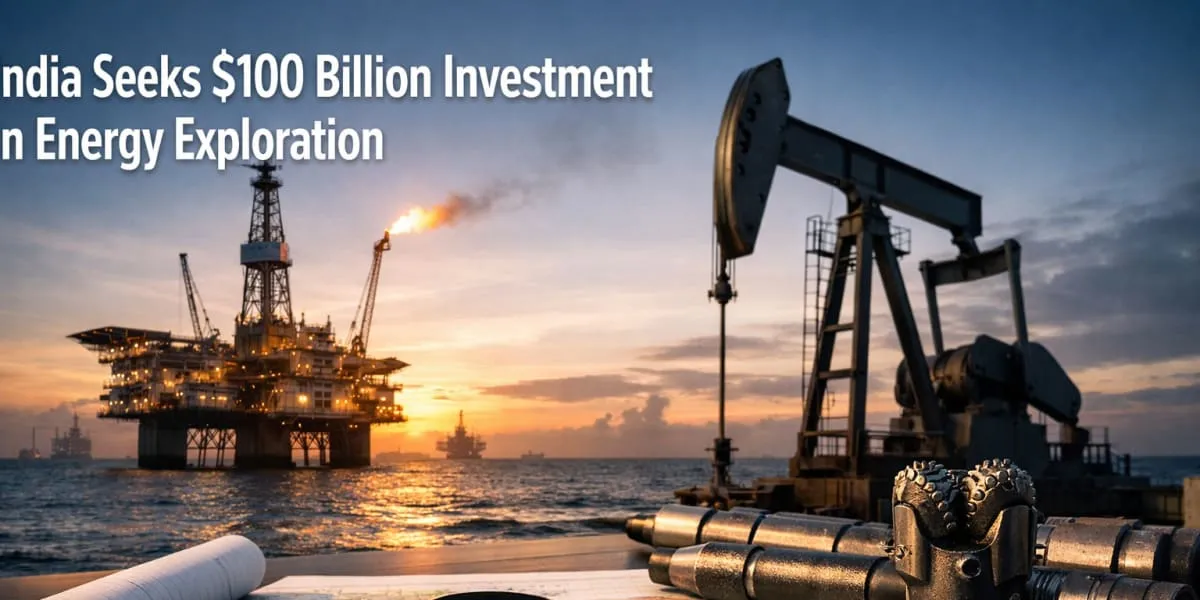
India aims to attract USD 100 bn in upstream investment and expand exploration acreage to one million sq km by 2030, a senior hydrocarbons official said at CERAWeek in Houston.

Director General of Hydrocarbons Srikant Nagulapalli outlined policy reforms, enhanced data access and exploration opportunities intended to draw international capital and presented a roadmap for large scale investment while acknowledging complex global energy transition dynamics.

Speakers positioned India as a major destination for global capital and set out the USD 100 bn target for upstream investment. India's Consul General in Houston said the initiative reflects a growing strategic convergence in India–US energy cooperation and emphasised the creation of a competitive, investor friendly ecosystem linking American technology with Indian resources.

Nagulapalli said output from current levels of about 29 million tonnes (29 mn t) of oil and over 36 billion cubic metres (36 bn cubic metres) of gas annually must rise through improved reservoir management and focus on deepwater exploration. Officials highlighted the National Data Repository and a node at the University of Houston that allows companies to access geological and seismic datasets locally, lowering entry barriers. They also noted Open Acreage Licensing Policy bid rounds offering blocks with marketing and pricing freedom and recent policy changes to enhance operational flexibility and fiscal stability.

The conference drew policymakers, operators and executives who discussed energy security, supply risks and rising demand driven by urbanisation, industrial growth and new load centres such as artificial intelligence and data centres. Participants flagged a structural rise in demand and the reconfiguration of global liquefied natural gas markets alongside a surge in electricity demand with implications for import dependent economies such as India. Climate protests outside the venue underscored tensions over continued fossil fuel investment and participants said competing priorities of energy security, economic growth and climate commitments will shape the global outlook.

India aims to attract USD 100 bn in upstream investment and expand exploration acreage to one million sq km by 2030, a senior hydrocarbons official said at CERAWeek in Houston. Director General of Hydrocarbons Srikant Nagulapalli outlined policy reforms, enhanced data access and exploration opportunities intended to draw international capital and presented a roadmap for large scale investment while acknowledging complex global energy transition dynamics. Speakers positioned India as a major destination for global capital and set out the USD 100 bn target for upstream investment. India's Consul General in Houston said the initiative reflects a growing strategic convergence in India–US energy cooperation and emphasised the creation of a competitive, investor friendly ecosystem linking American technology with Indian resources. Nagulapalli said output from current levels of about 29 million tonnes (29 mn t) of oil and over 36 billion cubic metres (36 bn cubic metres) of gas annually must rise through improved reservoir management and focus on deepwater exploration. Officials highlighted the National Data Repository and a node at the University of Houston that allows companies to access geological and seismic datasets locally, lowering entry barriers. They also noted Open Acreage Licensing Policy bid rounds offering blocks with marketing and pricing freedom and recent policy changes to enhance operational flexibility and fiscal stability. The conference drew policymakers, operators and executives who discussed energy security, supply risks and rising demand driven by urbanisation, industrial growth and new load centres such as artificial intelligence and data centres. Participants flagged a structural rise in demand and the reconfiguration of global liquefied natural gas markets alongside a surge in electricity demand with implications for import dependent economies such as India. Climate protests outside the venue underscored tensions over continued fossil fuel investment and participants said competing priorities of energy security, economic growth and climate commitments will shape the global outlook.

Related Stories

Gold Stories

Next Story
Real Estate

Kamdhenu Realities acquires 4-acre Navi Mumbai land parcel

Kamdhenu Realities has acquired a 4-acre land parcel from RPG Life Sciences on Thane-Belapur Road for approximately Rs 1.5 billion, expanding its commercial real estate portfolio in Navi Mumbai.The parcel has a total developable potential of 1.8 million sq ft, on which Kamdhenu plans to develop a destination-scale commercial and lifestyle ecosystem. The proposed development will combine corporate office suites with high-street retail, F&B outlets, double-height lobbies, business infrastructure and lifestyle amenities.Located close to IKEA and opposite the upcoming Pawane Railway Station, t..

Next Story
Infrastructure Transport

97 Per Cent Of Rongjeng-Mangsang-Adokgre Road Nears Completion

Deputy Chief Minister in-charge of public works Prestone Tynsong said in Shillong on 26 August that 97 per cent physical progress had been achieved on the ongoing Rongjeng-Mangsang-Adokgre road being constructed under the Non-Lapsable Central Pool of Resources (NLCPR). He noted the project was sanctioned in 2017 and that the stipulated time for completion had been 24 months from issue of the final work order. The deputy chief minister informed the assembly that the government had decided to include the remaining work under a World Bank project. In reply to a query from Rongjeng MLA Jim M Sangm..

Next Story
Infrastructure Transport

First TBM Starts Digging Five Point Three Kilometre Tunnel Under SGNP

The Goregaon-Mulund Link Road (GMLR) Phase three (B) project has reached a key milestone as the first tunnel boring machine (TBM) began excavation of the first of two tunnels beneath the Sanjay Gandhi National Park (SGNP). The machine, named Tulsi, started cutting a five point three kilometre bore that will link Dadasaheb Phalke Chitranagari in Goregaon East with Amar Nagar in Mulund West. Officials issued a statement noting the commencement of tunnelling work under the protected green belt. The twin tunnels are being constructed using mechanised tunnelling methods that aim to limit surface di..

Advertisement

Subscribe to Our Newsletter

Get daily newsletters around different themes from Construction world.

STAY CONNECTED

Advertisement

SPECIAL OFFER
QR Code