Jack Jendo Showcases Digital Twin Technology Live on the TEDx Stage
ECONOMY & POLICY

Jack Jendo Showcases Digital Twin Technology Live on the TEDx Stage

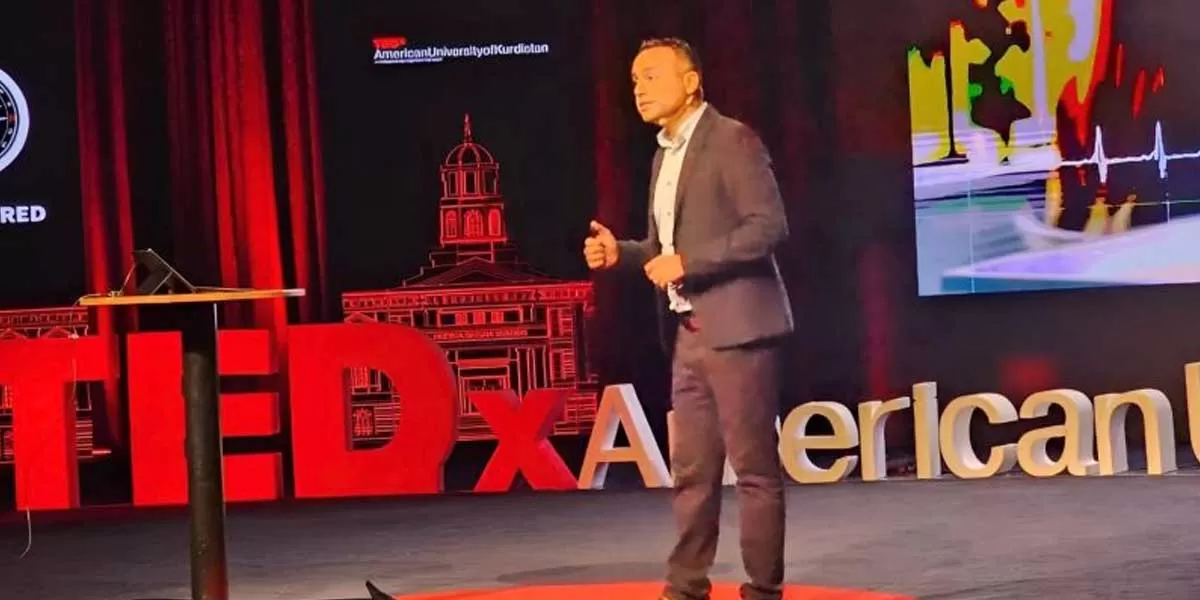
Digital twins, once primarily confined to industrial applications, are now reshaping personal growth and leadership. In a groundbreaking TEDx talk held at the American University of Kurdistan in Duhok, Iraq and titled ‘The Rise of the Digital Twin: Redefining Our World and Personal Growth’, Jack Jendo, Founder and CEO of Brain Digits, introduced his revolutionary vision of digital twins as tools for empowering individuals and transforming societies.

In a TEDx first, Jack Jendo showcased his personal digital twin, TwinJack, live on stage, demonstrating how these AI-powered entities can act as partners in self-reflection, decision-making, and personal development. Through a live demonstration, he guided the audience on creating their own digital twin using accessible AI tools, making the concept relatable and actionable. He further highlighted TwinJack’s versatility by collaborating with it to compose a song live on stage, illustrating the creative potential of digital twins.

Traditionally utilised in industries such as manufacturing and urban planning, digital twins are now poised to have a transformative impact across diverse fields, including healthcare, education, and urban development. Jack Jendo shared compelling examples: ? In healthcare, digital twins can simulate treatment outcomes, enhance preventive care, and improve patient-doctor collaboration. ? In education, they can provide immersive, interactive learning experiences, enabling students to engage with historical figures or explore the human body in 3D. ? In urban planning, digital twins offer data-driven insights to help leaders optimize resources and design sustainable communities.

Through his work at Brain Digits, Jendo envisions a future where digital twins empower individuals to make purposeful, data-driven decisions that align with personal values and societal needs. By merging technology with human potential, digital twins hold the promise of fostering a more informed, resilient, and sustainable world.

Digital twins, once primarily confined to industrial applications, are now reshaping personal growth and leadership. In a groundbreaking TEDx talk held at the American University of Kurdistan in Duhok, Iraq and titled ‘The Rise of the Digital Twin: Redefining Our World and Personal Growth’, Jack Jendo, Founder and CEO of Brain Digits, introduced his revolutionary vision of digital twins as tools for empowering individuals and transforming societies. In a TEDx first, Jack Jendo showcased his personal digital twin, TwinJack, live on stage, demonstrating how these AI-powered entities can act as partners in self-reflection, decision-making, and personal development. Through a live demonstration, he guided the audience on creating their own digital twin using accessible AI tools, making the concept relatable and actionable. He further highlighted TwinJack’s versatility by collaborating with it to compose a song live on stage, illustrating the creative potential of digital twins. Traditionally utilised in industries such as manufacturing and urban planning, digital twins are now poised to have a transformative impact across diverse fields, including healthcare, education, and urban development. Jack Jendo shared compelling examples: ? In healthcare, digital twins can simulate treatment outcomes, enhance preventive care, and improve patient-doctor collaboration. ? In education, they can provide immersive, interactive learning experiences, enabling students to engage with historical figures or explore the human body in 3D. ? In urban planning, digital twins offer data-driven insights to help leaders optimize resources and design sustainable communities. Through his work at Brain Digits, Jendo envisions a future where digital twins empower individuals to make purposeful, data-driven decisions that align with personal values and societal needs. By merging technology with human potential, digital twins hold the promise of fostering a more informed, resilient, and sustainable world.

Next Story
Infrastructure Transport

Kavach 4.0 Commissioned on Delhi–Mumbai and Delhi–Howrah

"Kavach version four has been commissioned on 1,452 route km, covering the high density Delhi–Mumbai and Delhi–Howrah corridors. The rollout included laying 8,570 km of optical fibre, installation of 1,100 telecom towers, deployment of trackside equipment over 6,776 RKm and establishment of 767 station data centres. Trackside implementation has been taken up on 24,427 RKm covering Golden Quadrilateral, Golden Diagonal and High Density Network sections. The programme aims to strengthen signalling and train protection on key routes.Kavach is an indigenously developed automatic train protecti..

Next Story
Infrastructure Transport

Railways Advance Kalyan–Murbad Line And Mumbai Capacity Expansion

"Indian Railways is advancing multiple rail infrastructure projects in Maharashtra, including the sanctioned Kalyan–Murbad new line and sizable investments under the Mumbai Urban Transport Project and the Mumbai–Ahmedabad High Speed Rail project. The Kalyan–Murbad 28 km new line has been sanctioned at Rs 8.36 billion (bn) on a 50:50 cost-sharing basis with the Government of Maharashtra and has been declared a Special Railway Project for land acquisition; proposals covering 214 hectares are at various stages of acquisition. Budgetary outlay for projects falling fully or partly in Maharash..

Next Story
Infrastructure Urban

Parliamentary Panel Flags Funding Gaps in Heavy Industries

"The Department-Related Parliamentary Standing Committee on Industry (Rajya Sabha) presented its 332nd report on the Demands for Grants 2026-27 of the Ministry of Heavy Industries (MHI). Figures converted from crore and lakh are expressed in million (mn). The Budget Estimates 2026-27 for the Ministry stand at Rs 79,399 mn against a projected requirement of Rs 94,843.2 mn, a shortfall of about 16 per cent, with revenue at Rs 79,370.8 mn and capital compressed to Rs 28.2 mn from Rs 5,020 mn.The committee flagged recurring BE-to-RE compression and declining revised estimate utilisation, and calle..

Advertisement

Subscribe to Our Newsletter

Get daily newsletters around different themes from Construction world.

STAY CONNECTED

Advertisement

Advertisement

Advertisement